"Beyond the conditioning which he receives from the world around him and the place in which he finds himself, the artist must yield, up to a certain point, to the possibilities and limitations of the medium he uses. Pencil, charcoal, pastel, oil paint, the blacks of print, marble bronze, clay or wood: these are all his companions and collaborators, and they too have something to say in the fiction he is about to produce. Materials have secrets to reveal; they have their own genius;”
Odilon Redon, 1913
In this series I explore the material substance of colour. By carefully collecting raw materials from places of significance, I hope to create a palette of pigments that captures something of my subjects that commercially produced pigments cannot. I want these harvested and processed materials to reveal their secrets, become my collaborators, and perhaps tell a little more of the story.
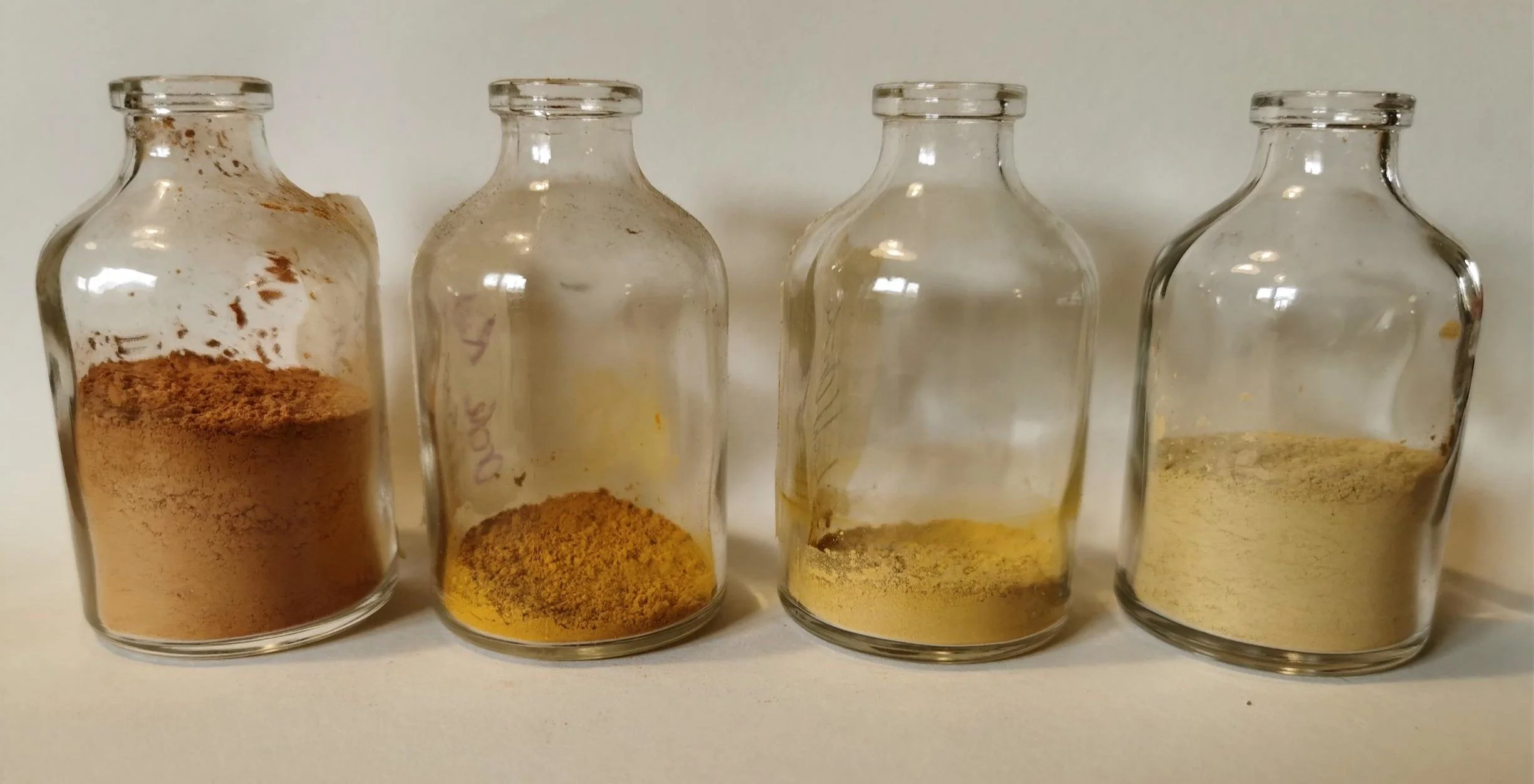
Four samples of pigments collected for “Part One: Yellow Ochre”
Image Credit: Charlotte Pratt
Buoyed by my success in gathering a good selection of ochres for my Zorn palette, I now turn to black. Within that palette, black serves a dual purpose: it creates depth through shading and stands in for blue. Zorn was not the only artist to work in this limited way. There are accounts, though opinions differ, that the ancient Greeks also used a restricted four-colour palette. Recorded by Pliny the Elder in Natural History (Book 35) and often associated with painters such as Apelles, this theory names white, black, red and yellow ochre as the artist’s fundamental pigments. These were believed to correspond to the four elements; water, air, fire and earth. Yet the absence of blue remains striking, and has led some to suggest that the black employed must have carried a bluish hue in order to extend the range of colour available.
It is easy to think of black as a single colour, but like all colours it is deeply variable. Through making my own pigments, I hope to discover a range of blacks shaped by place, process, memory and artistic intention. For that reason, black holds a particularly important place in this palette. It must provide depth through shading and also function as my blue; but beyond that, it carries a personal weight. Generations of my family have lived on or around the glistening black of the Blackwater Estuary and so the colour sits at the heart of my own colour geography.
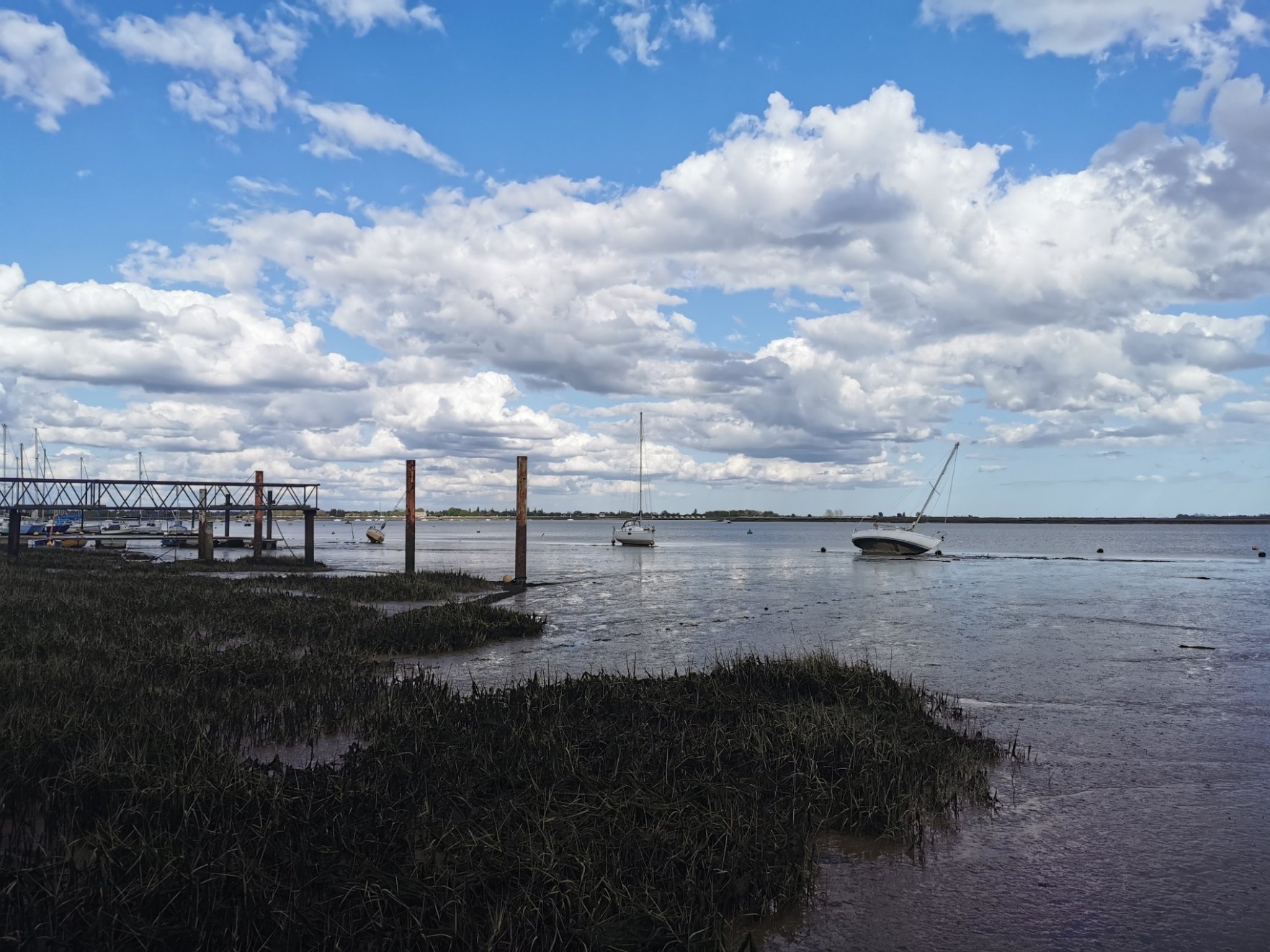
The Blackwater Estuary
Image Credit: Charlotte Pratt
The Blackwater Estuary is a strange place: a landscape of shifting marsh, of channels and islands that change shape with the tide. It is rich in plant and bird life, with the looming brutalist structure of Bradwell Power Station on the horizon. Beneath it all lies the mud: thick, black, oily and rich, staining my childhood with its undeniable wildness. Six generations of my family have lived around it or in the case of one grandparent, on the river itself. Two generations of ashes have been scattered into its waters and I expect that one day mine will be too. If the colour of where I now live is a rich ochre earth, then the colour of my childhood is a wonderful, oozing, sticky black.
Black pigments generally fall into three categories: carbon, iron oxide and synthetic. Carbon blacks are made through the partial burning or carbonising of organic materials such as oil, bones, wood or other vegetable matter. Iron oxide blacks, such as Mars Black, are produced by oxidising iron salts at high temperatures to form a dense, stable black iron oxide. Modern synthetic blacks are made from a range of materials and are often developed for high durability, industrial use, or ultra-matte artistic applications. Among the most famous is Vantablack, developed by Surrey NanoSystems and later popularised in the art world by Anish Kapoor. It is the darkest man-made substance currently available, absorbing 99.965% of visible light.
The Zorn palette specifically calls for ivory black. As the name suggests, genuine ivory black was made by burning ivory, making it an inherently expensive pigment. Today it is more likely to be produced from reclaimed ivory, such as old piano keys. As I have no access to either, I will have to turn to alternative recipes.
In the craftsman’s handbook, Cennini writes:
“Know that there are several kinds of black colours. There is a black which is a soft, black stone……Then there is a black which is made from vine twigs; these twigs are to be burned; and when they are burnt, throw water in them, quench then and then work them up like the other black. And this is a colour both black and lean; and is one of the perfect colours that we employ and is the whole…There is another black which is made from burnt almond or peach stones, and this is a perfect black, and fine. There is another black which is made in this manner: take a lamp full of linseed oil, and fill the lamp with this oil, and light the lamp. Then putt it, so lighted, underneath a good clean baking dish and have the little flame of the lamp come about to the bottom of the dish, two or three fingers away…”
The blacks to which Cennini refers in this passage include a kind of earth black; possibly Roman black, a natural iron-oxide-based pigment sourced from ground slate or lignite deposits in Italy - as well as vine black, peach black and lamp black. In other words, he gives us two of the three categories already outlined: an iron oxide and several carbon blacks.
Let us turn to the charcoal carbon blacks. Like ochre, they are among the oldest pigments used by humans in art, a fact apparent to anyone who has looked at Palaeolithic cave painting. In its simplest form, charcoal is what remains when a piece of wood is incompletely burned.
In An Introduction to the Chemistry of Paints, J. Newton Friend writes:
“Carbon is the main constituent of organic matter, and can be obtained by heating any organic substance, such as wood, leaves, sugar, and starch, out of contact with air. This test-tube contains a piece of wood, and we will now heat it strongly. First of all you notice that moisture is set free. Now a gas is escaping, which bums like coal gas, and with a smoky flame. The wood also is becoming blacker, and tarry matter collects on the cooler parts of the tube. The experiment is now over, and on breaking the tube you see that a lump of cinder or charcoal is left behind.”
What Friend is describing here is the production of charcoal from organic matter by heating it while excluding oxygen. Most carbon blacks are made in this way, from vine black to bone black and the principle is the same as that used to make charcoal for a barbecue. In the course of my research, I found several historical texts describing how such pigments were prepared.
Friend writes on the production of bone black:
“As its name implies. Bone Black is obtained by the carbonization of animal bones, whereby the volatile products are expelled, and carbon and mineral matter are left behind. The crushed bones are packed into clay crucibles with loosely fitting lids and heated in a furnace. The residue is now ground to a fine powder, and sent into the market”
In Henley’s Twentieth Century Book of Recipes, Formulas and Processes there is a recipe for the making of Frankfort Black, which is described as a superior grade of lamp black.
“…it is said to be made by calcining wine lees and tartar. The material is heated in large cylindrical vessels having a vent in the cover for the escape of smoke and vapours that are evolved during the process. When no more smoke is observed, the operation is finished. The residuum in the vessels is then washed several times to extract the salts contained therein and finally it is reduced to a proper degree of fineness by grinding on a porphyry”
With these methods in mind, I began experimenting with creating my own palette of blacks. The first step was to collect the raw ingredients. The historical recipes offered a broad range of possibilities - grapevines, peach stones, wood, bones, soot and eart = and with that list in mind I travelled to the Blackwater Estuary for a spot of beach or more accurately, saltmarsh, combing.
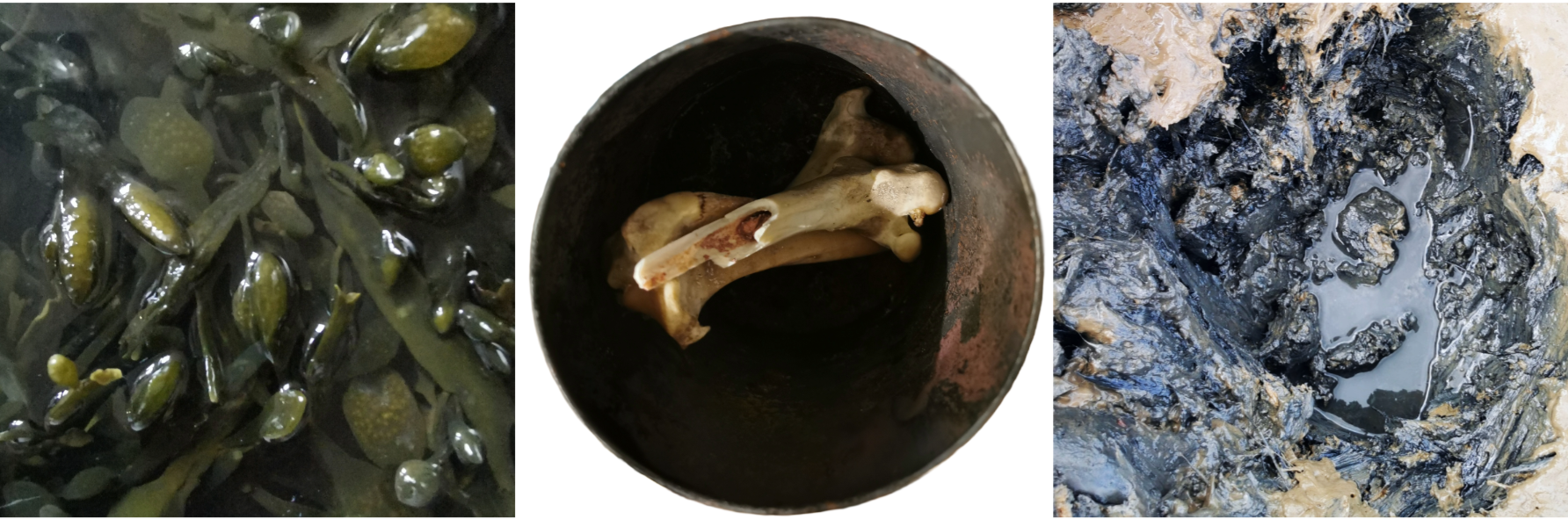
Materials collected from the Blackwater Estuary. Left to right: egg wrack seaweed, bones, estuary mud.
Image Credit: Charlotte Pratt
Alongside the materials gathered from the Blackwater Estuary, I also collected others from my grandparents’ house, which, since my grandfather’s death, I have been clearing in preparation for its sale. The house has been such a significant part of family life for the past sixty years that incorporating something of its very substance into future portraits feels essential.
My grandfather was an enthusiastic winemaker and the back garden is still home to a sprawling grapevine from which I harvested some of last year’s dried twigs. I also swept soot from the chimney, thinking of family Christmases around the fire. Finally, I collected a length of soffit removed during recent renovation work, probably original to the house when it was built in 1912 by the Bentall’s company, for whom both my grandfather and father would later work.
I then began processing the materials. The mud sample was thoroughly rinsed to remove as much larger organic matter and oil as possible, passed through a fine sieve and left to dry. The seaweed and bones were soaked and rinsed to remove salt, then dried, while the grapevine was cut into short lengths for the next stage: carbonisation.
All of the materials, apart from the chimney soot, were then subjected to the same process: burning without oxygen in my log burner. My other grandfather is a woodsman and traditional charcoal maker, so I am not only familiar with this method, but also feel that the act itself and the materials it produces, form part of my internal colour geography.
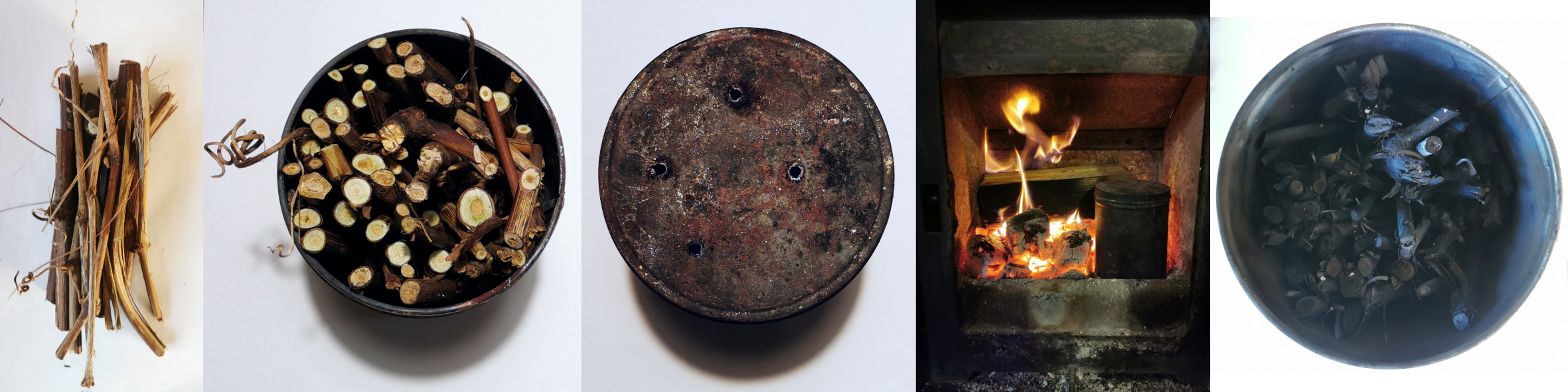
Charcoal making
Image Credit: Charlotte Pratt
Each material was placed into its own tin with a secure-fitting lid, into which I had drilled four small holes to allow the gases produced during burning to escape. The tins were placed in the lit log burner and left overnight. By morning, once everything had cooled completely, I was left with charcoal made from bones, vine twigs, earth, hardwood and seaweed, along with the soot collected from the chimney. Each material then needed to be ground and sieved before being combined with oil.
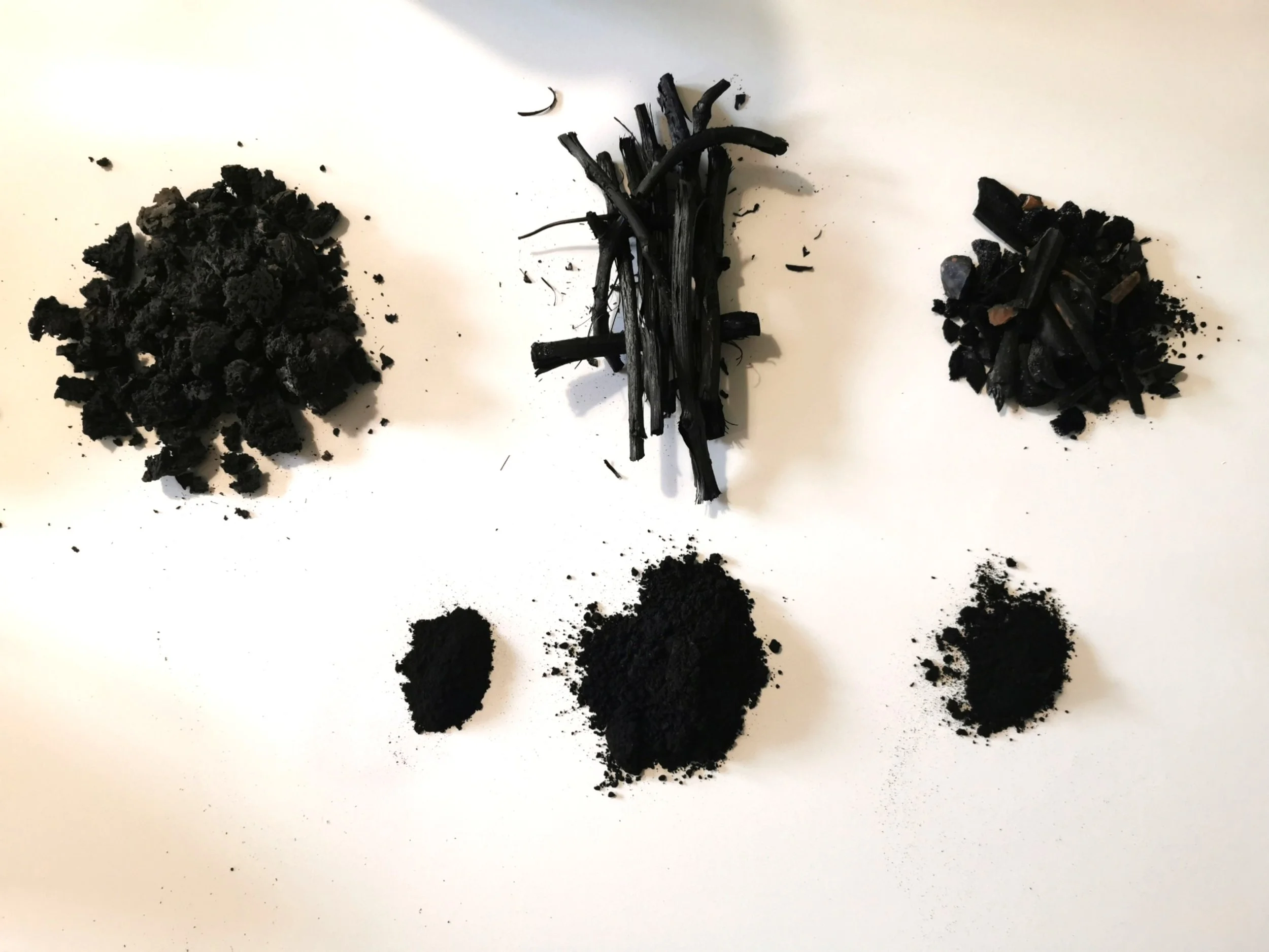
The six materials. Top row, left to right: unground Blackwater mud, grapevine and bones. Bottom row, left to right: ground seaweed carbon, hardwood carbon and soot.
Image Credit: Charlotte Pratt
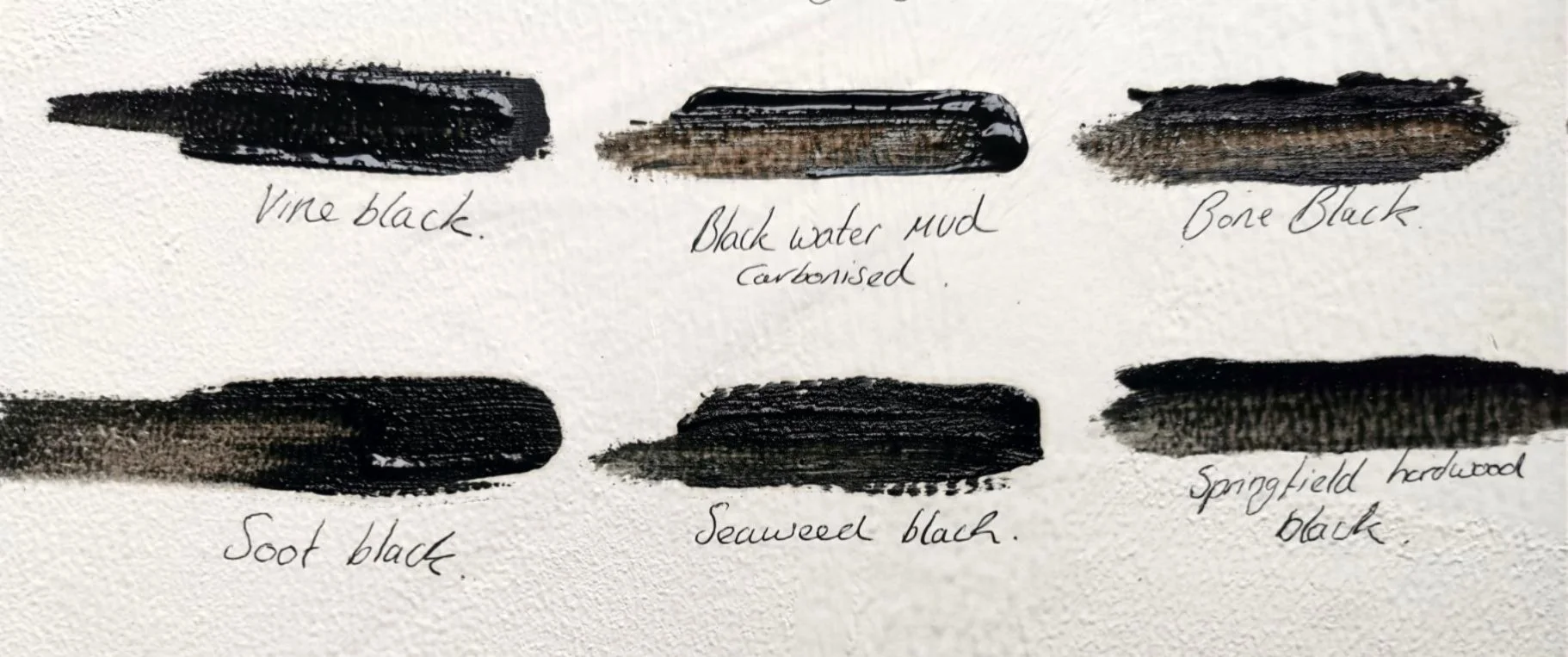
Ground pigments combined with oil
Image Credit: Charlotte Pratt
As with the yellow pigments, these materials produced paints with a striking depth of colour and despite the similarities in how they were made, a pleasing range of tones. The bone black is a very dark shade of blue, composed of 10.59% red, 10.98% green and 12.16% blue. Blackwater mud produces a very dark, muted yellow with ashy brown undertones. The vine black reaches a deep, near-black shade, while the soot black has a browner tint and the seaweed black a stronger green cast. The Springfield hardwood yields a very dark blue-magenta, composed of 5.1% red, 5.1% green and 5.88% blue.
These colours - or perhaps more accurately, these pigments or materials - feel incredibly personal, even more so than those I have collected near my current home. Whether that connection to family, landscape and colour geography will make itself visible in the work remains to be seen. Still, I hope that they may, in Redon’s words, become companions and collaborators, and reveal some of their secrets.
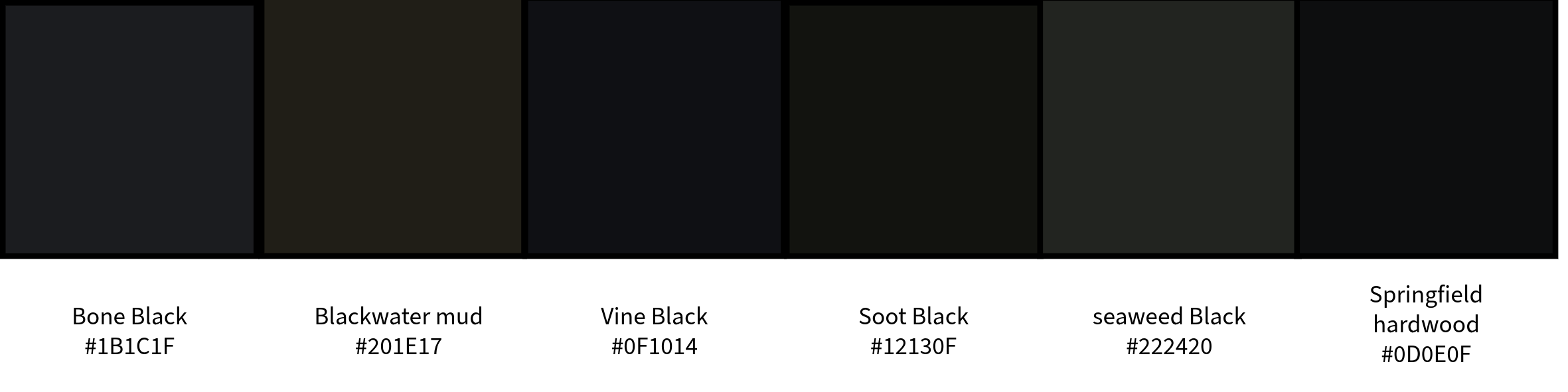
Colour samples created with a colour picker tool, with hex codes
Image Credit: Charlotte Pratt
References
Hiscox, G.D. (1909) Henley’s twentieth century book of recipes, formulas and processes. New York: N.W. Henley Publishing Company.
Bersch, J. (1901) The manufacture of mineral and lake pigments: containing directions for the manufacture of all artificial artists’ and painters’ colours, enamel colours, soot and metallic pigments. London: Scott, Greenwood.
Cennini, C. d’A. (1933) The craftsman’s handbook. Translated by D.V. Thompson, Jr. New Haven: Yale University Press.
Friend, J.N. (1910) An introduction to the chemistry of paints. London and New York: Longmans, Green and Co.