

Robert & Sonia Delaunay: Multidimensional Colour of the 1910s
Robert and Sonia Delaunay – two fascinating artists, who pushed the avant-guard further, each talented in their own right, yet extraordinary in their combined power. Both born in 1885, they were brought up in very different contexts: Robert in Paris, where he became a largely self-taught painter influenced by artists like Paul Cézanne and Sonia in Odessa, later raised in Saint Petersburg and educated in Berlin before moving to Paris to pursue art. There she met Robert and they married in 1910, forming a close personal and creative partnership that helped shape their shared exploration of colour and abstraction. Artists lived mainly in Paris, although during World War I they relocated to Madrid and Lisbon, where Sonia expanded into fashion and design, before eventually returning to Paris, which remained their primary home and artistic base for the rest of their lives.
The cross-pollination of ideas between Robert Delaunay and Sonia Delaunay is evident in their work, making it difficult to analyse their use of colour separately, as both addressed similar artistic and mundane concerns of various scale. Several art historians see Sonia’s influence on Robert as fundamental to both of their successes, with art historian John Gage noting that ‘Sonia Delaunay’s applied arts […] had a decisive impact on her own painting as well as that of her husband Robert Delaunay – characterised Simultané because of the central importance of simultaneous contrasts of colour.’ Beyond painting, her work in decorative arts demonstrated both versatility and commercial skill, at times supporting the whole family financially. Her use of collage and patchwork techniques from textile design added a distinctive dimension to her paintings.
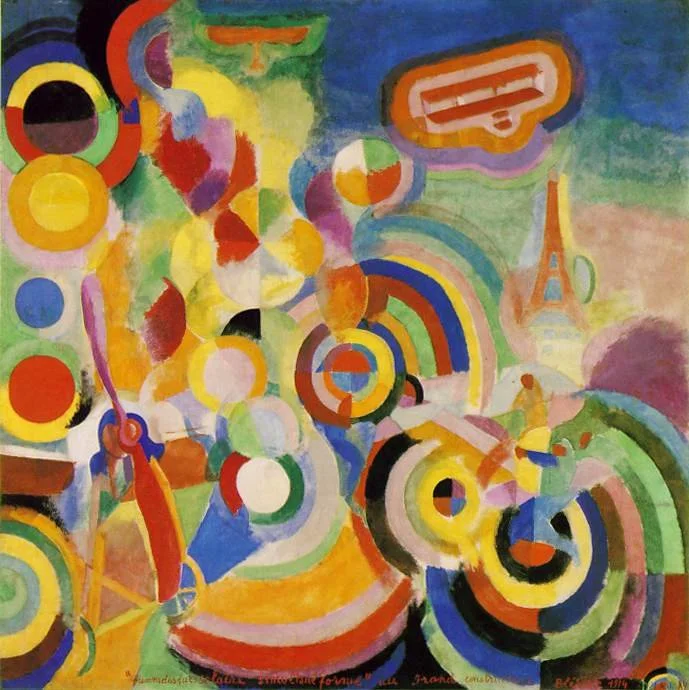
Hommage à Blériot by Robert Delaunay, 1914, tempera on canvas, 250 × 250 cm
Image Credit: Kunstmuseum Basel Collection via Wikimedia Commons
Dissecting the work of Robert Delaunay and Sonia Delaunay also requires recognising their place within a broader artistic network, including strong exchanges with the The Blue Rider group: Wassily Kandinsky, August Macke, Franz Marc, Gabriele Münter and others. The Blue Rider and Orphism were linked through travel and correspondence, shaping shared ideas on colour and perception, while Kandinsky’s texts Concerning the Spiritual in Art (1911) and Point and Line to Plane (1926) influenced a large share of his contemporaries. This exchange was strengthened when Robert exhibited in Munich in 1912 and met Paul Klee, Franz Marc and August Macke. Their cultural and social connections were recently highlighted in large-scale Expressionists: Kandinsky, Münter and The Blue Rider exhibition (2024) at Tate Modern, which aimed to ‘tell a story of friendship through art.’
Throughout their bohemian artistic life, the Delaunays ‘were attracted to everything that carried a spark of originality’ and ‘shared their table with the avant-garde of avant-gardes’, uniting the descendants of various movements. Sonia maintained links with both expressionists, émigré artists and Russian Constructivists circles, which reflected in correspondence with several famous artists (including Kandinsky) preserved at the National Library in Paris.
Poetic and Scientific
Delaunays work was also informed by the interplay of poetic and scientific ideas that circulated around the time. The poetry and art of the Romantic era, focused on subjective perception, emotion and encounters with nature, became an inspiration for abstract artists to resist the western academic Realist canon of faithful representation and tonal painting. First taken up by the Impressionists, this resistance continued with avant-garde artists at a new stage of artistic development. The growing interest in psychology and cognitive science gave the Romantic legacy the new spin: “Naturalism, Pleinairism, Symbolism; Impressionists, Pointillists […] can all appeal to Johann Wolfgang von Goethe’ – and his Colour Theory (1810) which was written a century earlier – but ‘the most significant revival of Romanticism appeared after 1900.’
Goethe’s scientific experiments blended with poetic remarks on nature made him artists key point of inspiration, leading them ‘to claim as their own’ for his affective approach to perception of colour. His Colour Theory (1810) and study of ‘after-image effects’- the visual effects of seeing the colour after the stimulation has ceased - suggested that ‘only strongly coloured stimuli needed to be painted, rather than their representational results. Exactly this approach manifested itself through abstraction of the beginning of the 20th century, notably through the paintings based on formlessness and fragmented shapes, where colour took the leading role.
The poetic vision of reality also informed the term Orphism coined by poet and critic Guillaume Apollinaire, to describe avant-garde painting, especially the lyrical work of Robert Delaunay. In referring to the ancient Greek poet and singer he argued that painting should be like music, which aligned the term with Expressionists’ ideas of connection between music and colour and the Delaunays’ interest in rhythm and dynamism.
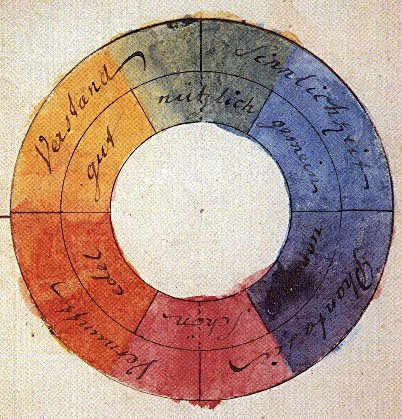
Colour wheel from Johann Wolfgang von Goethe’s Theory of Colours, 1810
Image Credit: Goethe, via Prof. Dr. Hans Irtel; Universität Mannheim via Wikimedia Commons
The understanding of scientific theories on colour in Delaunays’ work was rather poetic too. After being christened as ‘Orphists’, Robert and Sonia Delaunay developed their own term, Simultanism, which ‘derived from the theories of Michel Eugène Chevreul’ notably his De la loi du contraste simultané des couleurs (1839). The main idea of this work was that put together simultaneously, the contrasting colours enhance one another, increasing their own intensity and vibrancy. Thus, studying interaction of contrasting and complementing colours became central to both Robert’s theory and practice and Sonia’s painting and decorative work.
Robert positioned himself as the main ‘theorist’ of the Simultaneity movement elaborating extensive writings on the role of colour, while Sonia dissimilated the principle of simultaneous contrasts through the decorative arts. ‘Colours,’ Robert wrote in one of his 1924 texts, ‘establish other dimensions among themselves, which are then reproduced in the eye of the viewer and not only on the surface of the painting, what is commonly called optical confusion.’

Optics: a colour‑circle, after M. E. Chevreul. Coloured process print by René Henri Digeon, c. 1868
Image Credit: Iconographic Collections via Wikimedia Commons
With the help of ‘science’, the Delaunays sought to demonstrate that colour alone could be used as a tool to transfer the perception of light – without the necessity to picture light and shadows. The idea wasn’t new: before them, the Impressionists already pioneered this path by establishing that they didn’t want to paint as painters did before, having to deliberately darken most of their palette to create a background against which the luminosity of the bright day could be best demonstrated. In expressing their resistance, Impressionists ‘replaced the chiaroscuro effects characteristic of previous outdoor painting’ with bright colours and ‘introduced bright light into landscape art.’
In the pursuit of visualising light with colour, the avant-guard artists studied prismatic experiments, including Newton’s optic theory. By the early 20th century, colour in science was understood as light of specific wavelengths within the electromagnetic spectrum - short wavelengths appearing blue or violet, medium as green to yellow and long as orange to red. At the same time, scientists already recognised that perception plays a key role in understanding of the colour. The trichromatic theory, developed by Thomas Young and expanded by Hermann von Helmholtz, proposed that three types of cone cells in the eye, sensitive to red, green, and blue; combine to produce the full range of colours we see. As Helmholtz noted in Handbook of Physiological Optics (1867) ‘the sensations of colour do not depend directly upon the nature of the rays, but upon the peculiarities of the sensory apparatus.’ These colour theories combined both the physics of light and the physiology of vision.
The key achievement of the abstract expressionism project was showing that light and shadow no longer needed to be depicted directly, as colour contrasts could now provide those effects. More importantly, light and reality itself were no longer visualised, but replaced by the idea of them. This was very much in line with Goethe’s thoughts expressed in an unpublished essay on the eye: ‘Painting is truer to the eye than reality itself. It presents what man would like to see and should see, not what he habitually sees.’ In this phrase he pointed to the limits of cognition, prioritising subjective perception and asserting the artist as a figure who has a power to manipulate the reality.
In 1950, art historian Wolfrang Shöne explored in his book On Light in Painting how light was used in artworks of different periods, ‘distinguishing between “immanent light” in medieval manuscripts and altar paintings and “illuminating light” of later eras.’ He argued that ‘the essential difference between the immanent light of the Middle Ages and the pictorial light of post-war painting’ ‘rests on a fundamental shift in relationship between colour and light.’ In 2000, curators Marcus Brüderlin and Reinhold Hohl organised the Colour to Light exhibition, where they analysed the different ways artists have sought to translate the effects of light throughout history. Using examples of Robert Delaunay and František Kupka (another artist associated with Orphism) among other artists, they showed that in abstract expressionism colour became no longer ‘a function of light’, as it had been in Western painting from the Middle Ages to the 19th century realism. Instead, light became a ‘function of colour’ being ‘generated at the heart of the paint itself’, ‘radiating from that centre’ and ‘dissolving the world of objects in a dynamic continuum.’
In his painting – they argued – Robert Delaunay explored these ideas, ‘aspiring to create the strongest possible impression of light in a dynamic colouristic style’ and ‘introducing light into his works by applying thin layers in the kind of segmented areas.’ The impression of light depended on how bright or muted the colours appeared. As a result, Robert produced abstract or semi-abstract paintings composed of simple geometric forms of ‘brightly luminous and translucent colour’, as seen in Circular Sun No. 1 (1912).
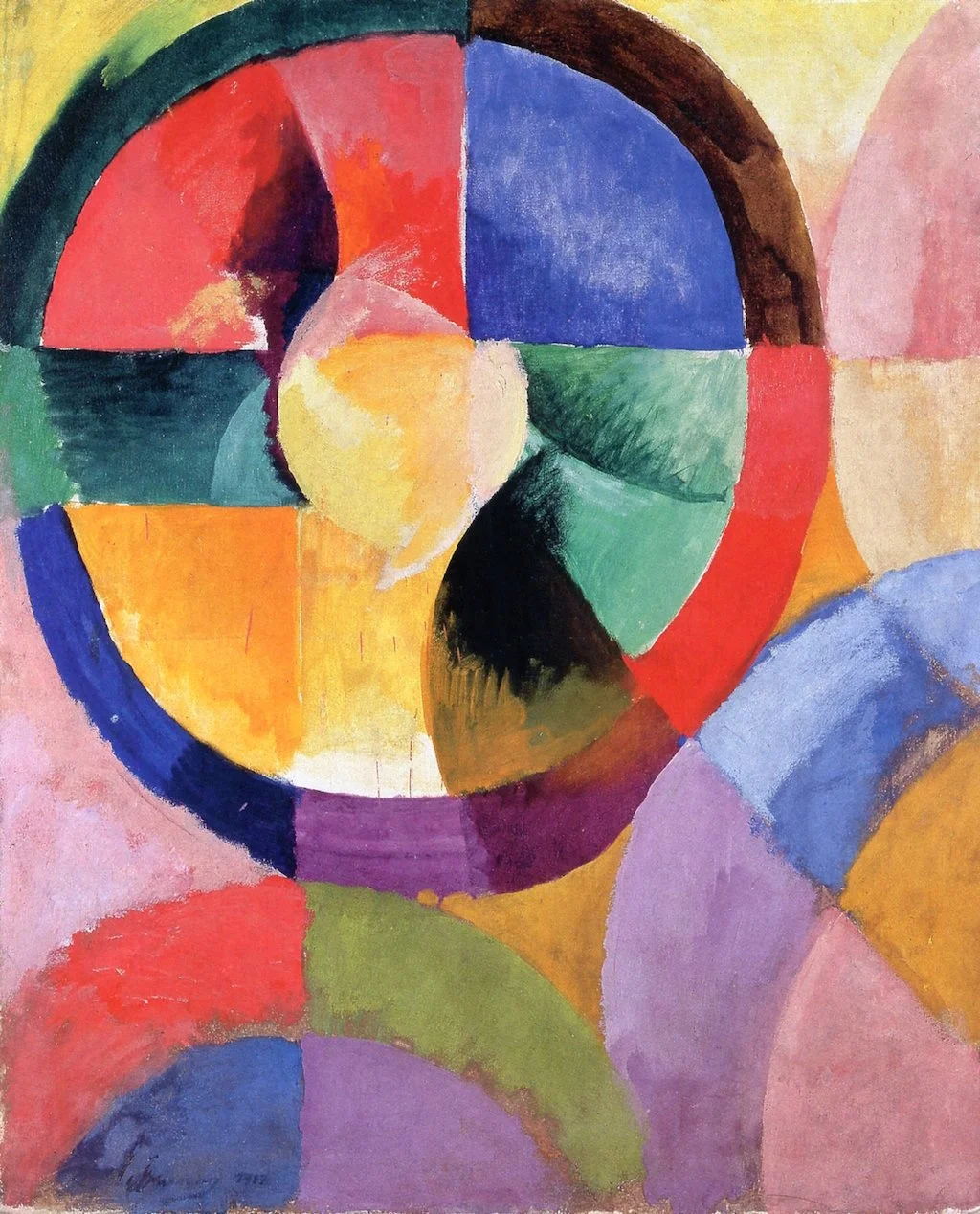
Circular Forms, Sun No. 1 by Robert Delaunay, 1912–1913, oil on canvas, 100 × 81 cm
Image Credit: Wilhelm-Hack-Museum Collection via museum website and Wikimedia Commons
Sonia combined science with imagination in a different way. As Sherry Buckberrow noted, ‘Sonya's passion for mathematics led her to discover her own intuitive system of calculation, corresponding numbers to the intensity of colour vibration…The order these numbers produced was flexible, it shifted at the will of colour.’ The fascination with geometry of colour has led her to the elaboration of the idea of ‘constructiveness,’ where colour defines composition. But unlike Constructivists – whose work Delaunays were familiar with, she interpreted ‘constructiveness’ poetically, celebrating speed, power and modern rhythms through the ‘infinite rhythms’ of simultaneous colour contrasts. While Constructivists’ work sought to create a machine-like geometry through the dense rapport between coloured segments on plane, Sonia would leave a lot of air and incompleteness between her colour segments, allowing colours to interact freely. For her it was about blending the scientific and the poetic: “The poets who surrounded me, Apollinaire and above all Cendrars, understood what I wanted to do: not to reduce abstract art to an intellectually defined goal, to simplify calculated geometry […] but […] to combine order and lyricism.” – she wrote.
In her Electric Prisms (1914), Sonia demonstrates the viewer the simultaneity of the poetic and the scientific. The painting, consists of two circles which multiply the waves of colour in a form of numerous scattered colourful segments of primary and secondary colours. The picture creates mosaic effect due to the fact that the color combinations within these segments are sometimes very contrasting, and sometimes quite close in colour. On the middle-left side of the Electric Prisms painting, there is a quadrant bearing the name of Blaise Cendrars and his poem Prose on the Trans-Siberian Railway, in which the poet’s thoughts alternate with the lulling rhythm of the train. The painting also connects to an earlier collaborative project - an artist book - by Sonia and the poet, Prose on the Trans-Siberian Railway and of Little Jehanne of France (1913), where art and literature were brought together. Through this allusion, Electric Prisms gets more closely aligned with the motif of landscape, where the experience of a journey is mapped as a socio-temporal phenomenon, an unfolding of objects and places along the vector of movement.
With its patches of light and shadow, the painting evokes a cartographic image seen from above, an aerial projection or a view from an airplane window. Across this surface run streams of different colours, like projections of electric lines which, when zoomed in, spark like sun-like light bulbs. Robert wrote that Sonia’s work ‘belongs to the future’, because it ‘corresponds to modern life, painting, architecture, the bodies of machines, the beautiful and original forms of airplanes - in a word, to the breath of this active, modern era, which has created a style closely linked to its intense, ever-accelerating life.’

Prismes électriques by Sonia Delaunay, 1914, oil on canvas, 250 × 250 cm
Image Credit: Musée National d'Art Moderne Collection via Wikimedia Commons
Dynamism, Spirit & Multiple Dimensions
The Delaunays were equally interested in the idea that colour could be manipulated to create an illusion of dynamics and additional dimensions. Starting from architecture-inspired semi-cubist paintings, Robert then developed the Disc series where he studied the dynamic effects of the circular shapes and the employment of colour contrasts to create an effect of spinning wheel. In The First Disc, 1913, Robert Delaunay is ‘blurring [colours] and tinting them lightly with black and white’, following the example of neo-expressionist Paul Signac, to create darker or lighter colour segments. The colourful segmentation of the painting creates an illusion of a spinning movement, although the way that contrasting segments are located at different height adds a slight dissonance as if this movement was chaotic. John Gage suggests that ‘Robert Delaunay’s Disc series of 1913, […] uses descriptive forms for sun and moon, showing that at this stage he was still interested in the expressive power of the subject, rather than depending solely on colour.’ One might suggest that this expressive power relies on the effects it produces of the dizziness of a circulating image, the rhythmic movement that – if observed for a long time - leaves the viewer transfixed and out of touch with reality.
If art can leave viewers transfixed – can it enlighten them? In Abstract Art (2020) Pepe Karmel discusses The First Disc painting in ‘Cosmologies’ chapter, suggesting that Robert refers to the idea of ‘the Sun and Moon’ as ‘symbols of enlightenment’, which ‘first oppose and then merge into a single multi-coloured disk’. The painting itself thus becomes the spinning body of light, a metaphor for cosmic entities: ‘It has been suggested that Delaunay wanted to shock viewers with colours as radiant as the sun itself’, however, ‘his true goal was spiritual seduction, leading the viewer through the colours to the divine light.’ Thus, he aligns the dynamism in Robert’s work to a sort of spiritual practice. This work is an experiment on the effects of a visual method, an exploration of the way colour contrasts create depth and movement that animate static image. But because this image is not mimetic it gives a certain detachment from familiar reality, creating trans-like dynamics, which aligns the subject of the painting with the notions of transcendental and unreachable.

Premier Disque by Robert Delaunay, 1912–1913, oil on canvas, 134 cm (52.7 in)
Image Credit: Private collection via Wikimedia Commons
Sonia Delaunay’s work with other mediums and techniques informs the potential interpretation of the texture-like quality of her paintings. Delaunay knew how to apply colour contrasts to the items that were designed to wrap around and interact with body. Such were the fashion items (i.e. the Simultaneous Dress) she created, or – the example I prefer the most – Baby Quilt Made for her Son Charles, (1913). These items organically blended the principles of colour contrasts, collage and geometry with the traditional technique of patchwork characteristic of Eastern European folk art.
The interchange of light segments with shadow-like areas in Sonia Delaunays’ paintings of the time – like Electric Prisms (1914) or Simultaneous Contrasts (1913) creates volume and depth in the painting, as if it had a heterogenous texture of the textiles. The fragmented image acquires a kind of soft, warm and enveloping quality. Colour in her paintings fluctuates with a different frequency, just as the rays of light play differently on textile than they do on a painting, flowing through segments of sleek material and ceasing, becoming mute when the coarser fragment of fabric captures them. As Robert suggested in his writings in 1924 colours in their work not only interacted with themselves, they also helped create an additional dimension to the painting:
…the measured object called the painting, a surface in two or more dimensions, simultaneously merging in the line of sight, is transformed into a multidimensional object; and these planes form groups that oppose or neutralise each other, since colour is the dimension of a vibration of a given intensity, depending on its environment and the area of its surface, in relation to all other colours.’
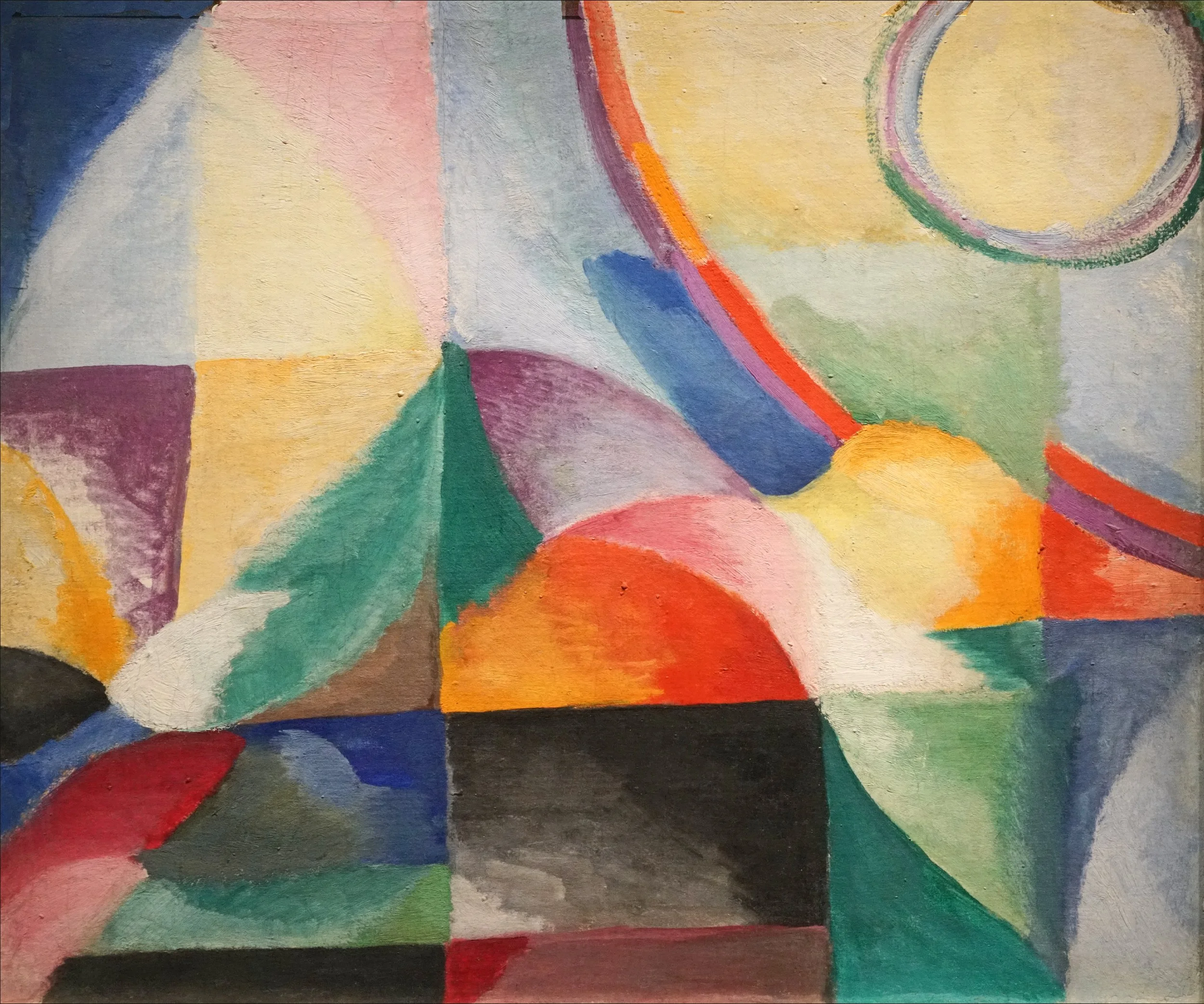
Simultaneous Contrasts by Sonia Delaunay, 1913, oil on canvas
Image Credit: Museo Nacional Thyssen-Bornemisza Collection; photograph by Jean-Pierre Dalbéra via Wikimedia Commons
The intellectual framework of the avant-guard combined science with modern understanding of perception: Robert Delaunay and Sonia Delaunay, like many contemporaries, engaged with the idea of the spiritual (in the broadest sense of this word) while Wassily Kandinsky became a key artist interpreting Theosophy of Rudolf Steiner, who sought to unite science with non-physical dimension of reality. As Kandinsky famously announced in Concerning the Spiritual in Art (1912) the ‘colour is the keyboard, the eyes are the hammers, the soul is the piano with many strings. The artist is the hand which plays, touching one key or another, to cause vibrations in the soul.’ In the phrase he formulated the shift in a paradigm: he didn’t just empower the artist’s figure as someone who can establish a deeper connection with the viewer through art, but also pointed at the necessity of looking into new tools – like colour – that had a capacity for creating the transcendental experience of reality. Kandinsky’s ideas were known to Orphists and this way of thinking about the role of the artist and role of colour, became a prominent theme in the artistic discussions of the time. Although the Delaunays favoured a more grounded spirituality linked to rhythm, music and modern technology, they still valued art’s poetic power, with Sonia criticising utilitarian art theories of her time and insisting that spirituality cannot be separated ‘from human nature and the best of human creation.
Robert and Sonia Delaunay – unique figures of abstract expressionism, the Orphists, the creators of Simultaneism, the pioneers in thoughtful application of colour contrast to both two-dimensional and multi-dimensional art. Their trail does not go unnoticed and continues to inspire museum projects, academic publications and artwork. Generation after generation, curators and scholars find their art a fruitful ground for building new approaches to art history, as much as a beautiful prism through which to study the changing perception of colour. Their art is a demonstration of blending science theories, poetic expression and various cultural influences into a distinct Delaunay approach.
Sources
Gage, John. Colour and Culture: Practice and Meaning from Antiquity to Abstraction. Thames and Hudson, 1993.
Goethe, Johann Wolfgang von. Goethe's Colour Theory. Edited by Rupprecht Matthaei, translated by Herb Aach, American ed., Van Nostrand Reinhold, 1971.
Hatje Cantz. Farbe zu Licht. Hatje Cantz Verlag, 2000.
Helmholtz, Hermann von. Handbook of Physiological Optics. Translated by Southall, James P.C., The Optical Society of America, 1924.
Jay, Martin. "Chromophilia: Der Blaue Reiter, Walter Benjamin and the Emancipation of Color." New German Critique, vol. 38, no. 1, 2011, pp. 69–100.
Karmel, Pepe. Abstract Art: A Global History. Thames and Hudson, 2020.
Tulovsky, Julia. Avant-Garde Textiles: Designs for Fabric. Tatlin, 2016.



.jpg)