

The Colour of the Living World: Colour, Nature and Wellbeing
WHITES
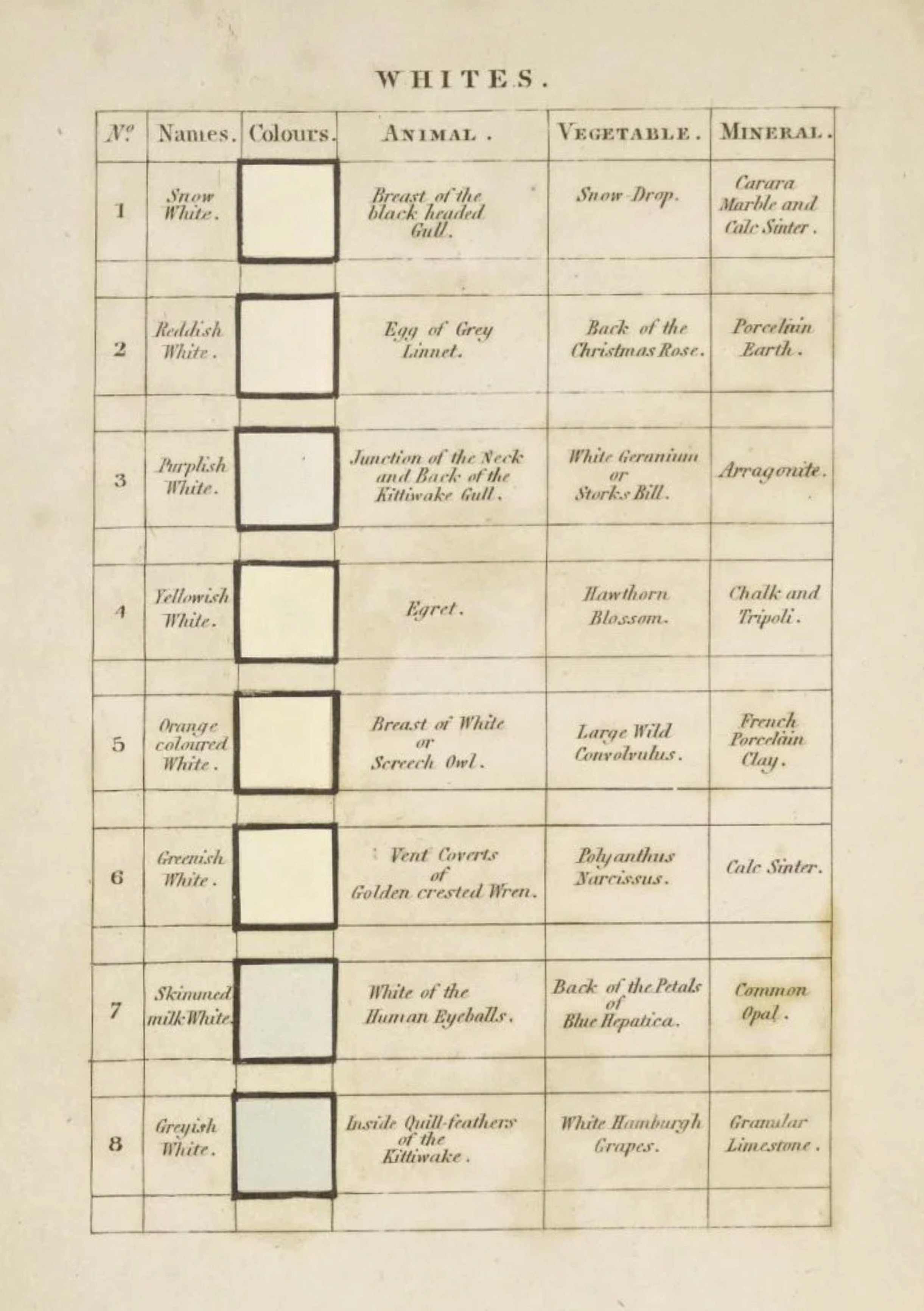
Whites colour plate from Werner's Nomenclature of Colours, 1821 edition, Patrick Syme
Image Credit: Public Domain Review
White is never just white.
In theory, white is pure: the absolute, the blank, the absence or the sum of all colour, depending on which physicist you ask. But no one has ever held pure white in their hand. What we hold and gather and reach for, is something else entirely.
Snow on a January morning. The first snowdrop pushing through frozen ground. Hawthorn blossom warming toward cream. A newly laid egg, still warm in the hand. The breast of a gull. A hag-stone worn smooth by the sea. The inside of a shell. A white moth at dusk.
None of them the same.
Noticing the Difference
Holding a white egg, it is not one shade of white. I find myself looking at it through the eyes of a painter, asking how I would recreate it. At the very top, where the light falls, the brightest and coolest white. As the shell curves to the left, the white grows warmer, softer, less sharp. Down the right side, away from the light, it deepens to a cool faint grey. And at the base it turns warmest and deepest, almost no longer a white at all.
One egg. Four whites, perhaps more, shifting into one another. The hag-stones beside it are different again: their white broken and textural, pitted and chalky, grey-brown settling into the hollows, a paler dust on the raised surfaces.
Two objects, side by side and not a single flat white between them.
There is something grounding and clarifying in holding them together, to stop and notice the subtleties, to see how different two whites can be.
I am drawn most to the warm whites, the creamy, the soft, the faintly brown. They make me feel held and cared for. And yet the cooler whites, the grey and the blue, have their own gift: a crispness that feels like being renewed, freshened, made new.
When I sort and arrange my white natural materials in the studio, grouping them by colour, I am sometimes surprised at what I discover. A colour in the white I had not noticed at first. And as I look, and sort, and match, my busy mind becomes quiet. Mindful. Focused.
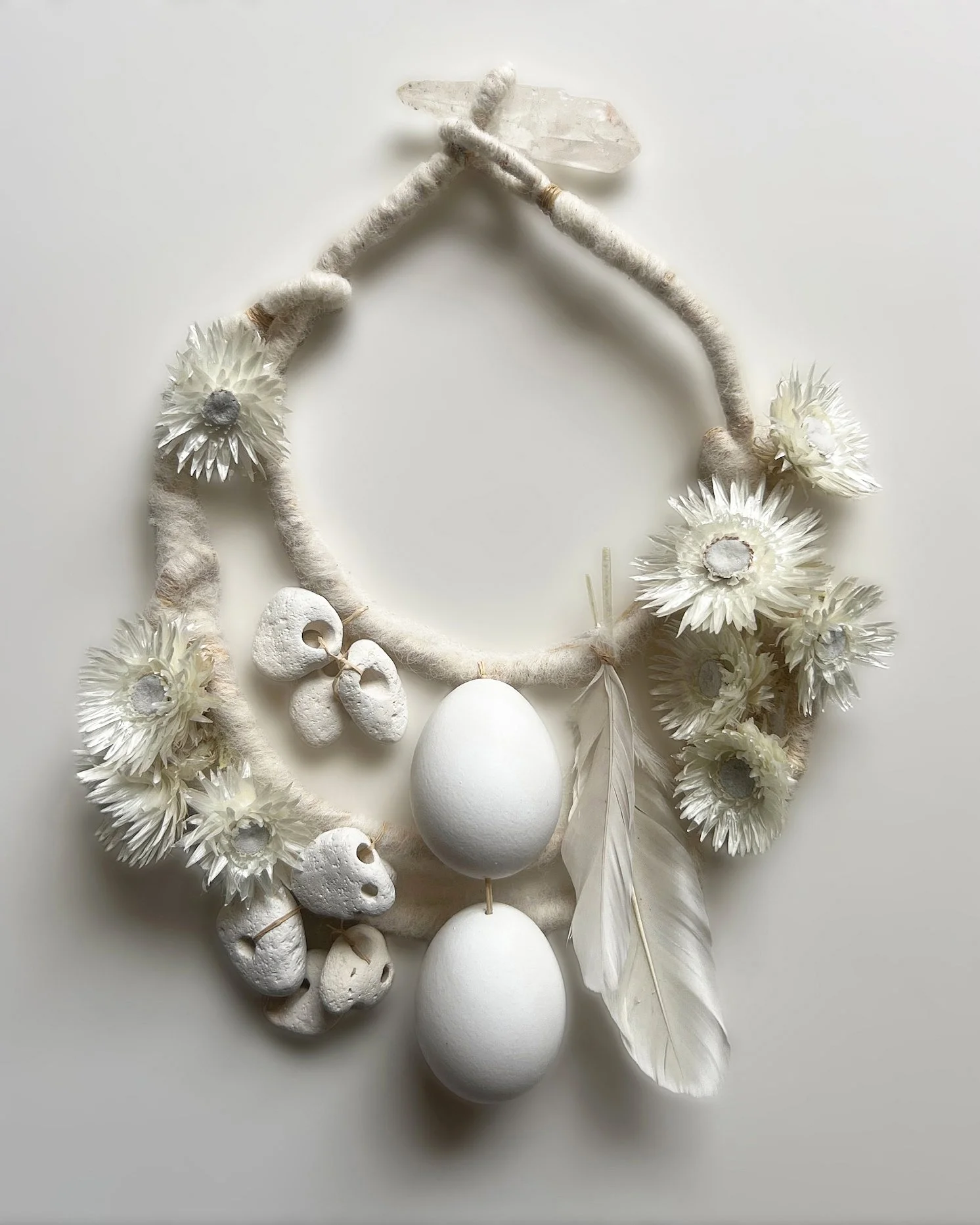
Whites, a protective necklace of natural materials: eggs, hag-stones, feathers, quartz, helichrysum, wool, raffia. From a series made for hospitals and healing spaces - Dawn Weller Studio
Image Credit: Dawn Weller
Werner and Syme
The mineralogist Abraham Gottlob Werner and the painter Patrick Syme were doing exactly this, two centuries ago. They searched the living world for animals, plants and minerals that matched a particular shade of white, then the shades that followed. The result, Werner's Nomenclature of Colours, named a beautiful range of eight whites: Snow White, Reddish White, Purplish White, Yellowish White, Orange-coloured White, Greenish White, Skimmed-milk White, and Greyish White.
Each one was matched to something exact. Yellowish White: the egret, hawthorn blossom, chalk. Greyish White: the inside quill feathers of the kittiwake, white Hamburgh grapes, granular limestone. Their search often took them to a very particular place to find a very particular white.
There is comfort and a kind of kinship, in knowing that two people paid this much care and attention two hundred years ago. We now live in a world of countless white paint shades, but the inspiration for all of them surely began here, in nature. Working with colour, I am often explaining the differences between whites and more often than not it is only when I show them side by side that people truly see. I am usually greeted with a small squeal of surprise, the moment they really notice.
The Whites We Gather
Hag-stones, those stones worn through with a natural hole by water and time, have long been gathered as protective charms. Some saw the hole as a glimpse into another dimension. They were hung over sickbeds, carried by healers and midwives, kept close against illness and harm.
They are not alone in this. The egg, the white feather, the smooth pale stone: across cultures and centuries, people have reached for the whites of the natural world as symbols of purity, protection, healing and new life. White has long been the colour of the threshold too, of transition and the sacred, worn for ceremony, carried for blessing, kept close at the edges of life and death. The very things I find myself gathering.
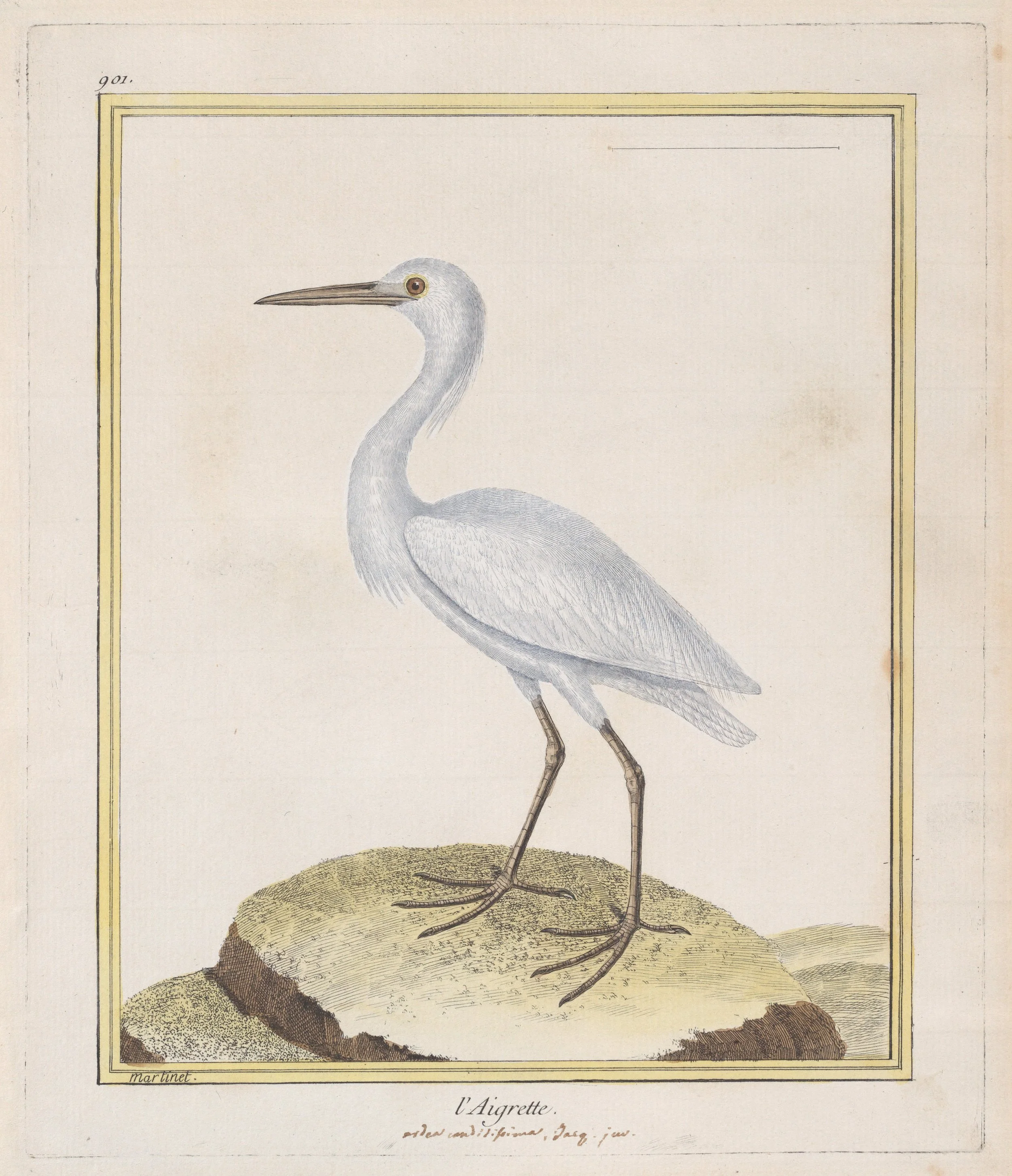
L'Aigrette (Egret), François Nicolas Martinet, 1770 to 1786, hand-coloured etching and engraving. The egret is Syme's natural reference for Yellowish White
Image Credit: The Metropolitan Museum of Art (public domain)
Goethe: White in Relationship
A natural white viewed in natural light never stays the same white all day. It is alive and changing. The soft honeyed glow of morning warms its tone; as the light cools through the day, so does the white. Dusk, a grey sky, a north or south facing window, each one alters it.
This is what Goethe grasped in his study of colour. He described white as the most active of the achromatic tones and argued that colour only exists in relationship: between light, the natural world and the eye that sees it. A natural white is never fixed. It breathes.
White as Default
Stand in front of a white hospital wall and there is a kind of openness, a blank canvas, a state of possibility. But there is also a sterility. Nothing to hold onto. No sense of connection.
For me the difference between the many-whited egg and the hospital wall is one of connection. The egg holds a biophilic pull, a thread back to the living world and within it a sophistication of tone that shifts and breathes. The commercial white of the wall, however much light may cross it, remains a single manufactured shade, harsher, flatter, connected to nothing.
We might assume hospitals turned white because white is somehow more hygienic. But the colour itself holds no special power to keep a surface clean. White was chosen because it showed the dirt, making any lapse in cleanliness visible and because it carried the look of science, modernity and order, the so-called white heat of the modern age. The hygiene lay in the cleaning, not the colour. White was the sign of cleanliness rather than its source, chosen for what it signalled and for the system that displayed it, more than for the person in the bed.
And the white of the hospital wall will almost certainly not have been chosen to reflect any natural environment or experience. Its position, the direction of the light it would catch, the artificial light falling on it after dark, none of this is likely to have been considered. It is white applied as a default, rather than white as a considered choice.
White as a Considered Choice
None of this is to say that white has no place in healing spaces. White can work and beautifully, when the particular white or whites, are consciously chosen: selected for the feeling they create in the patient, the visitor, the family, the member of staff. So that people can connect to them, recognising, even without naming it, the feeling we carry from our experience of white in nature. Biophilic design can help in this, but the heart of it is simpler. It comes down to time, attention and connection.
There is such care, for instance, in Maggie's Aberdeen, the cancer caring centre designed by Snøhetta and opened in 2013. Shaped like a white pebble or shell, its soft white concrete outer form curves over a warm timber interior, a natural shape and a natural material that catch the light differently through the day and across its spaces, just as a stone on a beach would. It makes me feel soothed, cared for. There is a purity to it and an openness to new possibility, that a sterile, artificially lit space could never offer.
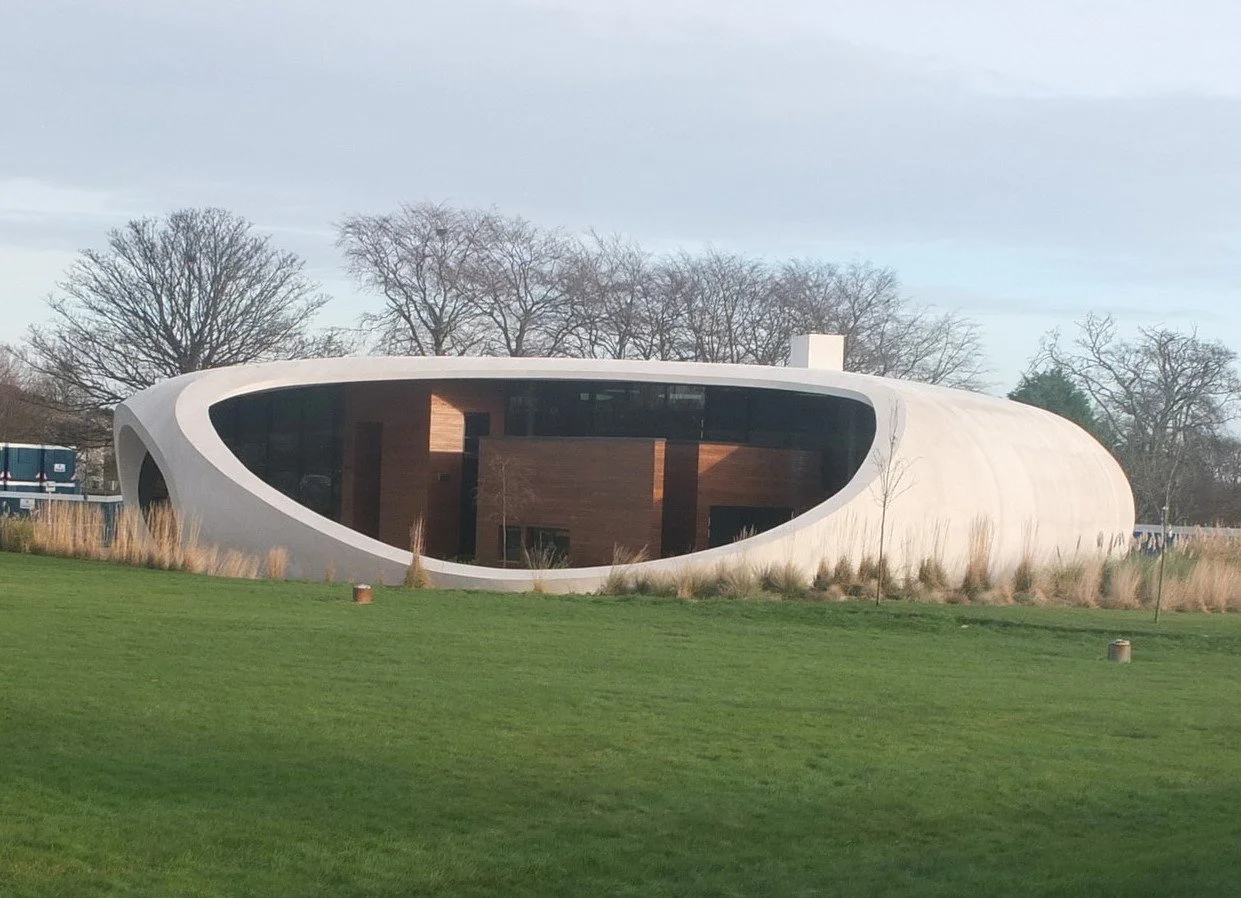
Maggie's Centre, Aberdeen Royal Infirmary, designed by Snøhetta, 2013
Image Credit: Wikimedia Commons - Bill Harrison / CC BY-SA 2.0
The Whites That Restore Us
White is never just white.
It is snow and snowdrop and hawthorn blossom. It is the egg warm in the hand, the gull's breast, the hag-stone worn smooth by the sea. It is the inside of a shell and the white moth at dusk. Each one different. Each one a thread back to something living.
To notice these whites, to gather them, to hold them side by side and see how they differ, is to be connected and to be still. The mind quietens. The world comes closer.
This is what the natural world offers and what no unconsidered wall can. Not white chosen merely to look clean, but the white of the living world, consciously drawn upon, which asks us only to pay attention and gives us, in return, a quiet mind.
References
Bates, V. L. (2023). 'Cold White of Day: White, Colour, and Materiality in the Twentieth-Century British Hospital.' Twentieth Century British History, 34(1), 1–37.
Bates, V. L. (2025). Feeling Blue: Colour and the Modern British Hospital. Manchester: Manchester University Press.
Birren, F. (1950). Color Psychology and Color Therapy. New York: McGraw-Hill.
Calvo Ivanovic, I. (2018). 'Symbolic Color Associations in Goethe's Farbenlehre.' Cultura e Scienza del Colore, 9.
Goethe, J. W. von (1810). Zur Farbenlehre. Tübingen: Cotta.
Horniman Museum and Gardens. 'Hag-stones and Lucky Charms.' horniman.ac.uk.
Kaplan, R. & Kaplan, S. (1989). The Experience of Nature: A Psychological Perspective. Cambridge: Cambridge University Press.
Kisacky, J. (2017). Rise of the Modern Hospital: An Architectural History of Health and Healing, 1870–1940. Pittsburgh: University of Pittsburgh Press.
Palmer, S. E. & Schloss, K. B. (2010). 'An Ecological Valence Theory of Human Color Preferences.' Proceedings of the National Academy of Sciences, 107(19).
Pastoureau, M. (2019). White: The History of a Color. Princeton: Princeton University Press.
Sullivan, H. I. (2017). 'Goethe's Colors: Revolutionary Optics and the Anthropocene.' Eighteenth-Century Studies, 51(1).
Syme, P. (1821). Werner's Nomenclature of Colours, 2nd ed. Edinburgh: William Blackwood.
Images
Figure 1 (Whites plate): https://publicdomainreview.org/collection/werner-s-nomenclature-of-colours-1814/
Figure 2 (Whites necklace): Dawn Weller Studio.
Figure 3 (Egret): https://commons.wikimedia.org/wiki/File:L%27Aigrette_(Egret)_Met_DP887749.jpg
Figure 4 (Maggie's Aberdeen): https://commons.wikimedia.org/wiki/File:Maggies_Centre,_Aberdeen_Royal_Infirmary_(geograph_4277045).jpg

_Met_DP887749.jpg)
.jpg)