

Effacing Presence, Efficacious Absence
“Yet my heart is sweet with the memory of the first fresh jasmines that filled my hands when I was a child”
Rabindranath Tagore (excerpt from “The First Jasmines”)
In Rabindranath Tagore’s poem, The First Jasmines, a handful of white flowers become a carrier of memories. Their fragrance carries the poet back to his childhood. Tagore contrasts life’s later joys, such as festivals and relationships, with the lasting, sweet memory of holding white jasmines as a child. He expresses this contrast through the image of the bakula flower, “I have worn 'round my neck the evening wreath of bakulas woven by the hand of love. Yet my heart is still sweet with the memory of the first fresh jasmines that filled my hands when I was a child.” Unlike most flowers that lose their scent after wilting, bakula flowers retain their rich, woody aroma for days, even after drying. Yet, for Tagore, this longevity or a metaphor for the joys of adult life yields to the foundational sweetness of childhood’s fresh white jasmines.
The colour white occupies a curious place in human consciousness, especially within Indian society. It comes to represent the maturity of the bakula as well as the innocence of jasmine. It appears in food and flowers, in rituals and architecture, in mourning and celebration. It adorns saints, revolutionaries, widows, brides, politicians and gods. Sometimes it signifies detachment from the world; elsewhere it becomes the colour of love, prosperity or divine illumination. It is at once the colour that seems to contain nothing and the colour that appears to contain everything. This paradox extends beyond symbolism into the very nature of the colour itself. Is white the absence of colour? Or the harmonious union of all colours? Perhaps, this ambiguity is precisely what makes white so powerful. Its meaning is never fixed. Instead, it shifts according to the material that bears it, the culture that interprets it and the philosophical lens through which it is viewed.
Language offers one medium through which we can interpret the mutable quality of the white. Classical Sanskrit possesses no single definitive word for white. More than fifty words exist, each describing a different white and used in different contexts. There is śukla, a radiant white; dhavala, a glaring white; śubhra, a shimmering white; kṣīra, milky white; avadāta, washed white; sītā, a cool white; pāṇḍu, a pale yellowish white; muktatva, pearl white and many more.
These distinctions allow us to understand white not as a static colour but as an experience. Here, white is not just visual but relational. Its significance emerges from the object that bears it, the space it inhabits and the moment in which it is encountered. What appears to be the simplest of colours thus becomes remarkably multifaceted, offering a lens through which to explore the complexity of Indian cultural experience. Colour cannot be understood in isolation from the material world. Housing diverse cultures, India is a deeply materialistic society; material objects have long been valued not merely for what they are, but for the qualities believed to reside within them. The Sāṅkhya Philosophy, one of the oldest Hindu philosophical schools of thought, offers a way to understand the relationship between human experience and matter.
According to Sāṅkhya, reality is composed of two independent, eternal principles: Purusa, pure inactive consciousness and Prakriti, primordial nature or inert matter. The cosmos evolves out of the union of the Purusa and Prakriti. Prakriti, in turn, is composed of three gunas or fundamental qualities that shape all physical and mental phenomena. These gunas: Sattva (pure and light), Rajas (passion and energy), Tamas (darkness and inertia) define all that is made of matter and have a significant effect on the physical, emotional and spiritual condition of the object as well as the one who engages with it. Interestingly, these three gunas are associated with white, red and black respectively, a chromatic triad that forms one of the oldest colour palettes in Indian art and remains central to many Hindu ritual practices.
Ayurveda, an Indian holistic system for wellbeing, further elaborates on how these materials are to be consumed and by whom. Ayurvedic prescriptions revolve around the belief that a person seeking to achieve a certain state of consciousness needs to alter the materials they come into contact with. In Sāṅkhya, the goal is not to eliminate Rajas and Tamas, as a physical body needs Tamas to sleep and Rajas to move. Instead, the goal is to cultivate Sattva, which calms the mind and prepares it for spiritual insight. These beliefs are intertwined with another important system of thought that views the physical body through the interplay of heat and coolness. The frequent pairing of white and red in Indian rituals reflects these complementary forces. Red signifies heat, vitality and the generative impulses necessary for sustaining life, while white embodies coolness, balance and restraint. Together, they represent the cyclical processes that govern human existence. If heat enables action and fulfilment in the material world, cooling provides the balance necessary for introspection, spiritual discipline and inner growth. White coloured food associated with Sattvic guna, therefore, is consumed as a coolant, especially during ritualistic fasting.
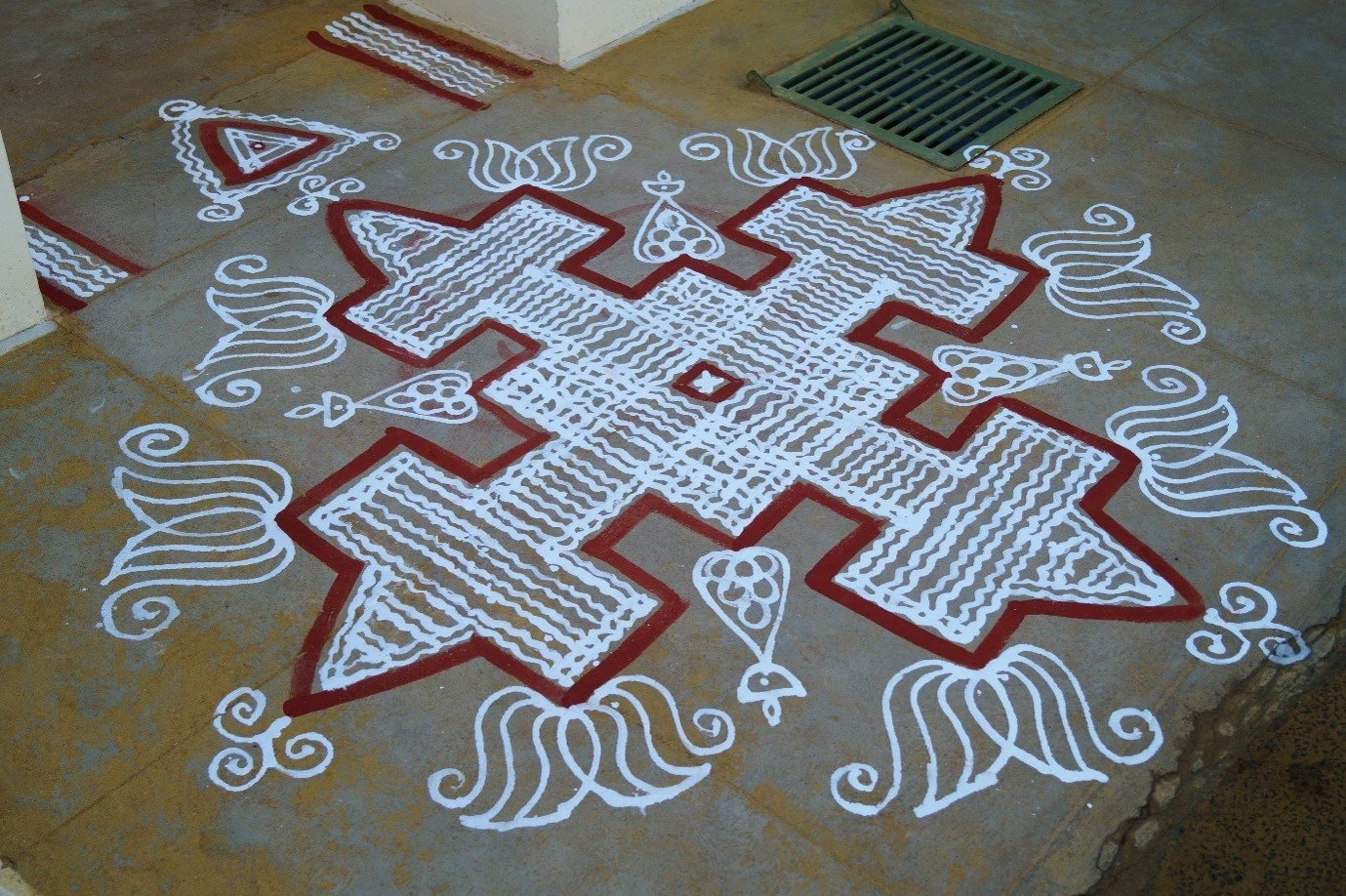
Traditional kolam made with rice flour and kaavi borders
Image Credit: Wikimedia Commons
For instance, on the day of Sharad Poonam or the full-moon night that marks the onset of winter, families gather on terraces and in courtyards to share white coloured foods such as doodh poha (milk-soaked flattened rice), kheer (sweet rice porridge) and curd beneath the moonlight. According to traditional belief, the transitional season can aggravate the body’s heat and the consumption of cooling foods is considered an effective remedy to balance the body. The moon itself is considered to radiate Amrita or divine nectar, which cleanses the body and soul.
After months of prolonged Indian summer and monsoon, the onset of winter signifies the cooling of activity and time for spiritual reflection. Many festivals are celebrated during this period. This cooling phase of the earth is announced by the blossoming of white flowers, especially in the months of October and November. Though small in size, these flowers release a powerful fragrance that lingers in the evening air. Among them, the Parijat or Shiuli has long captivated poets and storytellers, who invoke it as a symbol of longing, devotion and remembrance. Blooming at night and falling to the ground by dawn, it embodies the fleeting nature of life and the surrender of the ego before the divine. Its whiteness is transient, like a cherished memory, appearing suddenly, captivating the senses and vanishing before it can be fully grasped.
Beyond food and flowers, cloth is another medium through which white is experienced in the Indian culture. White garments occupy an important place in ritual life across religious traditions. Sufi saints wear white robes as symbols of the death of the ego and rebirth in divine love. White skullcaps worn by Muslim men during namaz signify physical and spiritual purity. Among Zoroastrians, the white cotton sudreh and woollen kusti, received during initiation, serve as daily reminders of faith and spiritual protection. Similarly, the Shvetambara (white-clad) sect of Jainism wears simple white, unstitched garments as an expression of ahimsa, or non-violence. Across these traditions, white cloth functions not just as attire but as an expression of spiritual discipline.
Clothes are considered to be the second skin of the body. Medieval Indian dyer manuals highlight the interrelation between colour production and medicines. Dyes or pigments put on cloth were considered to be absorbed by the skin and have an effect on the wearer. Hence, white or undyed cloth came to be considered as the most pure and uncontaminated in its most natural form and hence suitable for spiritual practice. However, white is not just a colour of detachment. Although it is popularly believed that white is a colour of mourning and not preferred for Hindu brides, white sarees are a staple tradition in many Indian cultures, such as Kasavu sarees of Kerala, worn during auspicious occasions. While mourning and happiness might seem to be contradictions, in essence, both derive from the notion of purity represented by the colour.
Similarly, in contrast to ascetism, white is also a signifier of kingship, often used to equate kingship to divinity. The Śilparatna, a 16th century treatise on Indian painting and sculpture, likewise recommends white paint for both divine beings and esteemed rulers. Mughal hagiographers often mention Mughal emperors, particularly Akbar, who frequently appeared in court dressed in white jama robes. The pale fabric caught and reflected light, producing a subtle radiance that distinguished the emperor from those around him. Here, whiteness was not merely a sign of purity but carefully transformed the ruler's presence into an image of authority and near-divine grace. Wearing white rather than richly coloured silks, the emperor could be understood as embodying spiritual virtue rather than worldly excess.
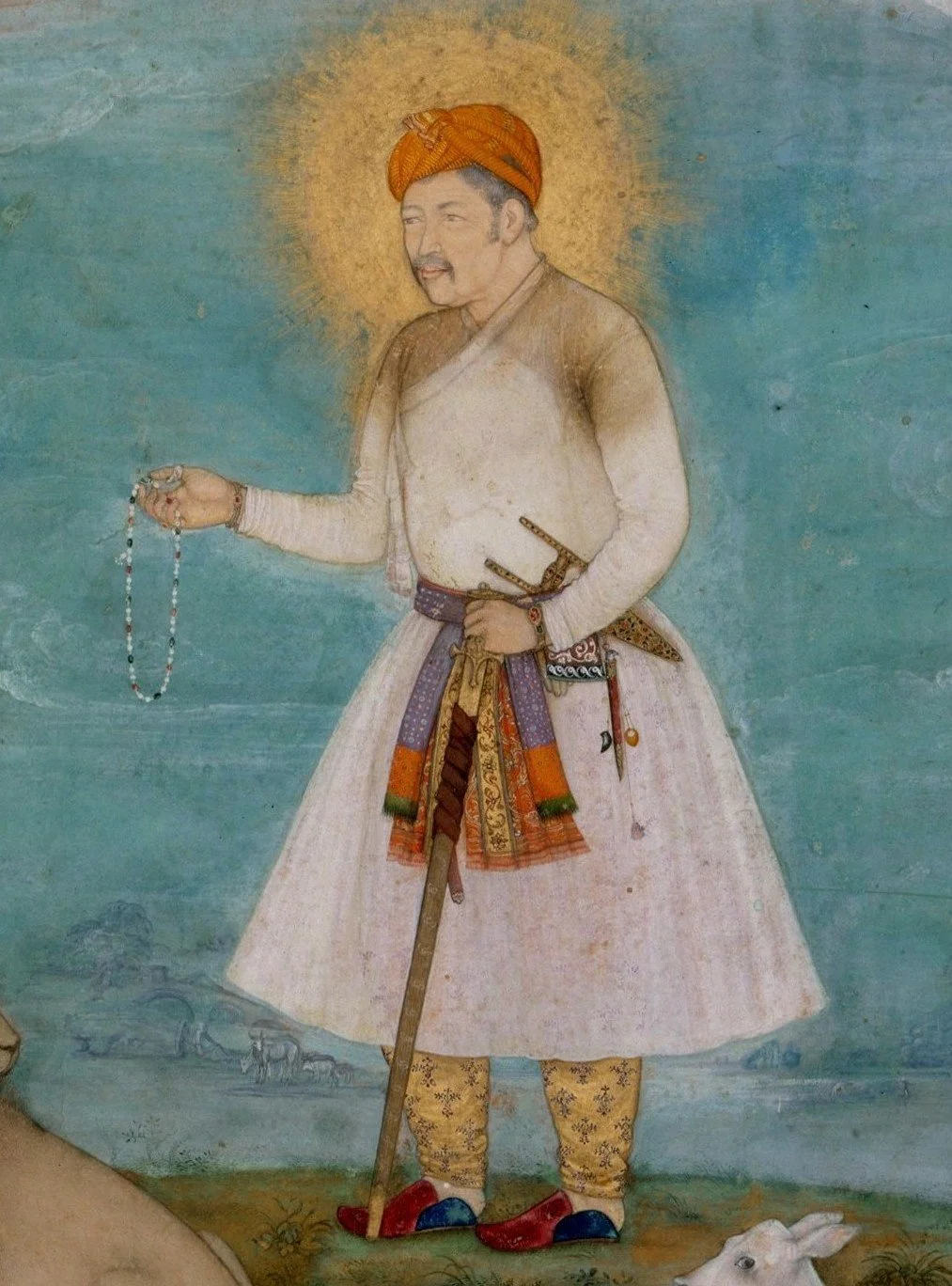
Akbar the Great (r.1556-1605) was the third and an influential Mughal emperor ( Padishah)
Image Credit: Wikimedia Commons
Expanding on this contradiction, in the classical dance of Kerala, Kathakali, Vella Thaddi or a white beard is used to symbolise divinity, popularly used for Lord Hanuman, central to the Ramayana and celebrated for his unwavering devotion to Rama and vow of Brahmacharya (abstinence from sensory pleasures). In contrast, Mohinyattam, another classical dance of Kerala, known as ‘the dance of the enchantress’, derives its name from Mohini, the female avatar of Lord Vishnu who defeated the demon Bhasmasur using her wit and charm. The whiteness of Mohiniyattam radiates the celestial beauty of Mohini, enchanting the audience with rhythmic motions and grace. Here, the colour of abstinence also becomes the colour of enchantment.
The Natyashastra, a classical Sanskrit text on Indian aesthetics, mentions nine rasas or aesthetic emotions that constitute the essence of artistic experience. Each rasa is denoted by a colour. The ninth rasa, Shanta rasa or the emotion of tranquillity, is represented by white. Interestingly, Hasya rasa or the emotion of merriment, is also denoted by white. According to Abhinavagupta, a 10th century philosopher and aesthetician’s commentary on Natyashashtra, aesthetic enjoyment is a transcendent spiritual experience which allows the spectator to temporarily experience the blissful, innate nature of the true Self. He firmly established Shanta as the ultimate emotional state and the goal of all artistic expression. Hasya is not just an emotion of comedy or laughter; it is also joy and true joy can only be achieved when the spectator is in an unburdened, peaceful state or Shanta. Abhinavagupta also linked Shanta rasa to Moksha or liberation. He described Shanta as the calm ocean, while the other eight rasas as the waves that rise and eventually dissolve back into it. The integration of all rasas into Shanta bears similarity to the convergence of all colours to form white light.
As white gradually detaches itself from its form or material, it begins to acquire an abstract life. Indian art and architecture have long explored these intangible dimensions of colour. At a practical level, white has often been used as a limestone wash to keep houses cool during the summer months. White marble is another fascinating material, known for its cooling properties and finesse. Jain derasars or temples, are constructed in white marble for both practical and spiritual reasons. The stone's pale surface allows worshippers to notice even the smallest living creatures beneath their feet, reflecting the Jain commitment to ahimsa.
The relationship between white as a reflecting surface finds its expression in the Taj Mahal. Built as a mausoleum for Mumtaz Mahal by Emperor Shah Jahan, the Taj Mahal appears to change its colour throughout the day due to its pure white Makrana Marble, which is a translucent white marble sourced from Rajasthan. This specific type allows light to penetrate its surface, which creates a luminous, glowing effect as lighting conditions naturally shift.
Philosophically, like a pure mind, the Taj Mahal’s marble allows the world around, light and shadows to cast a temporary effect on its surface, yet the structure beneath remains unchanged. Similarly, the colour white acts like a mirror, able to reflect the entire range of human emotion, from joyful memories to quite melancholy.
In this sense, white becomes the colour of balance, a still centre which radiates a quiet luminosity. Goddess Saraswati, the embodiment of wisdom and the arts, is often depicted seated upon a white lotus, clothed in simple white garments. Sarswati’s whiteness signals the illumination of wisdom, which allows one to see things as they truly are.
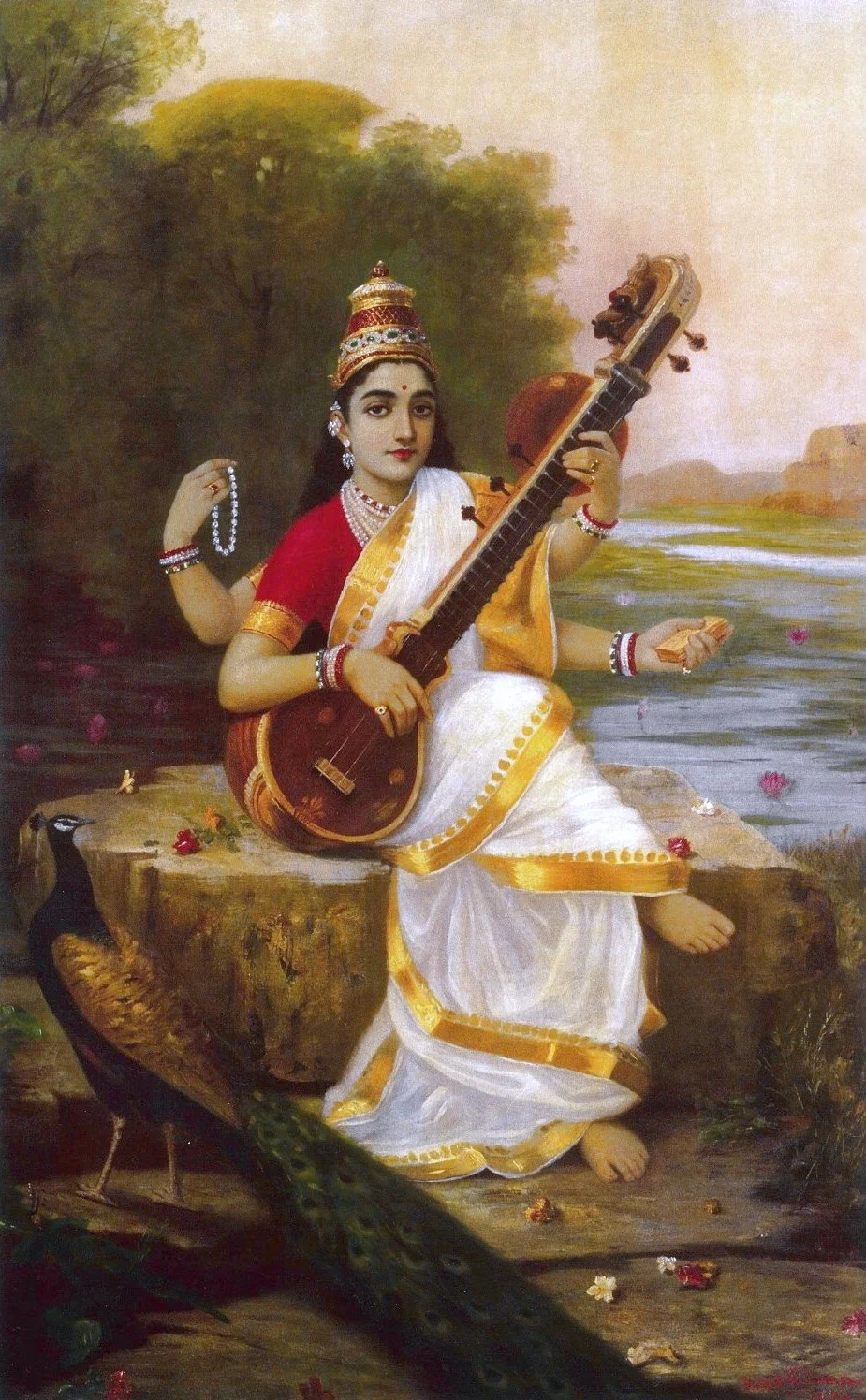
“Goddess Saraswati”, 1896, Raja Ravi Varma, oil on canvas, Maharaja Fateh Singh Museum, Lakshmi Vilas Palace, Vadodara, Gujarat
Image Credit: Wikimedia Commons
A similar symbolism appears in Sita Tara or White Tara, a beloved goddess in Himalayan Buddhism. Apart from removing obstacles from a devotee’s path, she is also known to have utmost compassion, seeing all and imparting healing to ease suffering impartially.
In the classic epic romance of Nala and Damyanti, the Hamsa or a white swan, serves as a pivotal divine messenger and the ultimate catalyst for their love story. The swan acts as a messenger and, using its intellect, makes the two protagonists fall in love. Beyond its narrative role as an otherworldly matchmaker, the Hamsa embodies the philosophical concept of Viveka, spiritual discernment. According to a popular belief, the Hamsa possesses the ability to separate milk from water, extracting the essence while leaving behind what is unnecessary. Unlike the whiteness of a pigment, the whiteness of the Hamsa is not rooted primarily in material qualities. It emerges as a metaphor for discernment itself.
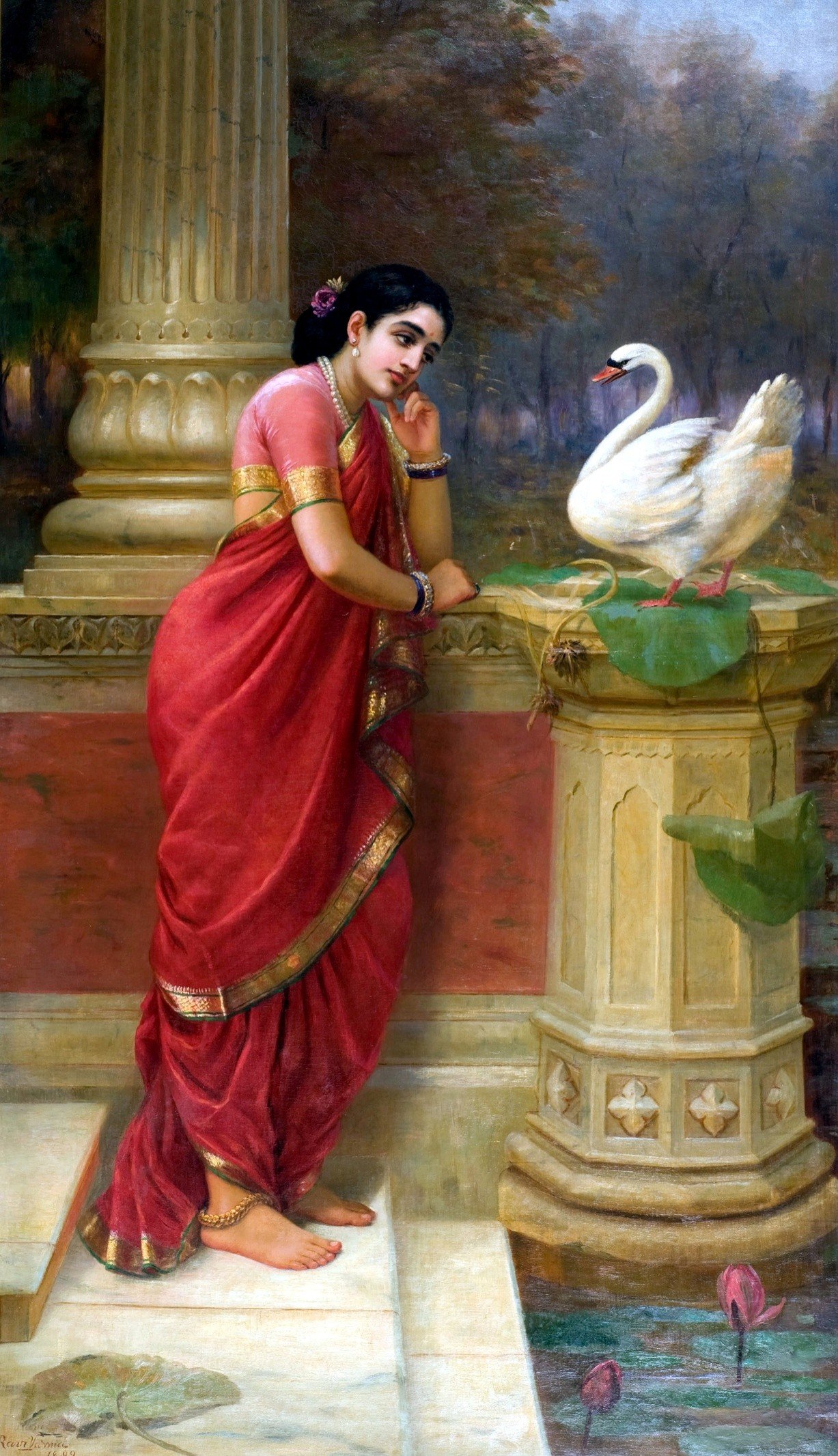
“Hamsa Damyanti”, 1899, Raja Ravi Varma, oil on canvas, Sree Chitra Art Gallery
Image Credit: Wikimedia Commons
In the 20th century, to counter British colonisation of India, M. K Gandhi employed white as a symbol of not just revolution but Satyagraha, the pursuit of truth. Gandhi’s demeanour can be considered anti-aesthetic to some extent. For him, the ideal aesthetic was of an ascetic. His philosophy revolved around the search for the eternal truth, uncontaminated, formless and pure. Gandhi envisioned the highest aesthetic as one in which the outward form mirrors the inward truth. White for him embodied the soul of the nationalist struggle because it rejected excess, only accepting the essential.
Khadi and salt became two of the most powerful expressions of this ideal. Hand-spun, undyed khadi encouraged economic self-reliance while dissolving visible markers of social hierarchy, uniting a diverse population around a common cause. Salt, similarly, was both ordinary and indispensable. By opposing the British salt tax and encouraging Indians to produce their own salt, Gandhi challenged not only colonial authority but also an economic system driven by extraction and industrial excess. Bapuji, a 1930 linocut by Nandalal Bose, depicts Gandhi as a white line emerging from darkness. The silhouette of Gandhi emerges in restraining the dark surroundings. By retaining only what is essential, the figure of Gandhi appears.
Post independence, mimicking Gandhian philosophy, Indian politicians adopted the white dress. However, this white was bleached, hiding the selfish interests and megalomania. Though this performance still continues today, it can be argued that the white dress of a politician no longer signifies Satyagraha. Why so? Because white requires maintenance and self-discipline. It is a colour which reveals stains. Precisely, as both Khadi and Salt required sacrifice and labour, the whiteness of both resonated with meaning, leading to impact.
White makes us feel uncomfortable, because it not just reveals but reflects. In an age saturated with colour and constant visual stimulation, the selection of Cloud Dancer as the colour of the year for 2026 was met with scepticism by many Indian critics. Dismissed by some as sterile and emblematic of a Western minimalist aesthetic, the shade was accused of favouring blankness over the rich chromatic diversity that characterises Indian visual culture. Yet such criticisms raise a deeper question. Does white truly reject colour or does it challenge our understanding of what purity can mean?
Purity is believed to be a rejection, an absolute state of flawlessness. However, the striking figure of the Aghori at the edge of the cremation grounds challenges our notion of purity.
The Aghoris, Shaivite ascetics, reject traditional societal norms to achieve spiritual liberation. They cover their body with ash as a reminder of the impermanence of matter. To many, the cremation ground represents impurity, a place where the boundaries between life and death become uncomfortably visible. Yet for the Aghori, ash is among the purest substances imaginable.
This apparent contradiction reveals a deeper understanding of purity. The ash is not pure because it is untouched. It is pure because nothing remains to corrupt it. Fire has consumed all distinctions of beauty, status, wealth and identity. What remains is matter in its most truthful state. It can neither decay nor transform further. The ash possesses no ambition, no attachment, no illusion of permanence.
To understand the colour white, we can take the analogy of a lotus. A lotus does not bloom in pristine water. Remove the mud, and the flower cannot survive. The lotus neither denies nor absorbs its environment. Instead, it draws nourishment from it while remaining unattached to it. Similarly, whiteness is active rather than passive. In Indian imagination, white has absorbed several meanings, sometimes contradictory. Like a mirror, it receives meanings and reflects them, but with discernment. It can be an absence but not empty, as well as a presence but without a persona. Maybe, its ability to discern makes it pure, knowing when to resist and when to assimilate.
Bibliography:
Balram, S. (1996) The Power of Representation: Krishna to Gandhi, India International Centre Quarterly, 23(2), pp. 6–29. Available at: http://www.jstor.com/stable/23004647 (Accessed: 19 May 2026).
Bean, S. (1989) Gandhi and Khadi, the Fabric of Indian Independence, in Weiner, A.B. and Schneider, J. (eds.) Cloth and the Human Experience. Washington: Smithsonian Institution Press, pp. 355–376.
Beck, B.E. (1969) Colour and Heat in South Indian Ritual, Man, 4(4), pp. 553–572. Available at: https://www.jstor.com/stable/2798195 (Accessed: 19 May 2026).
Chakrabarty, D. (1999) Clothing the Political Man: A Reading of the Use of Khadi/White in Indian Public Life, Journal of Human Values, 5(1), pp. 3–13. doi: 10.1177/097168589900500102.
Chishti, Rta Kapur. 2010. “Iconography” Saris of India: Tradition and Beyond, 160-165. New Delhi: Roli Books
Cohn, B. (1989) Cloth, Clothes and Colonialism in India, in Weiner, A.B. and Schneider, J. (eds.) Cloth and the Human Experience. Washington: Smithsonian Institution Press, pp. 303–353.
Eaton, N. (2013) Swadeshi Color: Artistic Production and Indian Nationalism, ca 1905–ca. 1947, The Art Bulletin, 95(4), pp. 623–641. Available at: https://www.jstor.com/stable/43188857 (Accessed: 19 May 2026).
Houghtelling, Sylvia. 2020, “Dyeing Springtime: The Art and Poetry of Fleeting Textile Colors in Medieval and Early Modern South Asia” Religions, 11, no. 12: 1-30 https://doi.org/10.3390/rel11120627
Jha, S. (2016) From Sacred to Commodity and Beyond: Colour and Values in India, Journal of Human Values, 22(1), pp. 1–13. doi: 10.1177/0971685815608045.
Jha, S. (2022) Floating Words and the Aesthetics of the Visual Vernacular: Political Culture in Contemporary India, Journal of Human Values, 28(2), pp. 143–160. doi: 10.1177/09716858221079005.
Lally, J. (2019) Colour as Commodity: Colonialism and the Sensory Worlds of South Asia, Third Text Forum Online. Available at: www.thirdtext.org/lally-colourascommodity (Accessed: 19 May 2026).
Marian Sawer (2007) Wearing your Politics on your Sleeve: The Role of Political Colours in Social Movements, Social Movement Studies: Journal of Social, Cultural and Political Protest, 6:1, 39-56, DOI:10.1080/14742830701251294
Mukerjee, R. (1965) "Rasas" as Springs of Art in Indian Aesthetics, The Journal of Aesthetics and Art Criticism, 24(1), pp. 91–96. doi: 10.2307/428251.
Mohan, Urmila. Clothing as Devotion in Contemporary Hinduism. Netherlands: Brill. 2019
Tridip, S. (2016) Toward a Gandhian Aesthetics: The Poetics of Surrender and the Art of Brahmacharya, in Chakrabarti, A. (ed.) The Bloomsbury Research Handbook of Indian Aesthetics and the Philosophy of Art. London: Bloomsbury Publishing PLC, pp. 373–386.
Agarwal, S. (2025). The emperor’s new clothes: How the Mughals fashioned a distinct identity. Scroll.in. Retrieved from https://scroll.in
Images
https://commons.wikimedia.org/wiki/File:Traditional_kolam.jpg
https://commons.wikimedia.org/wiki/File:Saraswati.jpg
Cover Image
https://commons.wikimedia.org/wiki/File:Two_kinds_of_rice_flour.jpg


.jpg)


