BLACKS
There is something magnetic about black. It draws us in, makes us feel more powerful, more sure of ourselves and at the same time frightens us with its hidden depth. Black is death, mourning, impending doom as much as it is mystery, strength, authority and protection, the dark that keeps its secrets close.
Black in the Living World
What do you think of when you think of black in nature? I think of a panther, strong, mysterious, powerful, smooth, moving through the darkness as though it were part of it. Then come the crows and ravens: knowing, watchful and a little sinister. They remember faces, hold and pass grudges and gather around their dead.
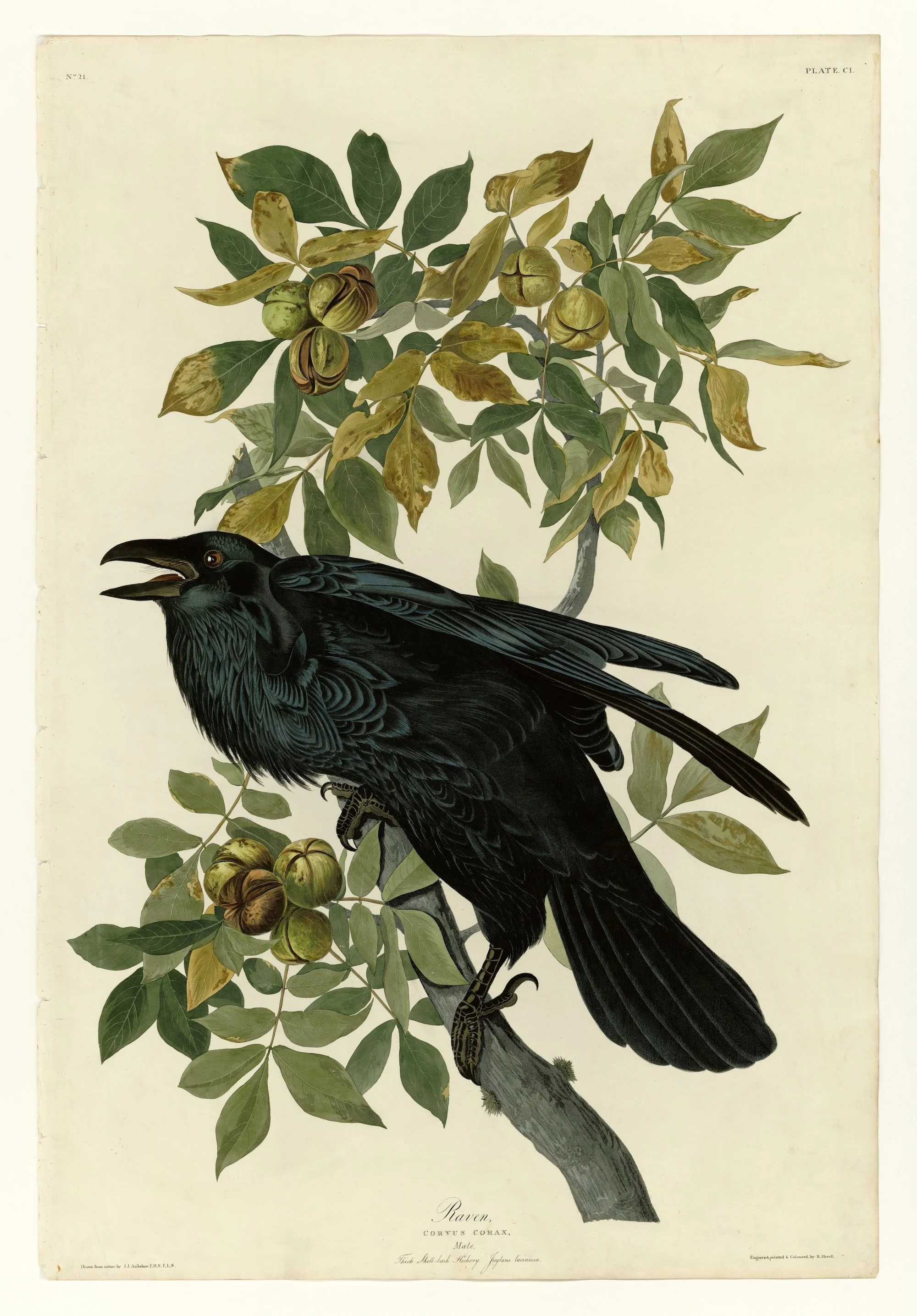
Plate 101 of Birds of America by John James Audubon depicting Raven (between 1827 and 1838)
Image Credit: John James Audubon, Public domain, via Wikimedia Commons
And then the deadly nightshade, beautiful, glossy and so tempting but of course fatal.
Beetles and slugs, ants and spiders, the tail feathers of a blackbird. Coal, basalt, obsidian and jet. Sloes, blackberries and elderberries heavy on the stem. A dark pool in a wood, peat water almost gone to ink. So many beautiful blacks, the list goes on.
In most animals the black is the same thing: melanin, the pigment that darkens a feather, a coat, an eye. The raven wears it, the blackbird, the panther; the living world reaching again and again for the same dark.
Black is also the colour of the odd one out. The black panther is in fact of no species of its own, only a leopard born darker than the rest, a flood of melanin turning its coat to night, the spots still there beneath the black. The black sheep is the same story: a recessive gene throws a dark lamb now and then into a white flock, its wool too dark to take the dye, and so it was worth less, pushed to the edge, and cast in our language as the one who does not belong.
And the melanin that marks them out is not only colour; it is strength. The same dark pigment hardens a feather against wear, shields skin from the sun, even plays its part in fighting infection. The black ones are not only the different ones; they are, quietly, the better armoured, the most striking and rarest.
It is worth remembering that black’s darker meanings are not universal but a particular inheritance. For example, in ancient Egypt, black was the colour of the fertile Nile silt, of life and renewal; in much of the world it is white, not black, that is worn for the dead. The idea of black as death and evil is a largely Western one, learned rather than given.
And I cannot write about that casting of black as the negative without acknowledging the harm it has done to Black people. The same language that made black the colour of death, evil and the outsider was turned, for centuries, against human beings. That is not my history to carry or to speak for. But a piece that tries to see black anew cannot pretend it away, and part of what draws me to this colour is the wish to meet it as what it truly is: not emptiness or lack, but depth, fullness and strength.
We are taught that black is nothing, an absence left when the light goes out. A black surface, the physicists say, swallows the whole spectrum and gives nothing back. But surely if black absorbs every colour, then every colour is in there, held, not lost; the crow’s feather is not empty of colour, it is keeping all of it. Goethe understood something of this when he refused to see colour the way Newton did: for him it was born at the meeting of light and dark, at the charged edge where the two press together. And we only see a true black when there is light in the room; in complete darkness there is no black at all, only a dim, restless grey the eye makes for itself. Black, it turns out, is made by light, and needs light to exist, the way a shadow needs the thing that casts it.
This is why black does what it does to everything beside it. It does not dull its neighbours; it wakes them. The berry looks blacker, yes, but the leaf beside it looks greener. Black is the colour that makes the other colours more themselves.
There is no greater proof of this than a total eclipse. For a few minutes the moon slides a disc of pure black across the sun, and it is only because of that black that we can see what is always there: the corona, the sun’s own light, streaming out around the dark. The birds fall quiet, the air cools, a hush comes over everything.
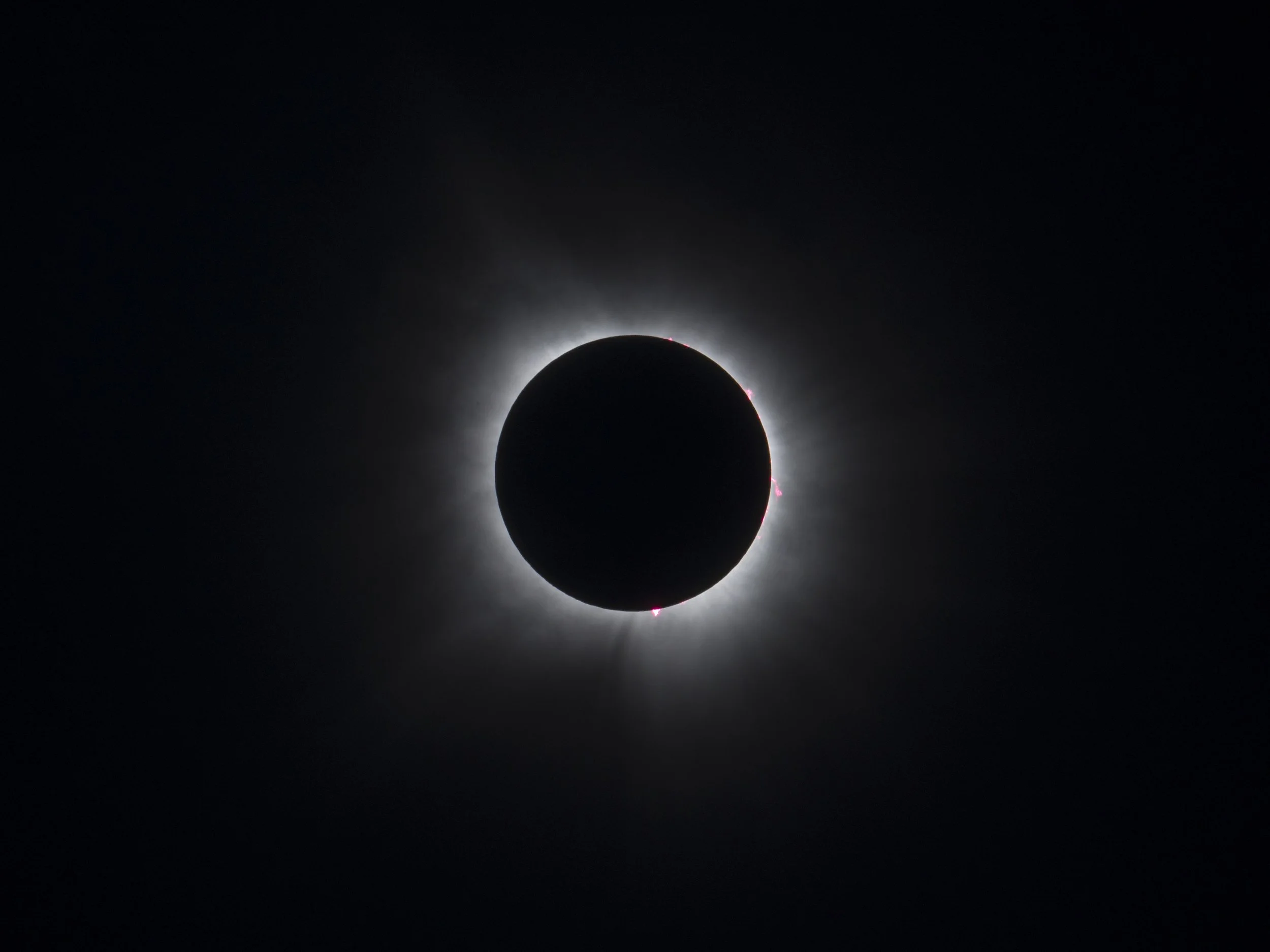
The total solar eclipse of April 8, 2024, as seen in Dallas, Texas
Image Credit: The Modern Polymath, CC BY-SA 4.0, via Wikimedia Commons
Werner’s Blacks
Two hundred years ago, the painter Patrick Syme set out to pinpoint the exact ‘living blacks’. Most of the colour names came from the mineralogist Abraham Gottlob Werner; Syme’s work, in his illustrated edition of 1821, was to match each one to something from the living world, and here and there to add a black of his own. There are seven blacks in the Nomenclature, and reading them you can feel him reaching for a black that was truly black. Greyish Black, from the water ousel and from basalt. Bluish Black, from the largest black slug, the crowberry, black cobalt ochre. Greenish Black, from the breast of the lapwing and from hornblende. Pitch or Brownish Black, from the guillemot and the wing coverts of the black cock. Reddish Black, from the spots on the tiger moth’s wings, the breast of the pochard duck, the berry of the fuchsia. And then, last, the only two that drop the prefix: Ink Black, and Velvet Black.
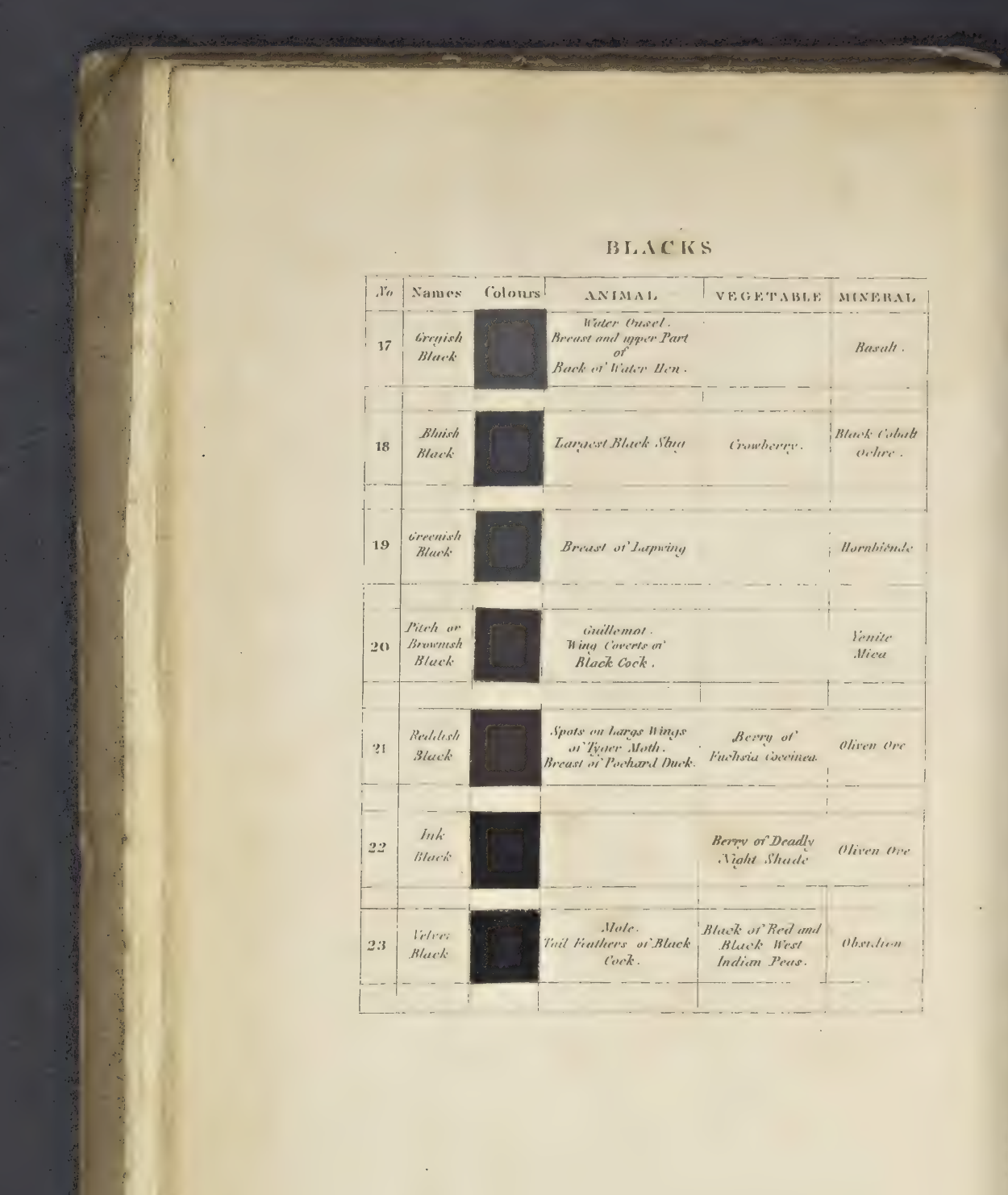
Blacks Colour Plate, Patrick Syme, Werner's nomenclature of colours; Edinburgh: William Blackwood, 1821
Image Credit: Getty Research Institute via Public Domain Review
Two of the seven were Syme’s own, added to Werner’s five: Reddish Black, and Ink Black. For Velvet Black, the deepest and softest on the page, he chose the mole and obsidian, the creature that lives in the dark and the glass made by fire. And for Ink Black, the truest black of all, the one he reached past Werner to name, he could find no animal at all: the animal column simply stops. The one living thing dark enough to stand for pure black was a plant, and the plant was the berry of the deadly nightshade. The single honest black in all of nature, and it is a poison.
Five of the seven blacks are really the darkest versions of grey, blue, green, red and brown. The vegetable column, beside the crowded animal one, keeps falling empty, because the living world simply does not grow much black. Syme was not trying to make a point. He was only matching, as carefully as he could, each shade to the living thing that carried it.
Handling Black
My work is centred around colour, nature and wellbeing, and more often than not for hospitals or healthcare settings. Gathered together, black natural things tip very easily into a wreath, into a symbol of death, and the work is always to make them read as protection instead, something to keep a person safe rather than to grieve them. Handling black feels different from the other colours. More ceremonial. A little secretive, as though what passes through my hands is treasure, and powerful, and not entirely mine to touch. It feels faintly transgressive, and no, I don’t think black would be right for every setting, certainly not a ward. But for a quiet, reflective, healing space? Perhaps exactly right.
Going into the Dark
Black is the colour of the shadow self too, the parts of us we keep in the dark and would rather not turn and look at. So much of healing is having the courage to go into the darkness and really feel those feelings.
We know this in our bodies, even if we never say it. We close our eyes to feel something fully: to meditate, to pray, to sink into a piece of music, to find the single flavour in a mouthful. We shut out the light so everything else can come forward. Darkness is not where the senses fail; it is where they sharpen. Black is the colour we reach for, without being told, whenever we want to feel something more deeply.
And the dark does more than sharpen us; it mends us. We are made to repair in it: the body heals and the mind settles in darkness, which is why a ward lit flat and bright around the clock is a harder place to get well, not a kinder one. Goethe understood darkness not as the mere absence of light but as a force in its own right, the pole that light needs before it can become colour at all. The seed does its work in the black of the soil.
Black and Our Wellbeing
And yet the healing dark is one thing, and black on a wall another. Which is why I would still hesitate to carry black into a hospital. It arrives already carrying too much: mourning, the hearse and the veil, the word we use when someone is in a dark place. On a ward wall, in the eyeline of someone frightened and unwell who did not choose it and cannot leave it, it risks saying the one thing nobody in that bed wants said. Black is not a colour to spread across a place of involuntary recovery.
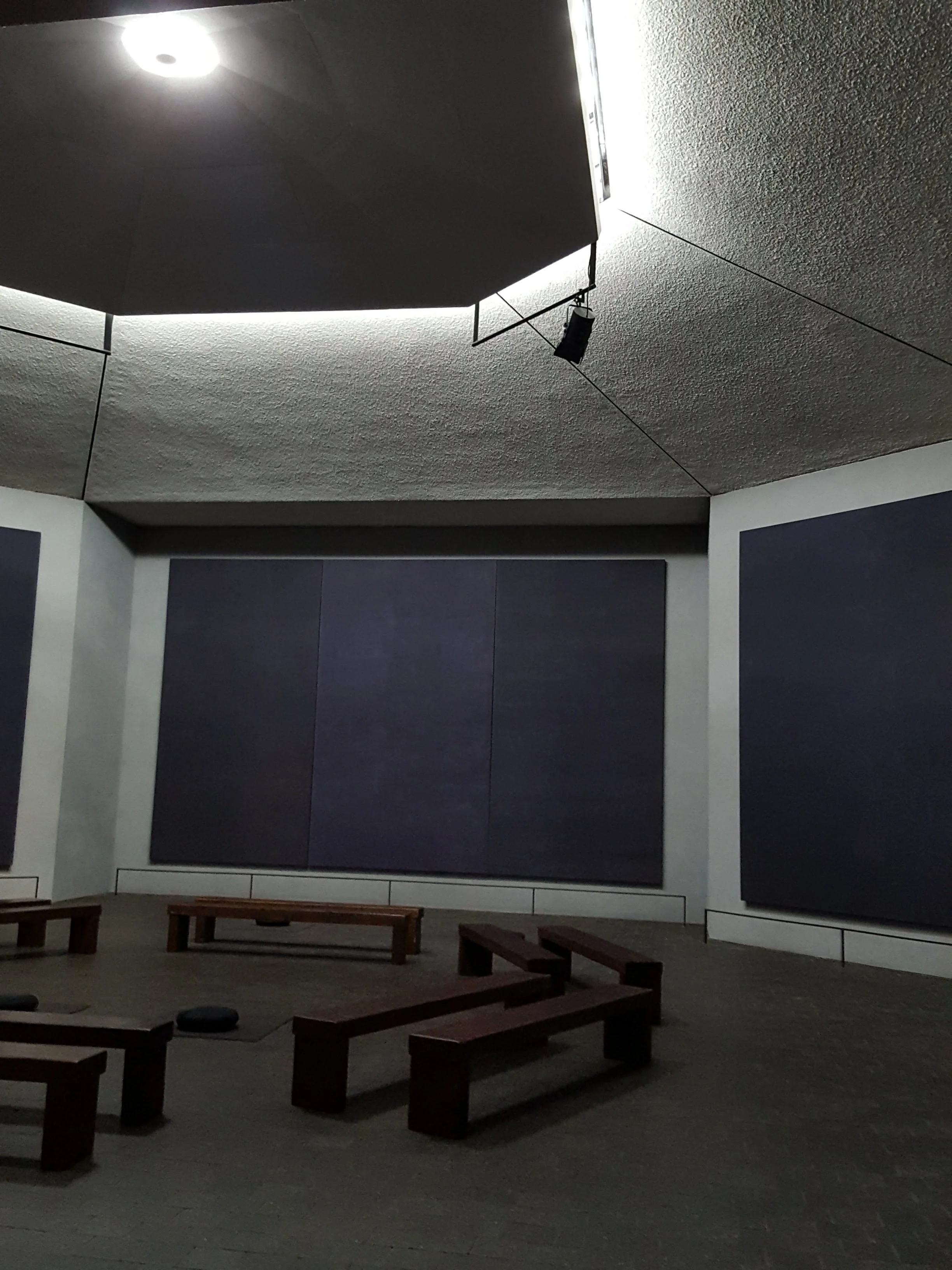
Interior of the Rothko Chapel, 2017
Image Credit: Alan Islas, CC BY-SA 4.0, via Wikimedia Commons
But that is not the same as having no place in our healing at all. The difference is choice. I once practised in a yoga studio with matte black walls and the daylight turned right down, and I have never forgotten how it felt: held, grounded, turned inward and quiet. It was not a room to be lifted in, and never meant to be; the black simply drew the edges in close and let me drop. This is a quiet tradition. Spas, retreat rooms, the dark bathroom run as a sanctuary, often reach for dark and black, because dark tones absorb the light, soften every edge and wrap a room around you. Designers call it cocooning, and paired with natural materials, dark does not read as cold at all, but as the warmest kind of shelter.
There is a more famous version of the same thing. In Houston the Rothko Chapel is an octagonal room hung with vast, near-black canvases, built for people of any faith or none to sit in silence, to grieve, to be still. People travel across the world to sit inside that darkness. Nobody is placed there against their will; they choose to step in, and the black holds them while they do the quiet work they came for.
The Artists of Black
Two other artists who have gone deepest into black tell the same two stories the living world does. David Nash makes his black from wood itself, charring timber with fire until, in his words, the surface turns ‘from a vegetable to a mineral, carbon.’ His Black Dome, a mound of charred larch set into the Forest of Dean, was made to rot slowly back into the ground it came from: not an ending but the forest’s own cycle, fire and growth and return. At the Schönthal sculpture park in Switzerland, two of his charred columns stand among the trees, black and towering against the green, the tree burned and raised up again. His is the living world’s black.
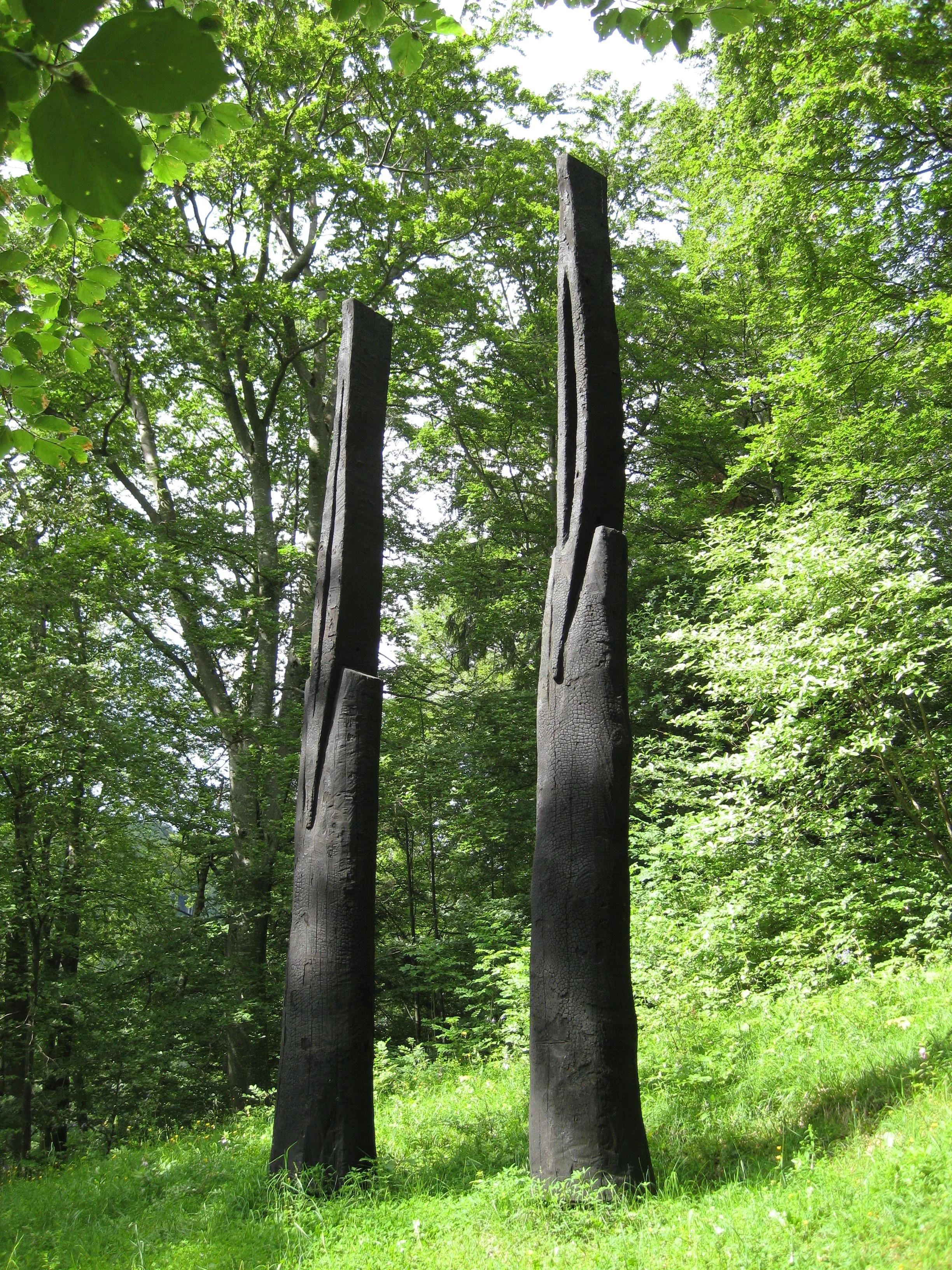
Sculpture at Schoenthal - David Nash, Two Charred Vessels, 1997
Image Credit: Kamahele, CC BY-SA 3.0, via Wikimedia Commons
Pierre Soulages reached for a different dark. He called what he was after outrenoir, beyond-black: not a void but a surface worked into ridges and furrows that catch the light and hand it back, shifting as you move before it. He always said his black was about light, not nature. And yet I would argue nature is there all the same. For sixty years he worked in brou de noix, walnut stain, a black pressed from the husks of a tree, so that even his material came from the living world. Those repetitive, rhythmic reliefs, and the way the light travels across them as you pass, are the very qualities we call biophilic, the ordered patterns and the moving, dappled light we know from water and bark and leaf-shade, the things that quiet the body and settle the mind. Soulages may not have set out to paint nature, but his black does to us what nature does. ‘I don’t paint with black any more,’ he said. ‘I paint with the light reflected off the black surface.’
That, I have come to think, is where black belongs. It grounds us; it does not raise us. It is the colour for the rooms we enter on purpose, to reflect, to be still, to put something down. Imposed on the vulnerable, black is a wreath. Chosen, and made or built with care, it becomes a talisman. And a talisman is a thing you keep close, not to remind you of death, but to keep you safe.
The Dark That Restores Us
So black holds both things at once, the fear and the strength. But the longer I look, the more the fear gives way. The colour I was taught to read as empty turns out to be full, made of light rather than the lack of it. And the dark I keep finding is not death but the place things grow from, the soil before the seed, the rest before healing. Not an ending. Something at its deepest, still alive.
References
Bonser, R. H. C. (1995). ‘Melanin and the abrasion resistance of feathers.’ The Condor, 97(2), 590–591.
Browning, W. D., Ryan, C. O., & Clancy, J. O. (2014). 14 Patterns of Biophilic Design. Terrapin Bright Green.
Fox, J. (2021). The World According to Colour: A Cultural History. Allen Lane.
Goethe, J. W. von (1840). Theory of Colours (C. L. Eastlake, Trans.). John Murray. (Original work published 1810.)
Marzluff, J. M., & Angell, T. (2005). In the Company of Crows and Ravens. Yale University Press.
Musée Soulages, Rodez; and Musée du Luxembourg (2024). Soulages, Another Light: The Works on Paper, on outrenoir and brou de noix (walnut stain).
Nash, D., on charring wood, Black Dome and Two Charred Vessels; see Yorkshire Sculpture Park, the Forest of Dean Sculpture Trust, and the Schönthal Foundation (Stiftung Schönthal), Langenbruck.
Pastoureau, M. (2008). Black: The History of a Color. Princeton University Press.
Rothko Chapel, Houston.
Rougeux, N. (2018). Werner’s Nomenclature of Colours, interactive reproduction of the 1821 edition. c82.net/werner.
Royal College of Physicians of Edinburgh.
Syme, P. (1821). Werner’s Nomenclature of Colours. William Blackwood.
Ulrich, R. S., et al. (1991). ‘Stress recovery during exposure to natural and urban environments.’ Journal of Environmental Psychology, 11, 201–230.
Images
Figure 1 (Raven)
https://commons.wikimedia.org/wiki/File:101_Raven.jpg
Figure 2 (Eclipse)
https://commons.wikimedia.org/wiki/File:2024-04-08_Totality.jpg
Figure 3 (Blacks Colour Plate, Werner’s Nomenclature)
https://publicdomainreview.org/collection/werner-s-nomenclature-of-colours-1814/
Figure 4 (Rothko’s Chapel)
https://commons.wikimedia.org/wiki/File:Rothko_chapel_interior.jpg
Figure 5 (David Nash’s Sculpture)
https://commons.wikimedia.org/wiki/File:Sculpture_at_Schoenthal-nash_076.jpg