

Scanning a shoreline for stones of one colour, sorting feathers by the quality of their white, the slow and attentive gathering of natural elements in a single hue is itself a restorative practice.
In this article, the first in a new series exploring colour, nature and wellbeing, I want to unravel the origins of Werner's Nomenclature of Colours and what it reveals about our relationship with the colours of the living world. Most people who encounter it know it as a beautiful and systematic record of the natural world's chromatic palette; 110 tints named, located and cross-referenced across mineral, plant and animal life. Fewer ask what compelled its making or what it might tell us about the relationship between colour, nature and the human mind.
In the articles that follow, I will explore each of the colour groups Werner and Syme documented in turn, looking at how they are experienced psychologically, how they shape our sense of wellbeing and what they might mean for the spaces in which we live, heal and recover.
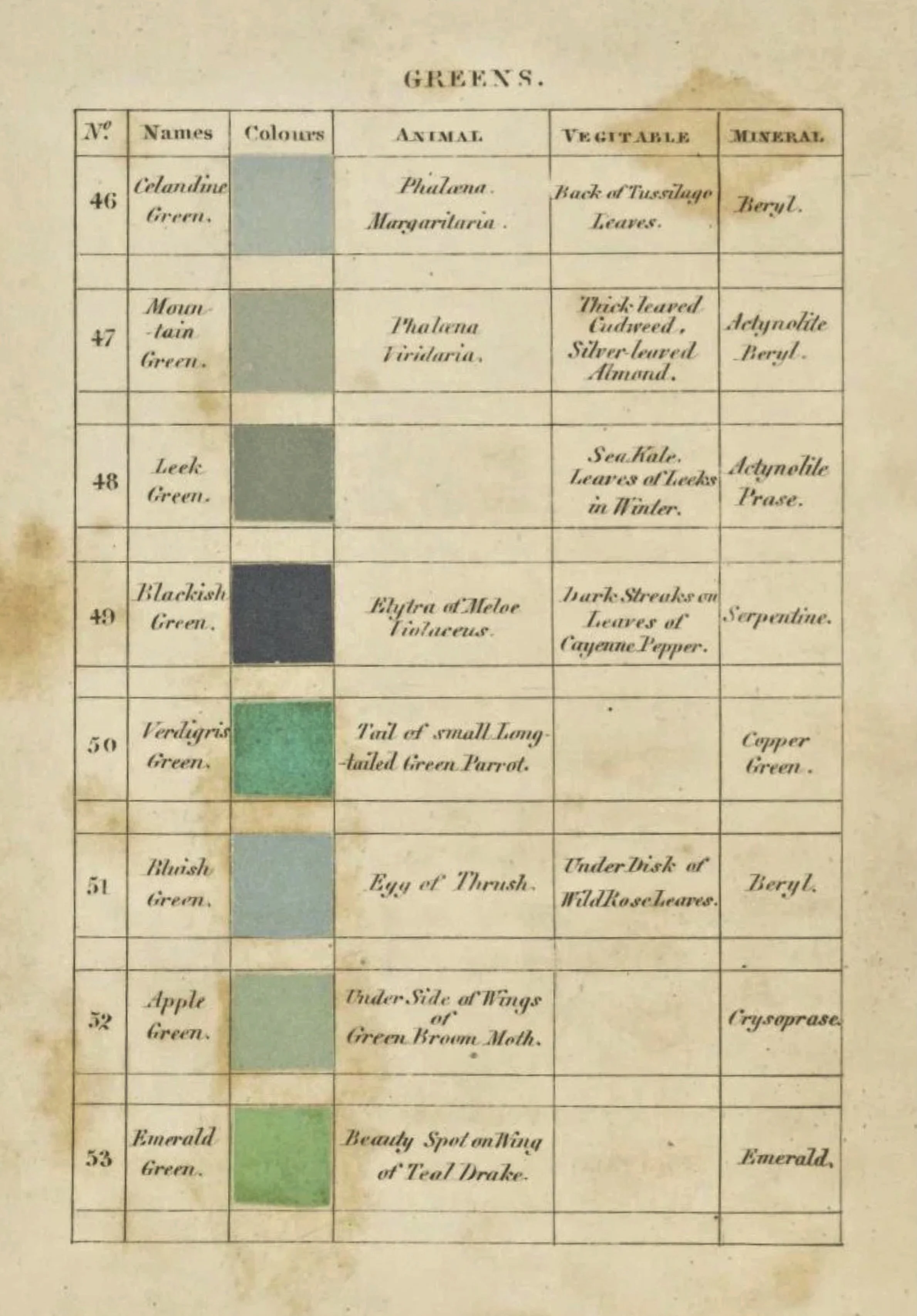
Greens colour plate from Werner's Nomenclature of Colours, 1821 edition, Patrick Syme.
Image Credit: Public Domain Review
Werner's System
It all started with Abraham Gottlob Werner (1749–1817), a German mineralogist and geologist, who devised Von den äußerlichen Kennzeichen der Fossilien (On the External Characteristics of Fossils) in 1774, a comprehensive method for identifying minerals by their external characteristics, as detected by the five human senses. Of those characteristics, he considered colour the most important and listed it first.
His system named fifty-four colours under eight principal groups: white, grey, black, blue, green, yellow, red and brown, each hue associated with something already known: a familiar pigment, a natural phenomenon or where no easy comparison existed, a combination of two colours: carmine red, apple green, greenish grey. There were no oranges or purples.
Werner was sceptical about colour charts in paper form because of their instability and fading. He chose instead to illustrate his nomenclature with a set of actual specimens of minerals and describe how to mix each colour with suggested mineral references. Aurora red, for instance, was a mixture of scarlet red and orange yellow, corresponding to the mineral crocoite. This was the original colour nomenclature that would later be developed and extended to include animal and plant life.
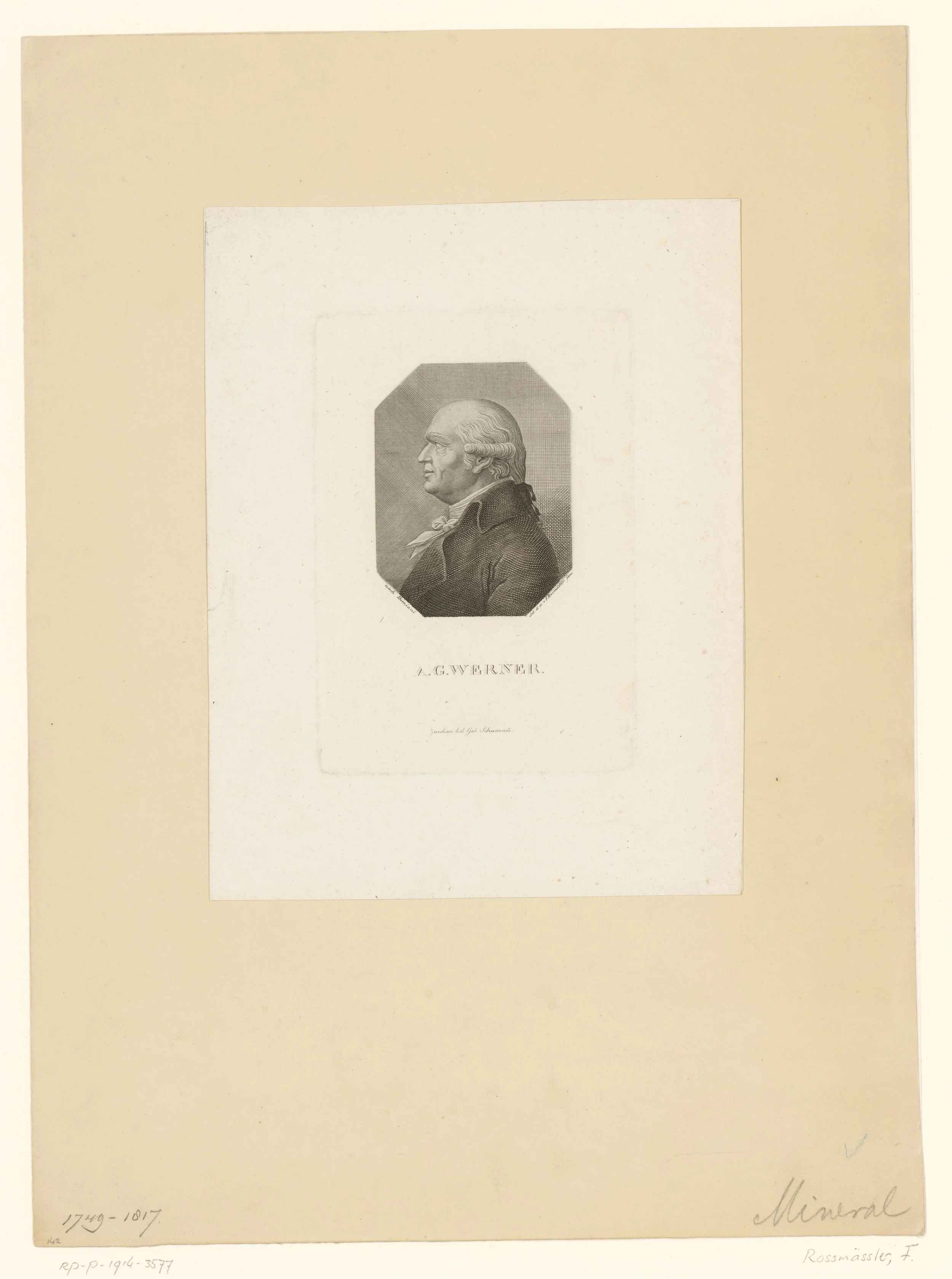
Portrait of Abraham Gottlob Werner
Image Credit: Wikimedia Commons
Patrick Syme
Patrick Syme (1774–1845), Scottish botanical artist, was born the same year that Von den äußerlichen Kennzeichen der Fossilien was published and destined to bring Werner's colour system to life. He was appointed designated painter of objects in natural history at the Wernerian Natural History Society in 1811.
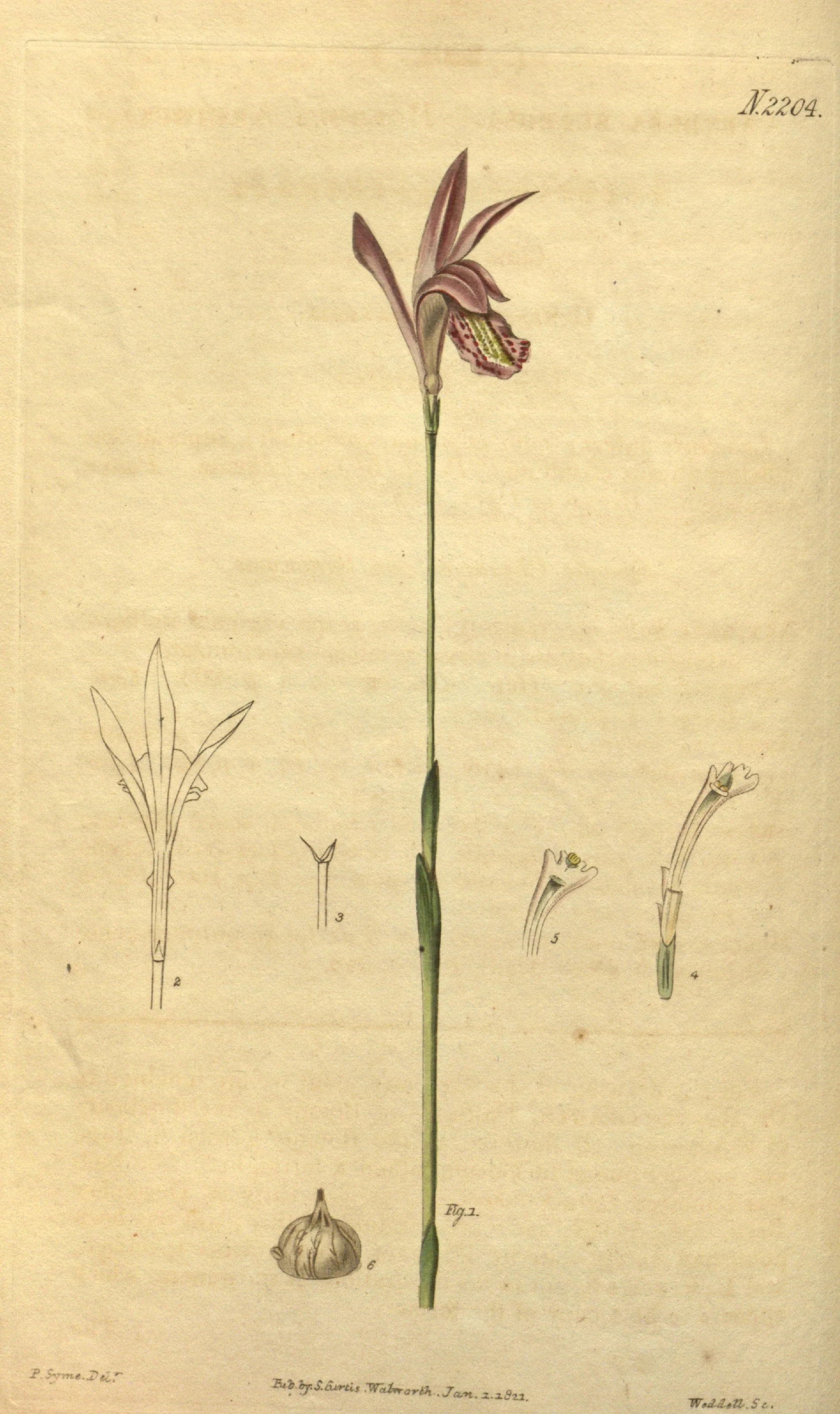
Arethusa bulbosa from Curtis's Botanical Magazine, Plate 2204, 1821, Patrick Syme.
Image Credit: Wikimedia Commons
Syme developed the original nomenclature to include 108 standard colours, the most common in nature, each accompanied by examples from the plant and animal kingdoms alongside minerals. These were divided into ten groups: whites, greys, blacks, blues, purples, greens, yellows, oranges, reds and browns, each group containing between seven and seventeen colours. Whereas most colour charts of the time presented all colour samples together with corresponding information elsewhere in the book, Syme organised each colour into a table alongside its name, colour swatch and three natural references, all on a single page, arranged by colour group. Not only did this make it a practical working tool, it also made it easier to reflect on the often subtle variations within a colour group.

Reds colour plate from Werner's Nomenclature of Colours, 1821 edition, Patrick Syme.
Image Credit: Public Domain Review
Syme also took care to prepare his colour swatches in a way that would minimise fading and inconsistencies. Each colour was painted onto a prepared sheet, then cut into swatches and pasted individually into every copy. The first edition was published in 1814 with 108 colours. The second edition appeared in 1821 with two additional colours: Scotch Blue and Purplish Red, bringing the total to 110.
Syme's experience as an artist and his genuine feeling for nature turned a mineralogist's system into a beautiful guide to the living world. So much so that in 1831 Charles Darwin took the second edition on his Beagle voyage, comparing specimens directly against the swatches at the moment of collection.
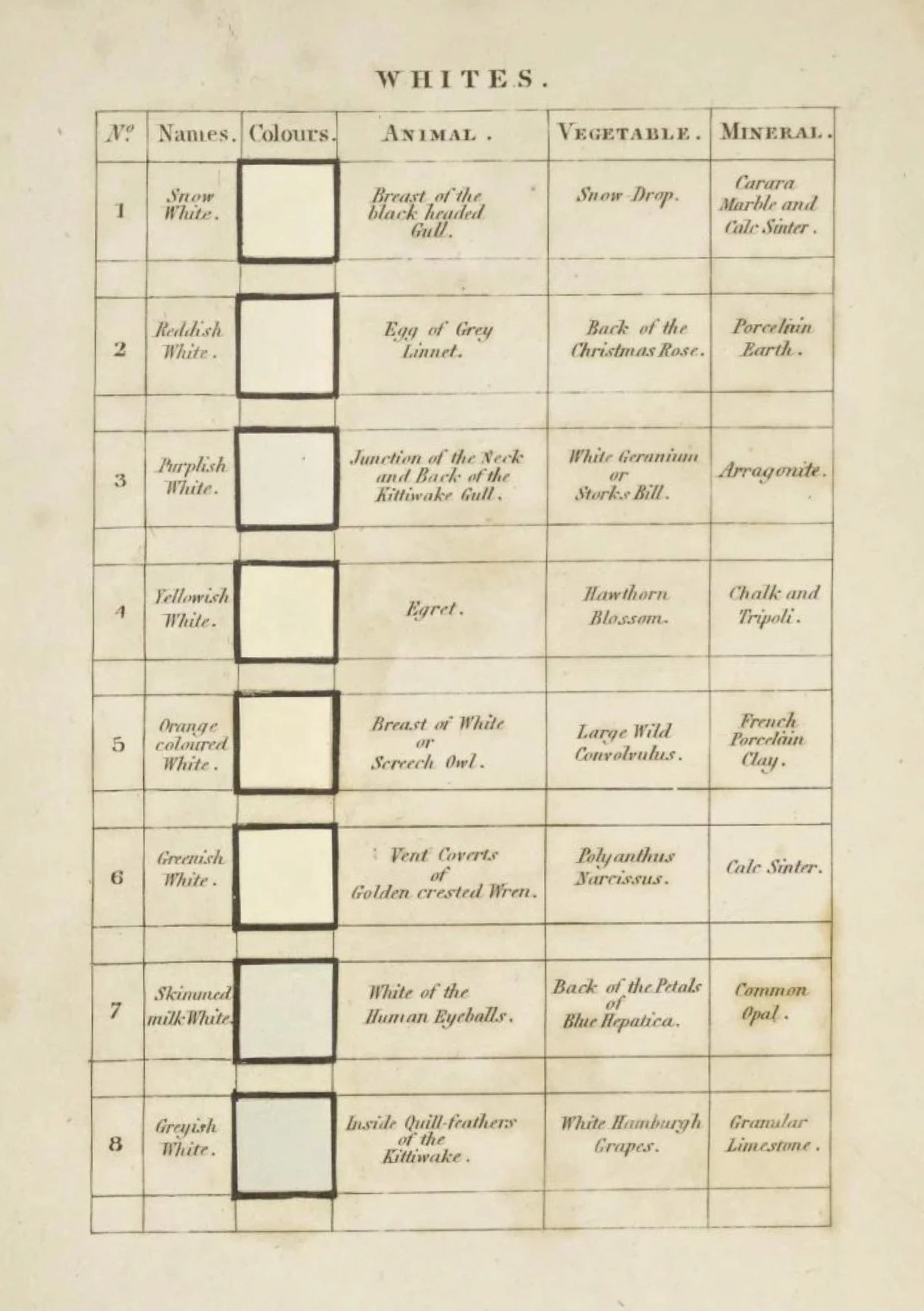
Whites colour plate from Werner's Nomenclature of Colours, 1821 edition, Patrick Syme.
Image Credit: Public Domain Review
The Golden Thread: Goethe
There is a golden thread that connects Werner and Syme to a third figure: Johann Wolfgang von Goethe (1749–1832), German poet, playwright and polymath. Goethe was a committed Neptunist, an adherent of Werner's own geological theory about the formation of the earth and an admirer of Werner's thinking. This placed him within the same intellectual current that gave rise to Syme's work in Edinburgh, where the Wernerian Natural History Society had been founded in Werner's honour. Although well known as a literary figure, Goethe considered his theory of colour the greatest achievement of his life, more important than anything else he wrote.
His theory of colours, Zur Farbenlehre, published in 1810, made a claim that no one had quite made before: that colour in nature does not simply exist to be observed. It affects us. For Goethe, colour could not be understood in isolation. It existed only in relationship: between light, the natural world and the human observer. He argued that colour acts directly on the emotions and the mind. He didn't believe that colours were cultural, arbitrary or decorative but communicative and that they were derived from nature itself. He identified green as the colour where the eye and mind find rest, the colour of the living world at its most abundant and the midpoint of his colour wheel where yellow and blue meet in perfect equilibrium. He described blue as the colour of distance and depth, of sky and water, and yellow as active, warm, the colour of sunlight. He was the first to argue systematically that colour in nature acts on the human mind and emotions and that we are built to receive it.
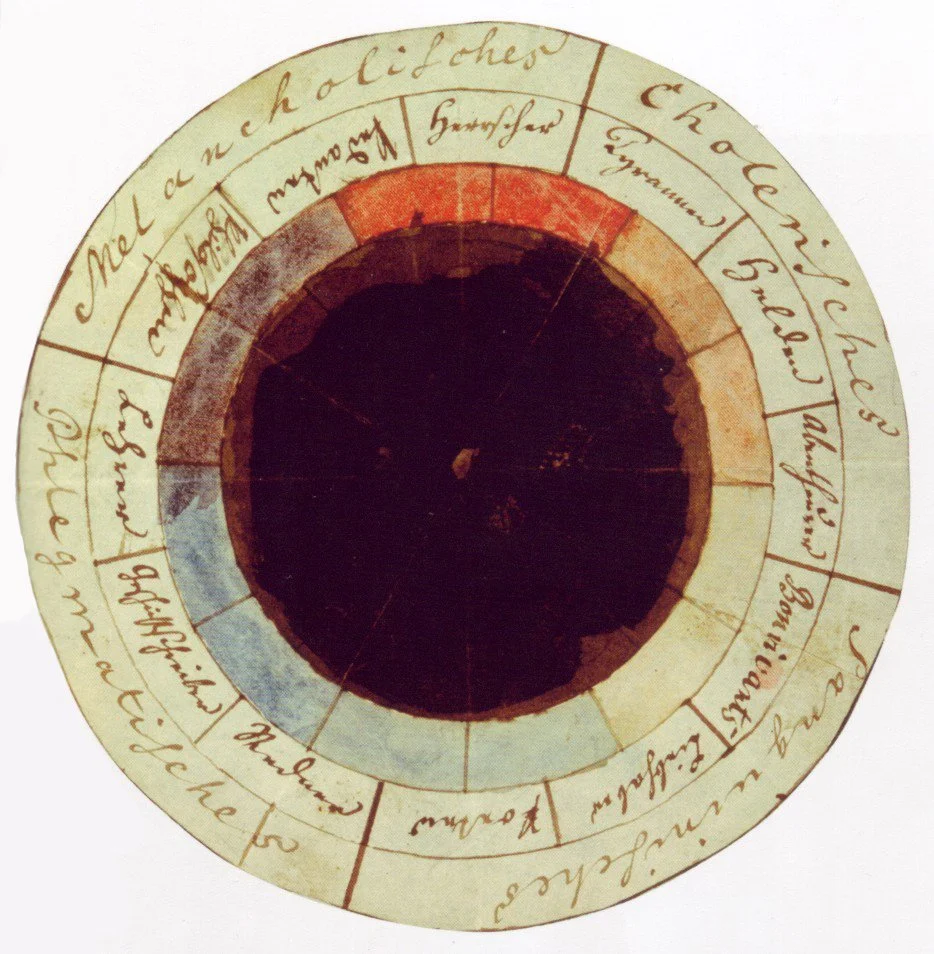
Die Temperamentenrose, Goethe and Schiller, c.1799, a working diagram mapping colour to human temperament, drawn during the years Goethe was developing Zur Farbenlehre.
Image Credit: Wikimedia Commons
What the Colours Offer Us
The colours that Werner and Syme documented are not simply a historical or botanical catalogue. What Werner, Syme and Goethe understood, each in their own way, is something we perhaps sense without quite articulating: that the colours of the natural world are not background. They are not decoration.
The slow gathering of stones by colour, the sorting of feathers by the quality of their white. These are not idle habits. They are a way of paying attention to something the natural world has always been offering. Colour, in nature, is not simply there to be seen. It is there to restore us.
Sources
Calvo Ivanovic, I. (2018). 'Symbolic Color Associations in Goethe's Farbenlehre and its Application in the Pictorial Work of its Early Receptors.' Cultura e Scienza del Colore, 9, 65–73. DOI: 10.23738/ccsj.i92018.07
Goethe, J.W. von (1810). Zur Farbenlehre. English translation by Charles Lock Eastlake (1840): Theory of Colours. Available at: https://www.gutenberg.org/files/50572/50572-h/50572-h.htm
Simonini, G. (2018). 'Organising Colours: Patrick Syme's Colour Chart and Nomenclature for Scientific Purposes.' XVII-XVIII, 75. DOI: 10.4000/1718.1327
Sullivan, H.I. (2017). 'Goethe's Colors: Revolutionary Optics and the Anthropocene.' Eighteenth-Century Studies, 51(1), 115–124. DOI: 10.1353/ecs.2017.0049
Syme, P. (1821). Werner's Nomenclature of Colours. 2nd ed. Edinburgh: William Blackwood. Available at: https://archive.org/details/gri_c00033125012743312
Images
Figure 1 (Greens plate): https://publicdomainreview.org/collection/werner-s-nomenclature-of-colours-1814/
Figure 2 (Werner portrait): https://commons.wikimedia.org/wiki/File:Portret_van_Abraham_Gottlob_Werner,_RP-P-1914-3577.jpg
Figure 3 (Arethusa bulbosa): https://commons.wikimedia.org/wiki/File:Arethusa_bulbosa-_Curtis%27_48_pl._2204_(1821).jpg
Figure 4 (Reds plate): https://publicdomainreview.org/collection/werner-s-nomenclature-of-colours-1814/
Figure 5 (Whites plate): https://publicdomainreview.org/collection/werner-s-nomenclature-of-colours-1814/
Figure 6 (Die Temperamentenrose): https://commons.wikimedia.org/wiki/File:Goethe_Schiller_Die_Temperamentenrose.jpg


.jpg)
