The Art of Gold: A Cultural History of a Universal Treasure
What comes to mind when you think of the colour gold? Is it a feeling or something more spiritual? Do you sense warmth, awe or even desire? Or perhaps you take a more analytical approach, seeing gold as something material rather than immaterial. For centuries, gold has played a significant role in shaping cultural history from the earliest ancient civilisations to the modern age. Desired by all, kings, queens and gods alike, gold is no doubt a universal treasure, a metal so influential that entire civilisations would fall and some of the most recognisable and iconic artworks in history would be born from the very nature of its allure.
Gold as Myth
It is unclear when humans first began to unearth gold; however, the discovery of a metal so closely resembling the warmth and radiance of the sun makes it easy to see how ancient civilisations would come to worship it. This desire to worship and honour gold is not only evident in myths and legends but also in surviving artefacts found and looted by archaeologists throughout the centuries. Take, for example, a ceremonial necklace or ‘sun pendant’ believed to be over 3,000 years old (1000-800BC). This pendant, so ‘elegant’ and ‘intricate’ in design, is rare in its depiction of the sun among objects found within Britain. For many of our ancestors, this was a celebration of the ‘life-giving power’ of the sun during a time when solar symbolism became a ‘key element of mythology and belief.’ Gold became widely valued and used across the ancient world, both materially and spiritually. The ancient Greeks created their myths and legends, forming narratives in which gold became the symbol of authority, prosperity and something sacred. Others, such as the ancient Egyptians, believed in its magical properties both for the living and the dead. A symbol of immortality and the ‘flesh of the gods,’ this rich and alluring material became the ingredient used for everyday objects and ceremonial rituals. Such a connection to the spiritual world was also present during the Byzantine Empire and the formative period of Christianity, with gold functioning as a symbolic language of transcendent and divine light.
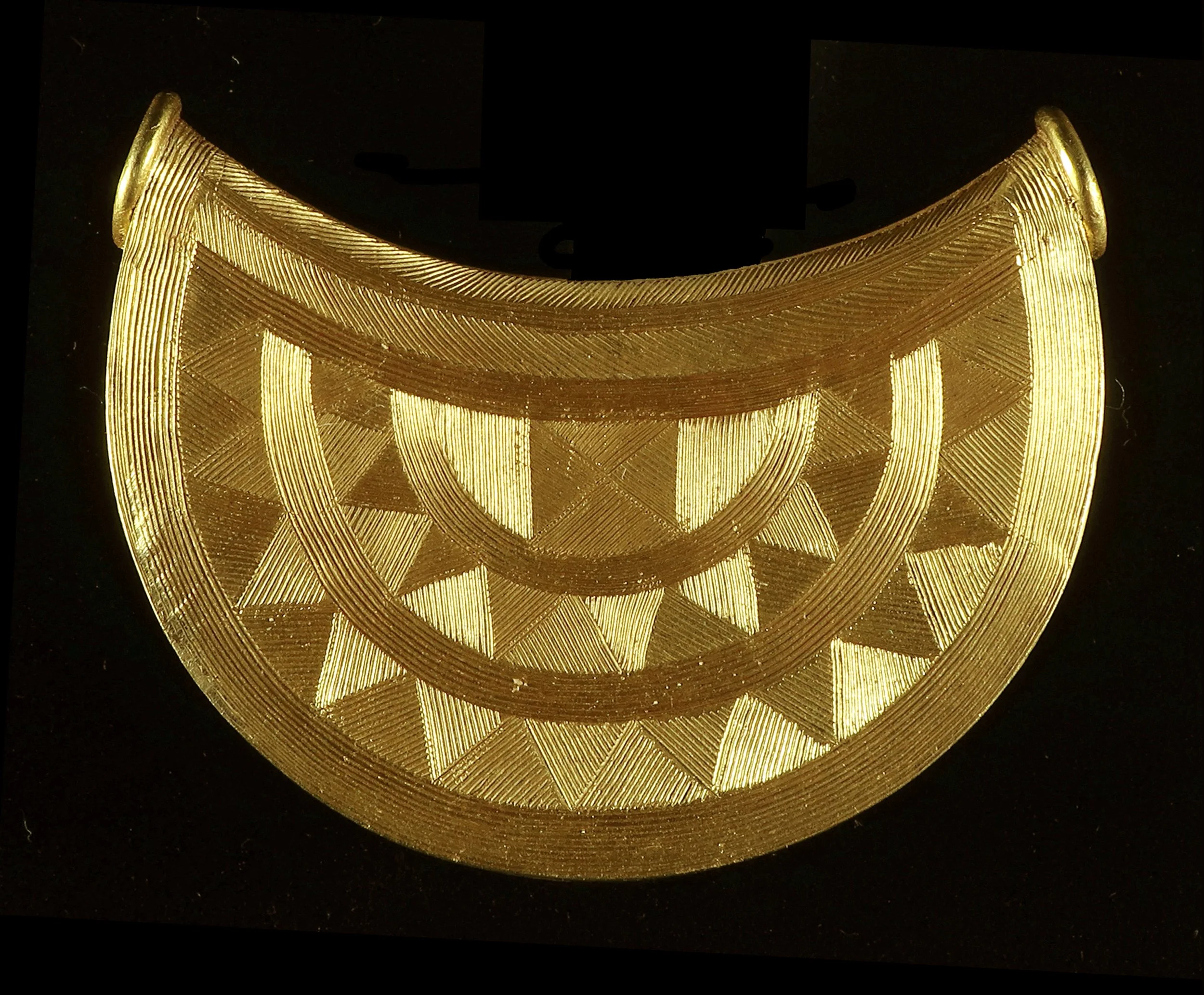
Bronze Age gold bulla, the 'Shropshire Sun Pendant', c. 1000-750 BC
Image Credit: Wikimedia Commons
The Conquest of Gold: A Case Study
Historically, due to limited gold deposits, Europe has relied heavily on its trade with regions across Africa and Asia. The Ancient Egyptians were unique and widely known for their geographical territory in relation to gold. Unlike many other cultures, there was little need to barter or venture to far-off lands in pursuit of this rare and luminous material. It would be centuries later that the Carthaginians became the ‘principal conduit for African gold in Europe’ for what is believed to have been three hundred years. This empire, which ‘ringed the Mediterranean in the millennia before the birth of Christ,’ would soon convert to silver after a military defeat in 202 BC. It becomes evident how politically inclined gold came to be, not only influencing the political landscape but also cultural identity. In 1324, Cairo welcomed the arrival of the Mali Emperor, Mansa Musa. It was during this pilgrimage that European and Arabic traders would witness the opulent wealth of the African continent. Travelling with a company of over 60,000 men and what is thought to have been 304 pounds of gold, it is not difficult to see how such a display of wealth would evoke such a sense of awe amongst curious spectators. Although celebrated for his generosity, his visit would trigger the collapse of the regional value of gold for over a decade. Such a performative display of wealth would reappear in 1520 in a meeting of newfound friendship between two rival kingdoms. This European festival of diplomacy, in which Henry VIII and the French King Francis I demonstrated the full spectacle of their kingship, would mark the beginning of an 18-day-long feast. An event that was so elaborate in design, with masquerades, tournaments and marquees made ‘entirely from gold cloth,’ it would later be known as the ‘Field of the Cloth of Gold,’ forever memorialised in paintings found within the royal collection.
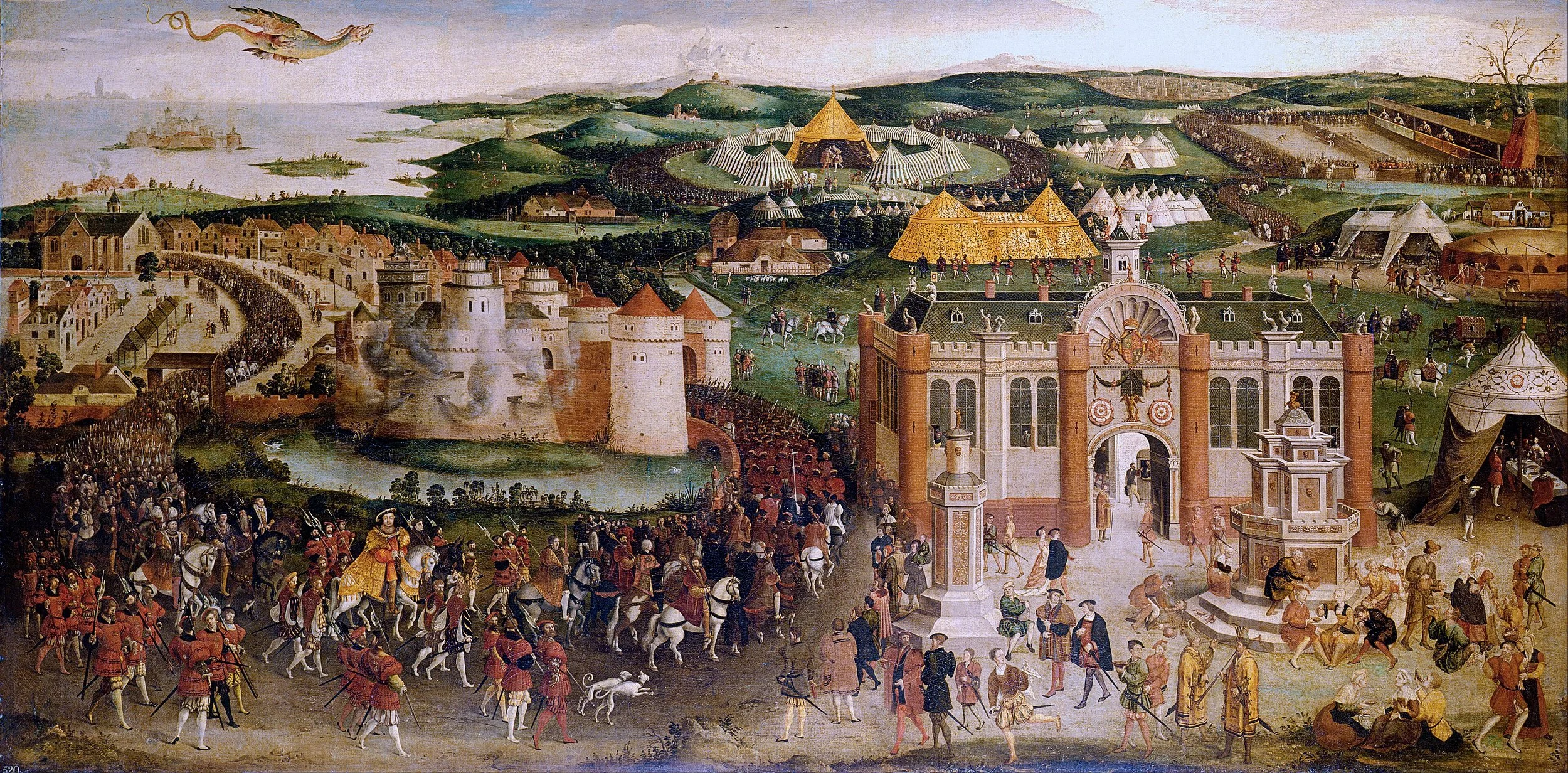
The Field of the Cloth of Gold, oil painting of circa 1545 in the Royal Collection at Hampton Court. Henry VIII on horseback approaches at bottom left.
Image Credit: Wikimedia Commons
The marriage of gold and royalty has historically been interwoven with tales of kings and queens and their pursuit of divine authority. In the 16th and 17th centuries, a growing interest in alchemy and the pursuit of gold through transmutation led to the imprisonment of German alchemist Johann Friedrich Böttger. Considered a magician and a cheat by his counterparts, he caught the attention of Frederick August I of Saxony. His boasting of transforming base metals into gold not only captured the interest of an impoverished ruler but also triggered the events that led to the discovery of ‘hard-past porcelain’ or ‘true porcelain,’ a material that would reshape the economic structure of Saxony and later the rest of Europe.
A Devotion of Gold
Throughout art history, gold has been associated with themes of a symbolic and spiritual nature. Much like iron, copper and silver, gold contains ‘mobile electrons,’ causing the metal to produce a ‘distinctive sheen.’ For many of our ancestors, such an effect would cause them to question the material's divine nature. With our newfound and developed understanding of this ‘pure medium,’ it is a visual language we might come to understand. During the Byzantine Empire and the formative period of Christianity, gold was commonly used in the backgrounds of icons, mosaics, triptych panels and even within architectural settings. Images produced as early as the 5th century contradict Christian views of gold as seductive and associated with material wealth. Many of these paintings transform under candlelight, turning a yellow hue. Those witnessing such a transformation may have felt a spiritual connection bringing them closer to God.
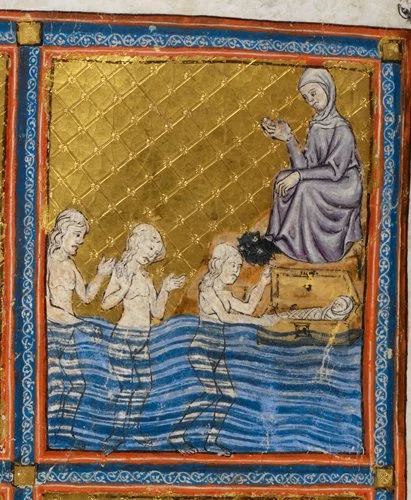
Unknown Artists. Ca.1320-1330. The Finding of Moses
Image Credit: Wikimedia Commons
Illuminated manuscripts dating from the early Christian and medieval periods embellished their books with gold leaf, a practice also found within Islamic manuscripts. The Golden Haggadah (1320-1330) exemplifies this use and reflects the belief in the visual splendour of religious narratives. In the 13th and 14th centuries, the predominant patron of the arts was the church and with it came a demand for religious and definitive subject matter. With the emergence of the Italian Renaissance, gold began to lose its reverence, no longer a sacred material but a force in worldly affairs.
Gold as a Craft
In the 14th century, gold became a prominent feature among Florentine paintings. In institutions such as the National Gallery, gold is used throughout its collection, with Duccio's The Virgin and Child with Saints Dominic and Aurea (1312-131) being the most notable example. Although used for its symbolic reference, gold's initial appeal would lie in its responsive and forgiving nature.

The Virgin and Child with Saints Dominic and Aurea, about 1312-15
Image Credit: Wikimedia Commons
Duccio di Buoninsegna
In the art of gilding, there are several traditional decorative methods; many of these centuries-old traditions are still in use today and can be found in restorative and specialised practice:
Water Gilding: In art history, water gilding is one of the oldest methods of applying gold leaf. It is used to create an illusion, transforming the surface of materials such as wood into what appears to be solid gold.
Mordant Gilding: Mordant gilding, more commonly known as ‘oil gilding,’ is an oil-based glue that adheres the leaf to the surface, leaving a softer and matte finish that is water-resistant. Such methods of application are often used on individual pieces of furniture and the interior and exterior of architectural features. Not all mordants are oil-based; some contain plant gum or glair (egg white).
Shell Gold: Historically, shell gold comes from ground leaf or ‘skewing’ that is mixed with a binder material such as gum arabic, egg white (glair) and even warm fish glue. This process creates a tablet-like form and is used on intricate details, designs, and repairs. Traditionally, this would be achieved by mixing the combined ingredients in a seashell.
Pastiglia: Pastiglia, often associated with the Italian Renaissance, is a technique used to create three-dimensional patterns and artists such as Jacopo di Cione (although not part of the Renaissance) were known for this practice.
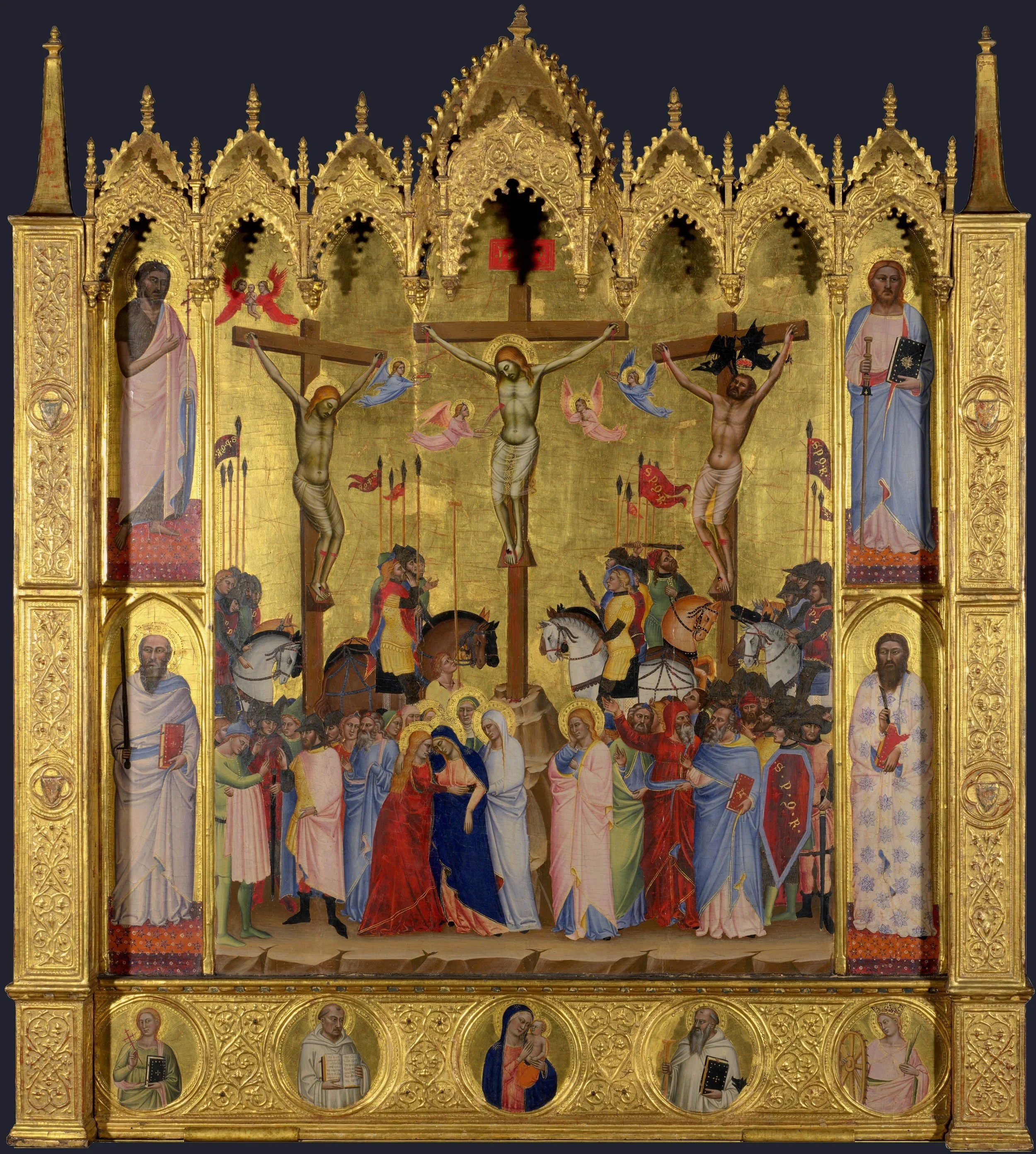
The Crucifixion by Jacopo di Cione, about 1369-70
Image Credit: Wikimedia Commons
Gustav Klimt: A Golden Phase
In the late 19th century, Vienna began to change and a new golden age of radical minds would challenge a city known for its traditions and Habsburg ways. Artists, musicians, architects and even social scientists began experimenting and transforming their respective fields, challenging imperial designs, putting Vienna at the forefront of modernity. Radical both in mind and expression, Gustav Klimt placed ‘sexuality at the forefront of his work,’ its very nature a form of protest concerning academic conservatism that separated fine art from craft. This act of rebellion can be seen in paintings such as Judith I (1901), in which eroticism plays throughout, not only in the portrayal of our heroine but also in the visual language, in which gold serves as the main object of desire.
Inspired by his travels to Ravena, a historic city known for its ‘collection of early Christian mosaics and monuments’ as well as traditional craft and skill, Klimt began the artistic transition of his ‘golden phase.’ The influence of this visit is evident in his paintings, both in the use of spiritual motifs and artistic practice. The Kiss (1907- 1908) is one such example, its canvas a ‘cosmos’ of gold leaf and decorative invention so often associated with early Christian and Byzantine art. In contemporary culture, gold continues to be a symbol of wealth, its connection to spirituality now lost to consumerism. Although a different period within art history, one might argue that the famed artist himself shaped such a change in narrative. No longer a saintly figure but now sensual and in tune with human desire, gold becomes personal, its form humanised through a break from tradition.
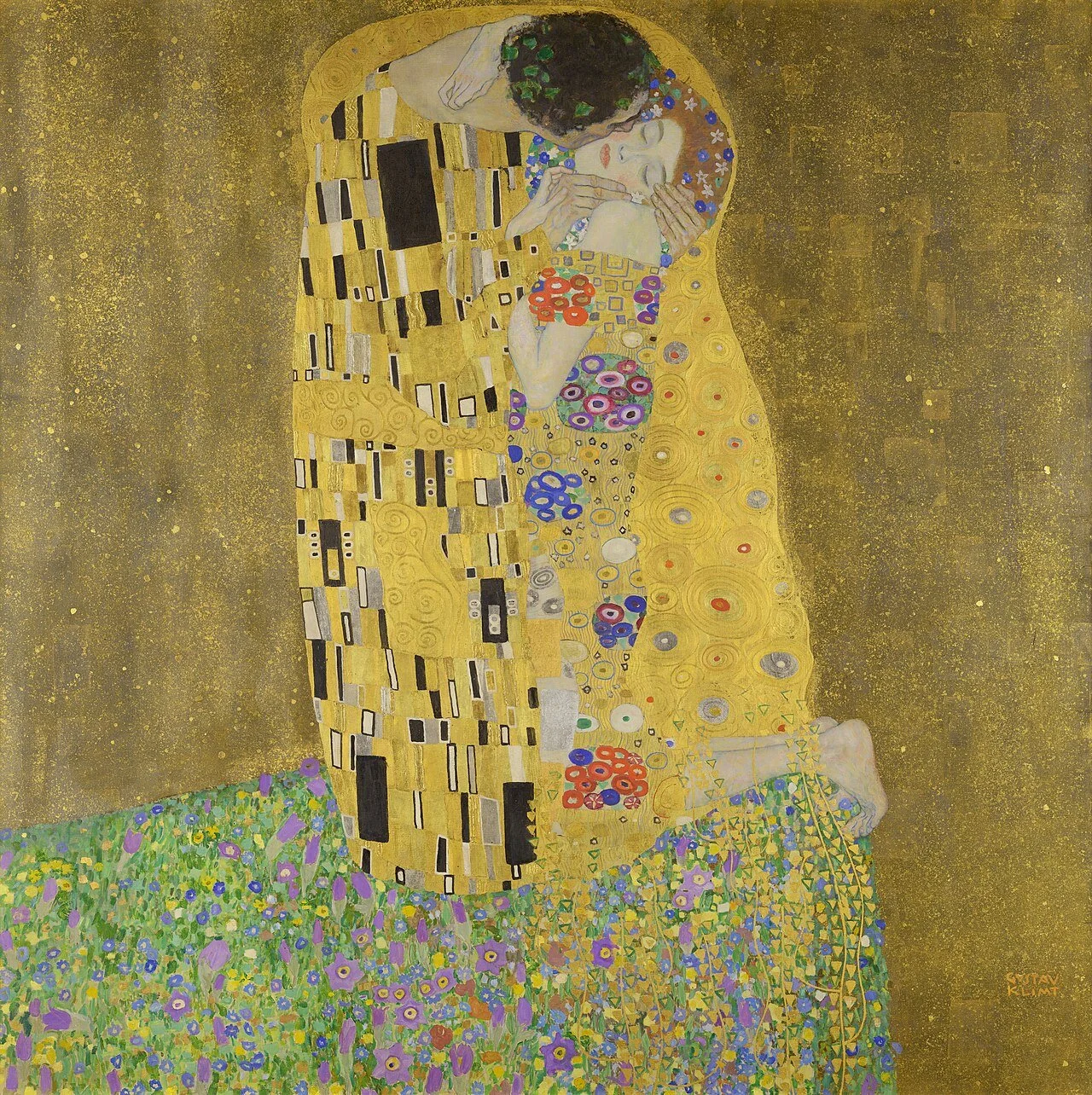
Gustav Klimt, The Kiss, 1907 - 1908
Image Credit: Wikimedia Commons
For centuries, gold has shaped the very language and landscape of cultural identity. This is evident in the way in which it has been used throughout art history, both in a material and spiritual sense. Although much has changed in contemporary culture, certain aspects of craft and tradition remain a vital part of heritage practice. This suggests that even in a consumerist world, where material value is ever fluid, gold persists in its relevance within our cultural imagination.
Sources
Belvedere Museum. n.d. Klimt as a High Earner. [Online]. Available from: https://artsandculture.google.com/story/klimt-as-a-high-earnerbelvedere/YQVBEdY0iGxxhQ?hl=en
Britannica. 2024. Carthage. [Online]. Available from: https://www.britannica.com/place/Carthage-ancient-city-Tunisia
BBC News. 2015. 'Rare sun disc' on show in Wiltshire for first time to mark solstice. [Online]. Available from: https://www.bbc.co.uk/news/uk-england-wiltshire-33187053
Figes, L. 2019. Colour in art: a brief history of gold. [Online]. Available from: https://artuk.org/discover/stories/colour-in-art-a-brief-history-of-gold
Great Art Explained. 2022. The Kiss by Gustav Klimt: Great Art Explained. [Online]. Available from: https://youtu.be/SNhmSdLDmto?si=1q9q8zTq3P2N_bX6
Historic Royal Palaces. n.d. The Field of Cloth of Gold. [Online]. Available from: https://www.hrp.org.uk/hampton-court-palace/history-and-stories/the-field-of-cloth-of-gold/
Museum and palaces. n.d. The Sun Chariot. [Online]. Available from: https://en.natmus.dk/historical-knowledge/denmark/prehistoric-period-until-1050-ad/the-bronzeage/the-sun-chariot/
Mundo da Arte Audiovisual. 2018. A History of Art in Three Colours - Episode 1 – Gold. [Online]. Available from: https://youtu.be/s11erXvRWZA?si=gYsKXbJ3EB0E4bbF
Reading the Past. 2024. The Field of the Cloth of Gold. [Online]. Available from: https://www.youtube.com/watch?v=BRkhX1gRyQE
Shropshire Council. 2021. Stunning 3,000-year-old gold pendant to go on public display for the first time in Shropshire [Online]. Available from: https://newsroom.shropshire.gov.uk/2021/07/gold-pendant-public-displayshropshire/#:~:text=The%20sun%20pendant%20(HESH%2D43148A,believed%20it%20must%2 0be%20Roman
St Clair, K. 2016. The Secret Lives of Colour. [Online]. London: John Murray. Available from: https://amzn.eu/d/0aSNKtLA UNESCO World Heritage Convention. 1996. Early Christian Monuments of Ravenna [Online]. Available from: https://whc.unesco.org/en/list/788/
The National Gallery. 2018. Applying Gold in Paintings: Stories of Gold | National Gallery. [Online]. Available From: https://youtu.be/2YNmjRq_XB4?si=J8B1im-Mi1-lLrPL
Images
https://en.wikipedia.org/wiki/Shropshire_bulla
https://en.wikipedia.org/wiki/Field_of_the_Cloth_of_Gold
https://en.wikipedia.org/wiki/Golden_Haggadah
https://commons.wikimedia.org/wiki/File:Duccio_London_triptych.jpg
https://commons.wikimedia.org/wiki/File:Cione,_Jacopo_di_-_Crucifixion_-_National_Gallery.jpg