The history and experiential study of colour can be traced back to the early medieval period, with perhaps the first instance of a colour wheel being a urine chart, used by physicians at the time as a medical tool. Colour, nature, science, and life are inextricably linked. The concept of colour theory is hardly new; however, as cultures evolve over time, new understandings of colour and its qualities emerge with each generation of artists, theorists, and academicians.
Sara Viloria is a colour educator based in Chile who has dedicated her practice to teaching and illuminating others about colour, its many attributes, and historical associations. Inspired by writer and social scientist Eva Heller, author of “The Psychology of Color” published in 2004, Viloria runs a Colour Academy where enrolled students can learn about colour, its history, and its use as a tool for fine art and business. In discussions with Vilroia, we examined colour as a concept and its role in contemporary societies, where commodification is increasingly prevalent within cultures centred on capitalist realism. It seems that colours can be perceived as possessions- like clothing or furniture, rather than as more spontaneous experiences within the natural environment.
We began by discussing Viloria’s early experiences with colour, having studied Fine Art as an undergraduate.
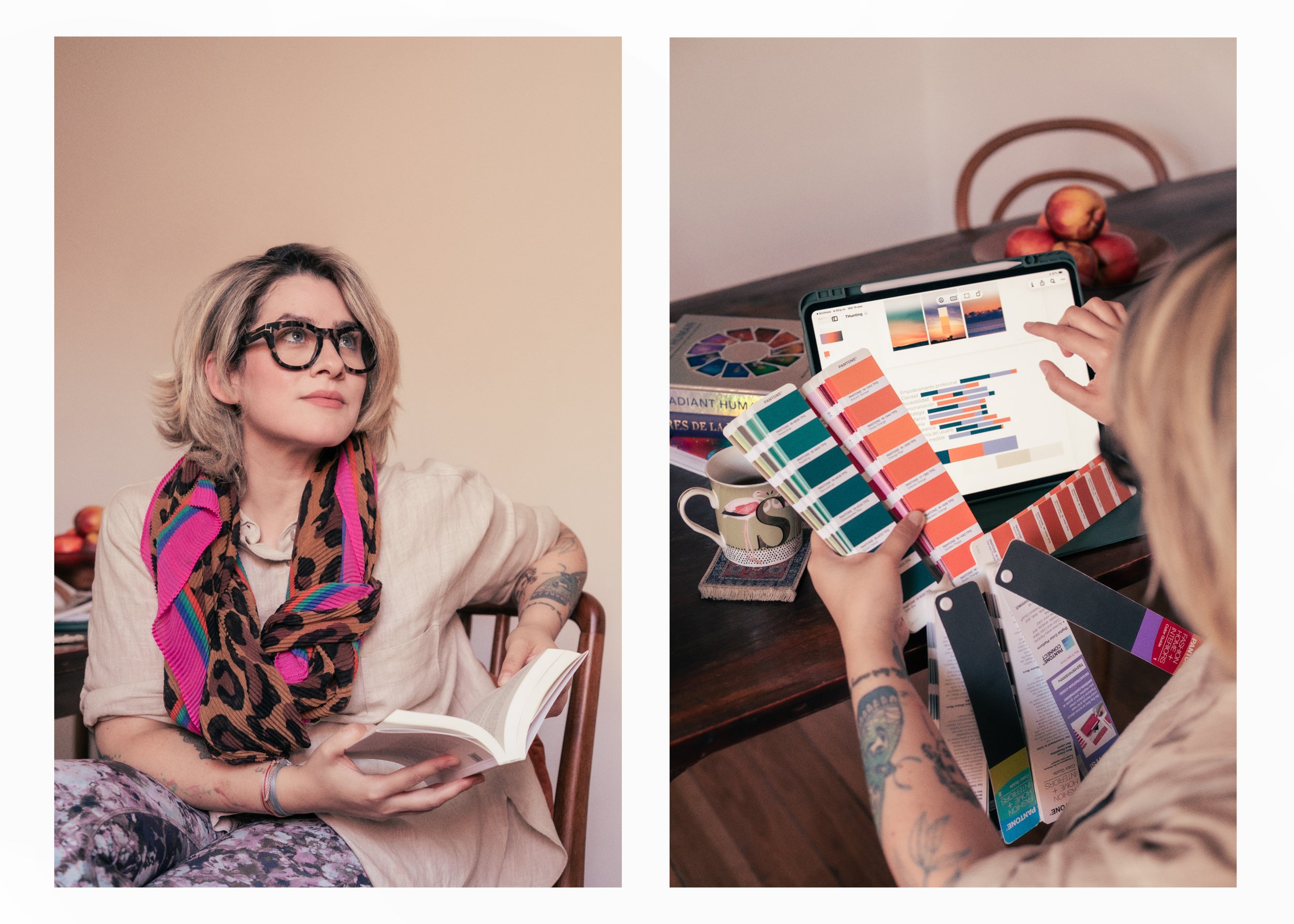
Sara Viloria
Photograph by Pilar Castro
I read you were an artist before becoming a colour educator. Do you think this has influenced the way you perceive colour?
Definitely, this has influenced me. I do have an art degree but one of the saddest things I do remember is that I never had the opportunity to take the colour class, which was an “elective” course. It might seem unbelievable, but because I took 4 years of the painting class, I think they assumed that I didn’t need it. After my graduation I worked for a few years as a watercolourist, and watercolour is a pretty specific technique based on how lights works on certain pigments, so anyways I ended up studying colour and light, and having a deep daily conversation with myself about how the way we see, determine the way we act in our environment. This need to poetize colours in everything, which comes from my training as an artist... ended up turning me into a colourist who loves and investigates everything that attracts my eyes.
Could you discuss the history of colour, including the earliest known instances of humans working with it theoretically, and explore its connection to art as well as its presence in nature and medicine?
This is extremely beautiful, since a lot of us believe that the first “colour” manifestations are the ones we see today in places like Altamira, those big animals made with charcoal and earth on the walls of the caves. But if we look even further, we’ll find that humans used to paint their own body, we were our first canvas. As a protection from the sun, we used clay (beautiful, red thick clay) and also as a way to make some ritualistic connections with the spirits that our ancestors believed that guided us. We understood colour in the first place, as a way of communication with things for which we even didn’t have a name, but we needed in our lives (blue from the sky and the lapis lazuli, ochre from the earth, the greens from nature extracted from malachite, etc).
Throughout my research, I have come across you using the term ‘ancestral colours’. What do you mean by this?
Well it depends on how you see it. I always say to my students that our disconnection with colour (our disconnection with “seeing life” itself) comes from this new “era”, all so easily discarded, everything “old” is discarded, as if the past was too far away. In Latinoamerica specifically we used to have a beautiful connection with colour, just check on the Mayas, the Aztecas, the Caribes in Venezuela, even here in Chile the relationship of the Mapuche people with grays and silver. It’s so beautiful, it’s crazy! But lately we see colour more as a trend, than as a part of our identity. Colour is an ancestral knowledge since thanks to the ability we had to see our world, we evolved as humans and we stablished symbolical connections with nature, colour is extremely human, but we treat this subject as an accessory.
In a capitalist world, ownership and status are especially prominent in certain cultures. Colours are often seen as possessions, like clothing or furniture, and are used in marketing and branding. Is the way we see colour being influenced by consumerism?
It is funny how the way we think on colour talks about who we are. For the Mapuche people in Chile, silver is the most profound way to canalize our energies with the moon, since silver shines as the moon itself. And this is poetic but also for a lot of people, it is a distant “nice story” in the world we live in today. I think in some colours as a fashion trend, and makes question myself “is it good because people is talking and thinking on colour? Or is it bad, since we no longer realize that colour is a democratic phenomenon, since we think we NEED to buy colours? I’m thinking in the Charlie XCX brat colour, which is now something important for a whole generation of teenagers that have at least a funky green shirt in their closet now…
How is our perception of colour influenced by capitalism? In the past white used to be the most expensive colour since only a few people could keep it clean, but nowadays the most exclusive colour is the Kapoor black, ¿why? ¿Why black and white? It is extreme in fact. It is hard to not think in a world guided and determined by consumerism, but at the same time, colour is an experience so complex, you can’t buy what you see, but the objects that project that. Colour is an experience, so ¿can we really pay for something so unique and specific? Maybe this is the true, new luxury… Maybe we need to read Kant again. I don’t think I do have a clear answer to this, having “colour” and “consumerism” in the same quote… This is such a responsibility to assume.
In one of your recent YouTube videos, where you analyse the Pantone Colour of the Year, ‘Cloud Dancer’, you briefly mention recession colour palettes: how is colour linked in this way to our current socio-political climate?
This is such a hard and complex time for us. Currently, there is no declared global recession, but rather a widespread economic slowdown with mixed indicators… At the same time the world never felt so alarmed, our crisis is more than just the socio-political climate. It is a human crisis. We’re living through wars, invasions, violations of the human rights, and we don’t even suppose this is happening, we can see it in real time. When Pantone says “the colour of the year is white” it feels strange, such a “silence” with this colour, but at the same time, ¿aren’t we choosing to don’t see at all? The thing on colour is that everybody says they don’t always understand it, but actually we do, and we do it very well since its language is universal. Maybe are not facing a lack of pigments to produce colours, but we are disconnected with the need to say and express things we want to say. We had so much to say in the 80s, and the 90s, and even 2000s, but then technology just when bigger and we made ourselves smaller. I think we navigate between nudes and less colours because we are so saturated from everything, “living is easy with eyes closed” Lennon said, I think sometimes is easier with our eyes open, but just enough.
Your work discusses how certain colours symbolise qualities like elegance and power. While resources on colour history and learning are generally affordable, experiences such as colour consultations can be very costly. Is colour, and the deliberate use of it in our lives, becoming something accessible only to the upper classes and elites?
I think we will always have power statements with colour, and with colour consultations what we do (or we should do) is to balance those powers in benefits from the people that need guidance, for themselves or their business. But nowadays I think in two issues, one of them is the fact that everyone can find information about colour, or colour psychology or colour application on the internet, so what we do as colour consultants is to humanize and create conversations about these things, is an act of resistance, because it depends in the work we make with others, more than how much you can charge or people pay for it, and I’m not trying to romanticize this, what I’m trying to say is that if people see colour consultations as something exclusive for the elite, then we colour consultants are not doing the work, which is to democratize and generate conversations around the way people see the world.
On the other side sometimes I am scared, colours is so “in” at this moment, ¿is it going to pass by, soon? If so, we have to think on it as a way of living and improving our environment, not as a fashion, not as trends. And the best way for doing it, is working on education, and making everybody participate because when we talk on colour, everybody counts, as we all have a point of view.
And finally, to what extent are our colour preferences influenced by personal taste, psychology, or the environment around us?