Earth, locality and industry, are terms that both introduce and encapsulate the artistry of Thomas Woltmann’s approach to colour production. Thomas Woltmann is a Copenhagen-based furniture designer who has dedicated his work on restoring the use and production of ochre pigments in Denmark. Ochre is an ancient pigment, being the oldest known natural pigment used by humans. The rich archeological history of mining, grinding and applying this material is long-standing for many regions and cultures. Much of Thomas’ work represents a sense of being deeply rooted in place, with his interest in local history and culture being a large source of inspiration. He emphasises seeing pigments as cultural and geographic materials, something that is tangible instead of as an ephemeral concept.
Earlier during his time at the Design Academy in Eindhoven, his graduation projection ‘The Value of Origin’, already was centered around ideas of bringing the origin of the materials used to the forefront of the product. Where the quantities of the materials used during the project were based on the distance relative to where it would be manufactured. However, Thomas initially began producing and utilising ochre pigments as a part of a project for his master’s thesis back in Denmark. This project was in collaboration with Linolie & Pigment, where they created a unique product. Which was the first Danish linseed oil paint to be made with locally sourced ochre in decades. Thomas designed and built a cabinet for this project that encapsulated examples on ochre’s potential uses. The cabinet itself was treated with an oil made from burned ochre, and inside of the cabinet was a display of how the local ochre can be used for textile dyeing, ceramic glazing and as a furniture treatment. Part of this display exhibited the isolated materials used and the different stages of what goes into the making of these applications. The cabinet and the project as a whole was a materialisation of Thomas’ involvement with every stage, and his intimate understanding of this pigment.
This project has since grown and developed into what is now Pigmenta Works, which is the company Thomas recently founded that produces and supplies natural earth pigments. In which promotes ideals of craftsmanship, material research and circular resource thinking. These approaches are implemented by reconnecting consumers with material origin. Many products are designed using materials that end up following a linear system. Made, used, discarded. Yet, Thomas approaches his colour production with regeneration in mind. Pigmenta Works sources their ochre from what is considered industrial waste, as they recover ochre from Danish water treatment plants. Definitions of colour often focus on vision and light ray absorption explaining why we see what we see, which removes the tangible aspect of colour. Thomas reimagines colour as a language to connect with the local environment, something he reflects in his work.
More of Thomas’ techniques and inspirations are explored further in the interview below.
Your design approach often emphasises the materiality of colour. Do you remember the first time you touched and held a natural earth pigment, and what influence this had on you?
Yes, the first time was in my home town of Vejle in Denmark 2022. I had just finished an apprenticeship within furniture restoration. It was doing this that my interest for surfaces and for using natural ingredients to create surfaces started. So in the summer of 2022 I was keen to find some local ochre pigments (I had recently read that these could be found all over – turned out to be a bit more complicated) I was immediately drawn to the natural origins, the locality and the durability of earth pigments. From the very beginning it was the contemporary and industrial potential that I found fascinating.
Ochre is a pigment that is significant to many cultures globally. What gravitated you towards focusing much of your work on ochre, and specifically Danish ochre?
I found the accessibility of ochre very interesting, the fact that it can be found in so many locations, but each place it’s a little different. Also when burning ochre the material shifts color to hues of red, orange brown and violet depending on the mineral content and the temperature you burn it at. This means that from a single specimen of ochre you can generate a very diverse palette of colors. Ochre is also present in large quantities, both from waterworks where it is pumped up with the ground water and from old quarries. This makes the material attractive from an industrial perspective. Why Danish ochre, is simply because I live and grew up in Denmark. I’m fascinated with local history and culture. Denmark use to have a thriving ochre industry but hasn’t had one since the mid 60’s, bringing that back seemed very purposeful to me.
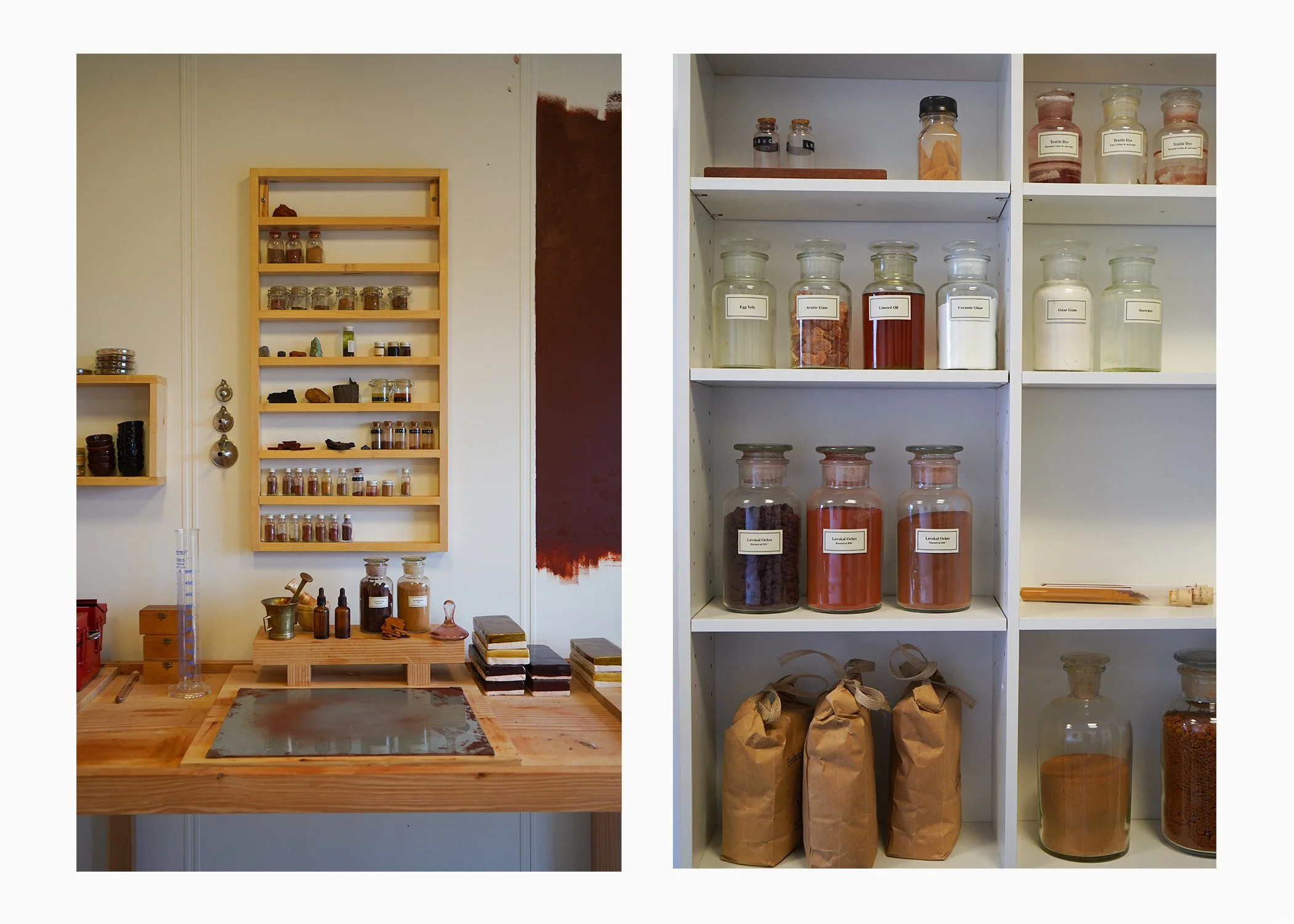
Thomas Woltmann’s Studio
Photograph by Richard Sturges
At what point for you did this historical practice of mining ochre shift meaning toward a more contemporary design concept?
Coming from a contemporary design background, that focus started almost immediately. The historical use and mining of ochre gives the material a lot of value and story which makes it unique and different to for instance synthetic colors. But to make it relevant and attractive again as an ingredient for color, we must steer past the historical context. Therefore it's been important to me that the ochre and its applications were presented in a contemporary manner. That’s why I’ve created sculptures, furniture, garments etc. To show that it can be modern and relevant today and in the future.
When you research past uses of ochre, is there any tradition or technique that has inspired the way you produce pigments at Pigmenta Works?
I think it's important to help everyone understand the nature of colour and often by applying language or terms, helps to define it. My standpoint is to encourage as many designers and people to use colour. Language doesn't need to be universal, not everyone will call a deep red a deep red, but by giving it a value or a quality we can begin to understand it.
I don't think this takes away its mystery, instead by giving it language helps us fall in love with it even more.
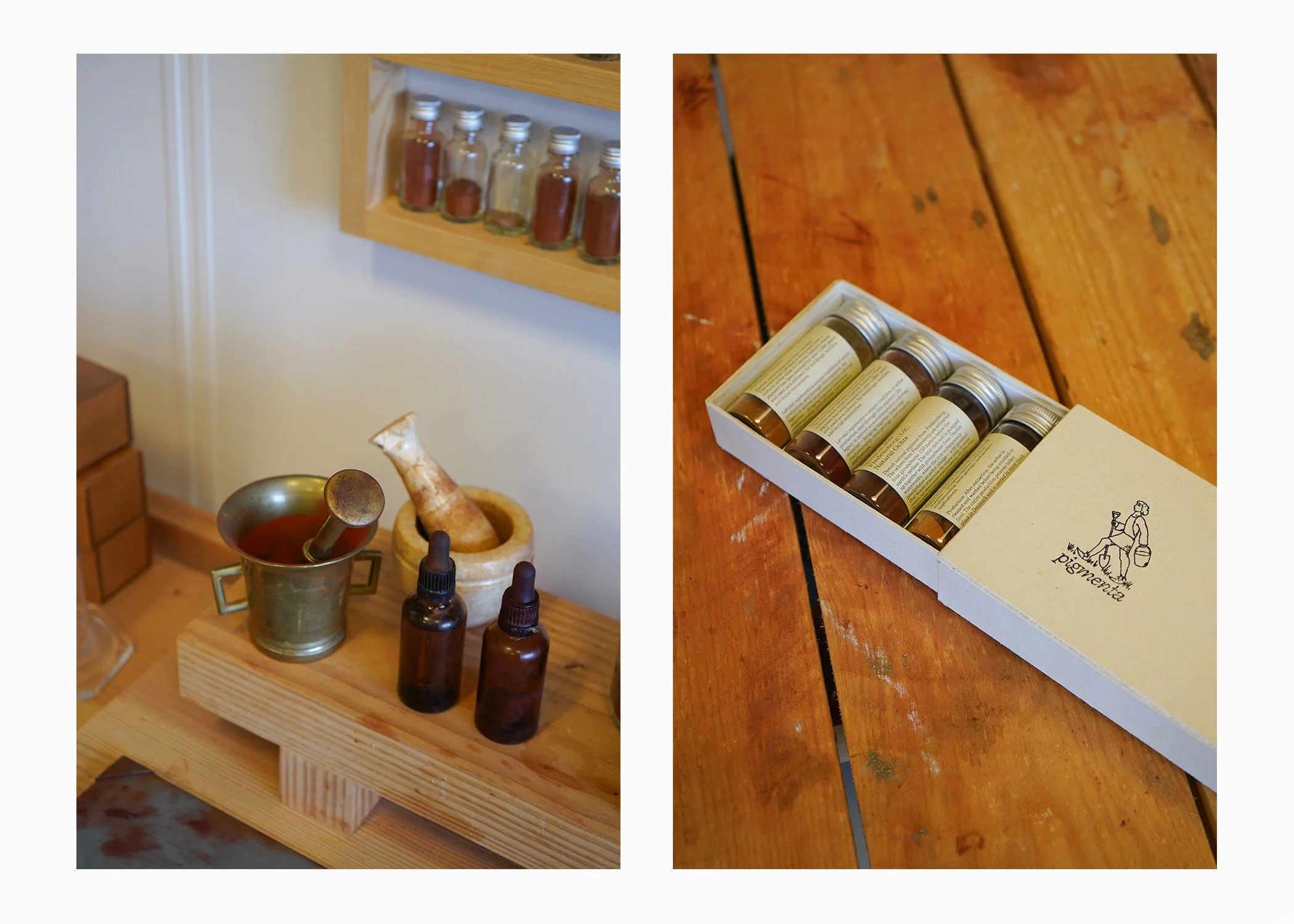
Thomas Woltmann’s Studio
Photograph by Richard Sturges
What you’re creating at Pigmenta Works originates from industrial by-products. Do you feel that there is an inherent paradox between producing a local colour from global industrial waste?
No, I think it's important to think about the nature of extraction when you work with a non-renewable material. By getting the material from waterworks I don’t have to dig out huge quarries, but instead can rely on existing pumping stations that pump up ochre as a by-product. These waterworks that I work with are so far all located in Denmark. What’s been important is that the origin of the ochre remains very clear. Therefore all colors are named after the place of origin. To connect the user to the color through its provenance. This method of using by-products can be applied to numerous countries and regions all over the world. And I would love to one day expand my operations beyond Denmark.
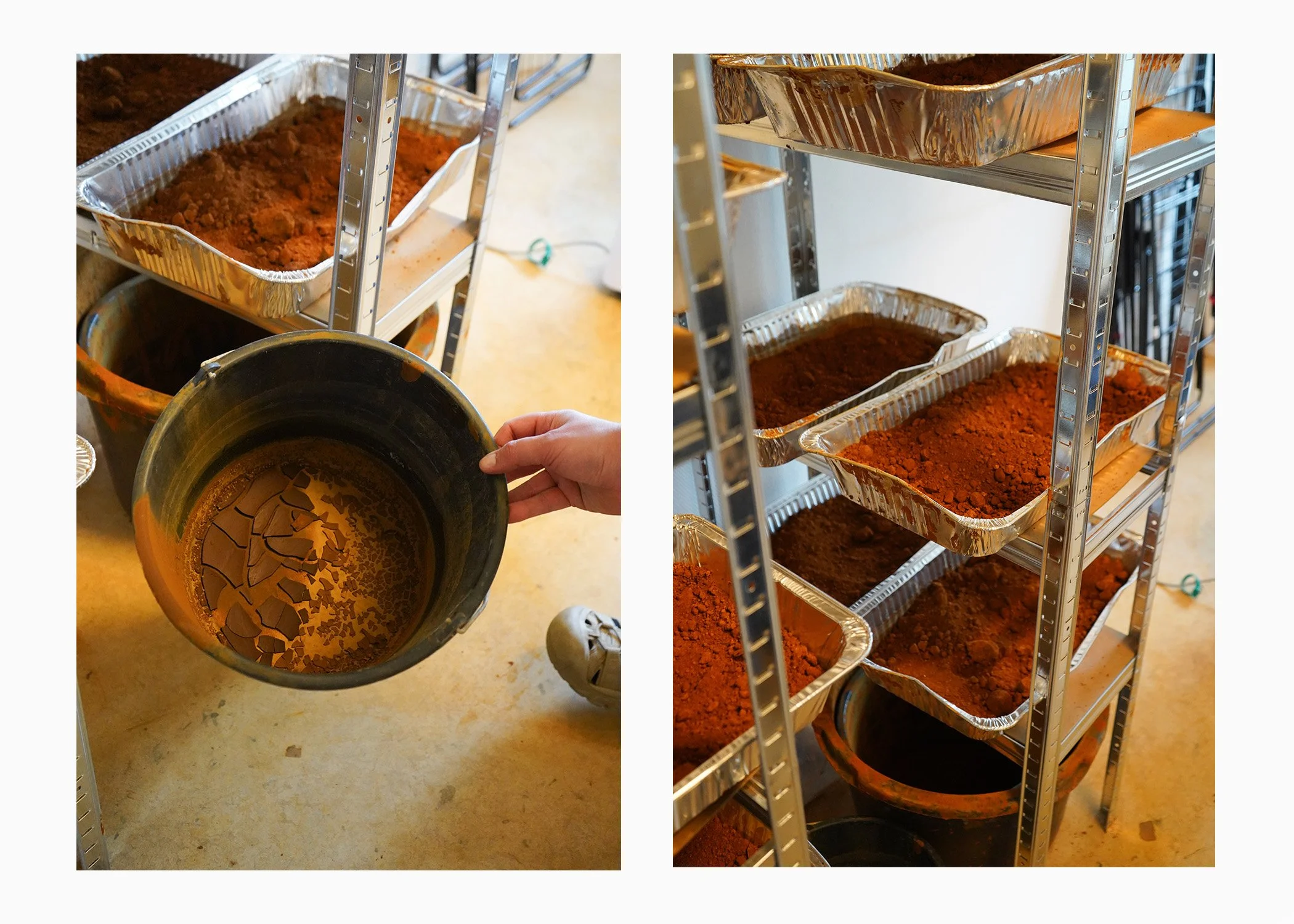
Thomas Woltmann’s Studio
Photograph by Richard Sturges
Your work occupies an interesting space between historic materials and contemporary industrial systems. Do you see this project as a model for others to follow, as a way in which we can use resources that are already available but often neglected?
Yes definitely. There is of course a big motivation and movement currently in many industries to find alternative materials that are circular and sustainable in nature. The big challenge is not finding resources that are neglected, but to figure out how to scale them up and to make them commercially interesting. This is where the bulk of the work is. Its also a task that one can manage on one's own. You need support in so many different areas of business, product and industry. This seemed very hard and intimidating to me a few years ago, but I learnt by taking one step at a time that it is incredibly motivating and purposeful to work towards creating a real industrial alternative. I can only hope to instil some of that in others.
What would need to change for ochre pigments to become a more widespread option in the future of production? Both in terms of natural materials being more widely adopted, and in a way that avoids an extractive industry?