The King, the Cottage and the Copper Mine: A History of the Swedish Red House
The Red Cottage is a symbol of Swedish culture. We may not think of it at first when asked to conjure up images of Sweden, but it is something we are all familiar with either in pop culture, art or even from a visit to Northern Europe. Inspired by a recent trip to Malmö, I was curious to find out where exactly their quaint red houses originated from. The story of the red paint starts in a copper mine in Falun with the waste produced from the ore mined there. It is not until the late sixteenth century that it was used as a pigment for paint on behalf of the then King Johan III. This marked the moment when Falun Red became synonymous with Swedish architecture forever. Since then, it has defined social hierarchy, been the poster girl of government home ownership initiatives, inspired artists and even been taken out of this world.
The Falun Copper mine has been in operation since the seventh century AD. Ore with a lower level of copper in it produces what is known as ‘Red Mull’ which is the pigment of Falun Red. It is formed of copper, iron ochre, silica and zinc and as a waste product, the hue of the mull is dynamic and dependent on the ores it is produced from. This can alter the vibrancy and richness over time and means that Falun Red can vary from a warming deep red to much darker browns. Whilst it is aesthetically pleasing, the paint is also practical and long lasting. Primarily used to paint dwellings, the paint allows the structures to breathe, it lets in moisture and allows it to them quickly evaporate afterwards which protects building exteriors from Sweden’s extreme weather. The rich red colour of the paint has also been known to capture the heat and warmth of the sunlight, with buildings ‘glowing’ in the summer months.
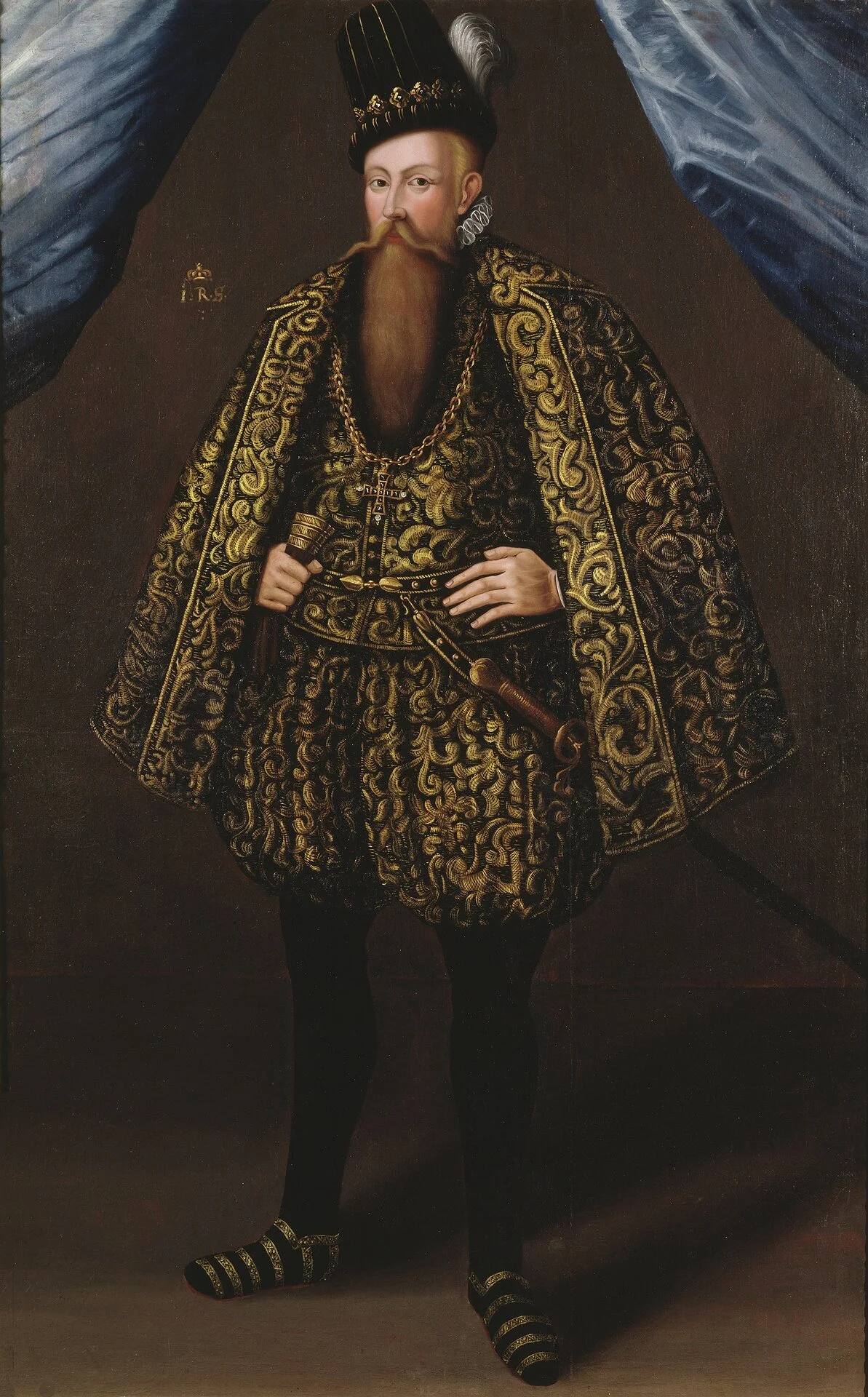
Portrait of King Johan III (1582) by John Baptista van Uther
Image Credit: Wikimedia Commons
Public Domain, https://commons.wikimedia.org/w/index.php?curid=52123309
The first known accounts of using the iconic Falun Red pigment in paint was in the late sixteenth century when King Johan III remodelled his royal residence in Stockholm, the Tre Kronor Palace. The second son of King Gustav I, he was considered ‘worldly’ (by sixteenth century standards) because of his interest in foreign diplomacy whilst still a prince. He spent much of his time in Central Europe, eventually marrying the Polish princess Catherine, sister to the then king [of Poland], in 1562. On his travels not only was he influenced by the renaissance courts he attended and religious reformation, but also contemporary architectural styles which he wanted to bring home to Sweden.
Once king, it was reported that he wrote to his chief architect, Willem Boy (Flemish, Guillaume Boyens, 1520-1592) with his ideas to develop the Tre Kronor palace in Stockholm from a medieval fort to a renaissance royal residence. He wanted to mimic the marble exteriors and red roofs of the palaces he became well acquainted with on his travels. Boyens was instructed to use the ‘mine bran’ from Falun to imitate the red of the roofs and a white lime wash was used on the palace exterior to resemble the marble walls. This is the first known account of using Falun red as a pigment for paint and it was this act that cemented the use of the iconic red paint into Swedish culture. Sadly, Johan’s beloved renaissance palace burnt down in the late 17th century but a painting from 1661 shows his palace in all its splendour. You can see the white walls, the red roofs and the developments made from its medieval origins as a fort, akin to other contemporary palaces at the time.
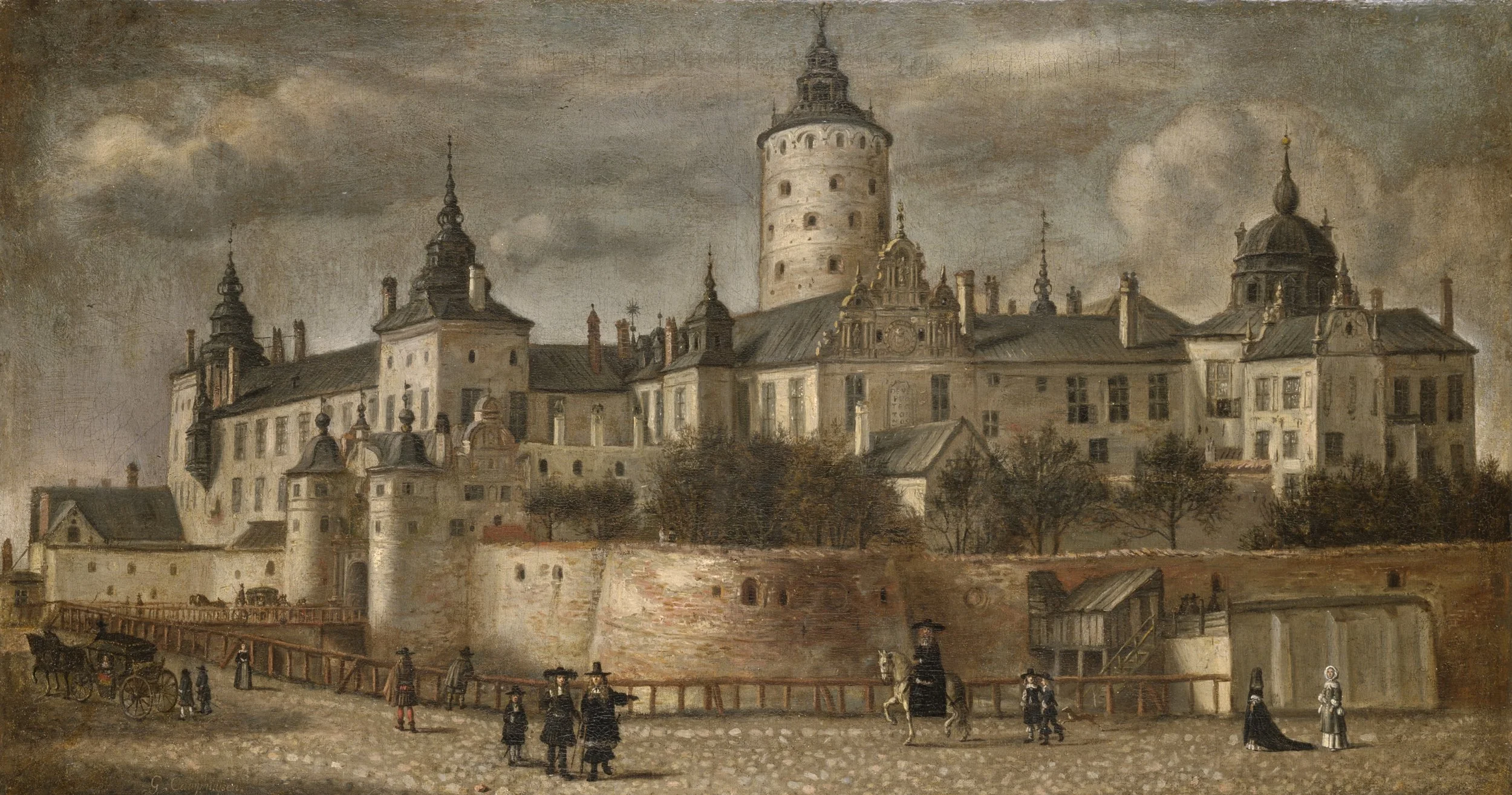
The castle in a painting from 1661 by Govert Dircksz Camphuysen
Image Credit: Wikimedia Commons
From King Johan’s introduction of using the Falun mine red paint, it caused a slow ‘trickle-down’ effect across the Swedish classes resembling style and connection to the royal court. Many aristocrats, members of the clergy and highly ranked military officers wanted their residences to look like the royal palace, becoming an exclusive trend. By the 18th century, using the red became more common and landowners and farmers were using it on their properties and by the end of the 19th century this extended to the working classes cementing the image of ‘the red cottage’ into national identity. By then, it was not just about fashion anymore; farmers and rural communities saw that the paint offered their homes protection against the harsh weather, making them more durable.
In the mid late 19th century, national romanticism had taken hold amongst many groups of European artists, particularly in Sweden. It was seen as a style that could bring back the fundamentals of culture and heritage and bringing them into contemporary art with many of its followers drawing on traditional techniques. It idealised national identity with many artists using imagery that resembled this; in Sweden many turned to producing folk arts and crafts, capturing the dramatic landscapes in the countryside and of course the red cottages. One of the more famous of these groups was the Rackstad Colony formed in the 1890s of artists, craftspeople and creatives gathering around lake Racken in the rural Varmland who followed the principles of the national romantic movement. They sought to capture the ‘true nature’ of the nation; its moody light, deep blue twilights, snowy forests and the red cottages. Lake Racken was chosen as a base for the artists commune because it would allow them to become immersed in the natural surroundings that so influenced their art.

Carl Larsson-gården
Image Credit: Wikimedia Commons
Por Carl Larsson - Nationalmuseum, Domínio público, https://commons.wikimedia.org/w/index.php?curid=52113011
The life and works of Carl Larsson (Swedish, 1853-1919) show off these ideals in his watercolour paintings of his farmhouse outside of Falun. Like many Swedish artists during the 19th and 20th centuries, he moved to Paris to further his career where he became skilled in illustration, watercolour painting and photo colour reproduction. On his return to Sweden, he and his family moved to Lilla Hyttnas which is located in Sundborn just outside Falun. The house, which is now a museum dedicated to Carl and his wife Karin boasts the idyllic rural Swedish life that the government Own your own home scheme sought to promote. Whilst living at the house, Larsson was famed for his interior paintings of family life in the cottage – showing the influence of the ‘good life’ in art and culture at the time. Neither the movement nor the artists that followed it were ever overtly political. However, in other areas of Europe it was associated with countries seeking to find an identity in the fundamental beauty of their homelands after centuries of wars, border changes and power struggles within the European elite.
The Swedish government was adapting to the changes of the 19th century; the rise of socialism, industrialisation and urbanisation. Like many European metropolises this brought mass overcrowding to cities as many sought to relocate for better job prospects. To combat this, the government introduced the Own your own home scheme that encourages workers to buy houses for their families in suburban and rural areas. This gave families the opportunity to escape overcrowded dwellings in the city so they could have their own space. It was pitched as a more idyllic way of life and would have likely been a safer choice in comparison to city life. Homes built under this scheme, rather unsurprisingly, were the iconic cottages painted in Falun red, cementing the connection between the red house and the ‘good life’ into Swedish culture. Not only was this a fashionable choice for homes built across the Scandinavian region, but it was discovered that the paint had practical qualities too. It offered structural protection to the harsh elements of Swedish weather making wooden structures far more durable.
Today the red cottage has become synonymous with Sweden globally. On travel sites and social media, it has become a ‘selling point’ for travellers visiting Scandinavia and the imagery surrounding the idyl of the red cottage has taken over interior design trends across the globe. It still holds strong Swedish artist Mikael Genberg has embarked on multiple projects that centre around the infamous red house; placing one under water, on the water, in a tree and even on the international space station. His latest red house project, 25 years in the making, was to place a little red house on the surface of the moon.
The idea was to take the most Swedish of all symbols, the red house, the white corners. I live in one. I was raised in one. My parents live in one. Taking this symbol and putting it in the most unreachable place thinkable for me. The moon. (Mikael Genberg, 2025)
Taking off in from the Kennedy Space Centre (USA) in late 2024, it was due to make its landing on the moon in June 2025. The house was attached to a lunar rover which was to deliver it to the surface of the moon, photograph it, and return to Earth.
The house arrived on the moon; however, signal was lost during the mission and it is believed to have crash landed. “Maybe a bit tainted. Maybe a bit bruised by the hard landing. But still – the house is there.” The quote that greets visitors to the project’s website, marking its conclusion. It is clear that the ‘red house’ is still influential with contemporary Swedish artists and acts as a cultural symbol. It will be interesting to see where Mikael decides to place a red house next.
Sources
Brunnström, P., Gladoić Håkansson, P. & Uppenberg, C. (2021) Migration and housing regimes in Sweden 1739–1982. Scandinavian Journal of History, 46(3), pp. 353–382. DOI: 10.1080/03468755.2020.1843532.
Carl Larsson [https://www.carllarsson.se]
Falu Gruva (n.d.) Modern in All Times [https://www.falugruva.se/en/moderninalltimes/falugruva]
Falu Rödfärg (n.d.) The History of the Red Cottage – the history of Falu Rödfärg [https://falurodfarg.com/en/about/the-story-of-the-red-cottage/]
Falu Rödfärg (n.d.) The Unique Pigment [ https://falurodfarg.com/en/about/the-unique-pigment]
House & Garden (n.d.) All About Swedish Red Cottages. [https://www.houseandgarden.co.uk/article/red-swedish-cottages-falu]
John III of Sweden (n.d.) Encyclopaedia Britannica. [https://www.britannica.com/biography/John-III-king-of-Sweden]
Kungliga Slotten (n.d.) The Royal Palace – History [https://www.kungligaslotten.se/vara-besoksmal/kungliga-slottet/kungliga-slottets-historia.html]
‘National Romanticism’ Oxford Reference (n.d.) Authority Entry Available at: [https://www.oxfordreference.com/display/10.1093/oi/authority.20110803100224524]
‘The Rackstad Colony’ Rackstadmuseet [https://www.rackstadmuseet.se/shop?funk=page&access_token=ea151d4cc07c6dd61132703c1d6e23a46256861a]
The Moon House [https://themoonhouse.se/]
The Swedish Red Cottage [https://visitsweden.com/about-sweden/swedish-red-houses]