Power of Purple: Murex Dye in Mesopotamia
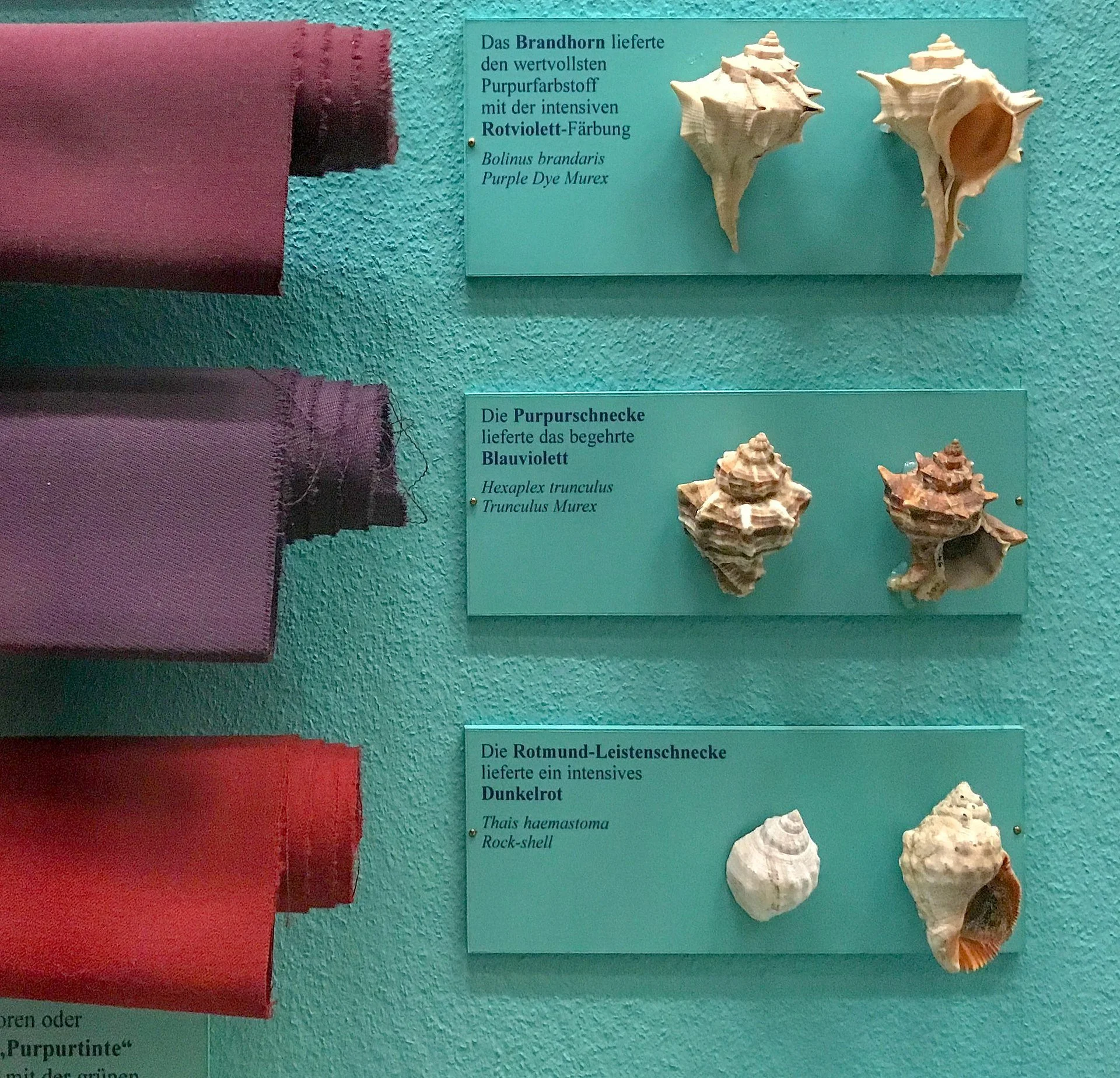
Fabrics dyed in the current era from different species of sea snail. The colours in this photograph may not represent them precisely.
Image Credit: Wikimedia Commons
The meaning of colours are socially constructed. Within the context of Mesopotamia during the late Bronze Age to early Iron Age, purple-dyed textiles were associated with status and prestige. Visual markers of status were important for the upper echelons of society, as it communicated their separation from the majority of society. Clothing is a tool that can be used to uphold and reinforce power dynamics, acting as a visual symbol of exclusivity. In the case of purple-dyed clothing this exclusivity is particularly evident, as the process of dyeing was so complex and unpleasant that only a few could afford to wear it. Throughout different eras rare and labour-intensive products have often been used to demonstrate prestige.
The purple dye that is commonly named ‘Tyrian purple’ and ‘Royal purple’, is derived from the hypobranchial gland of sea snails from the Muricidae family. However, when referring to this dye here to keep it consistent the term ‘Murex dye’ is used. This form of purple dye was highly prized due to its exclusivity and colour fastness. Murex dye was considered exclusive because it was expensive to purchase as the production of the dye was tedious and required an abundance of resources. This was confirmed later as the main component of murex dye (6,6’-Dibromoindigo) was identified by Paul Friedländer in 1909, who also discovered that 12,000 Bolinus Brandaris (a sea snail species in the Muricidae family) are required to produce only 1.4 g of pure pigment.
Interestingly in the case of murex dye during this period, there is a contrast between the lowly and common natural sources used to make the dye and the value attributed to it by people. This begs the question of how something that comes from a lowly natural source can become an exclusive and highly prized commodity for the elite? An intriguing lens to analyse this is through abjection theory. This theory was developed by philosopher and literary critic Julia Kristeva and is not easy to define. Yet this theory alludes to when something is separated from what is deemed as normal because it “disturbs identity, system [or order].” Given that the process of extracting murex dye involves decayed sea snails and the extraction of bodily fluids, which are typically considered abject. This impacts the mystique behind murex-dyed clothing. Signifying that the value of purple-dyed textiles is dependent on the boundary and separation of the “clean” final dyed textile and the “unclean” production to make it. It is the perceived separation that transforms something that is deemed as repulsive into something desirable and prestigious. Which presents how the lowly source of sea snails through laborious and unpleasant work, can be transformed into a highly prized commodity.
Regarding purple’s impact on social boundaries and identity, those who would wear clothing that was dyed purple are highly recognisable due to the visual difference that separates them from the majority of society. Examples of how purple-dyed textiles upheld elite status and social functions include the Bronze Age royal tomb at Tell Mishrifeh (Qatna). There is direct archaeological evidence of purple-dyed textiles found at this tomb, which was sealed in 1340 BC but is estimated to have been in use from 300-400 years prior to this. Archaeological fibres are rare and sparse, however through high-performance liquid chromatography testing the textile samples found are detected to be from murex-based dyes. Which marks one of the earliest links between purple-dyed textiles, royalty and divinity. The existence of purple-dyed textiles found in the context of a royal tomb clarifies their elite status, and visually marks their separation from the majority of society.
Another context of purple-dyed textiles used as a visual marker of status is at the Timna Valley, where at an early Iron Age copper mine purple-dyed fibres have been found. There is evidence of both murex and plant-based dyed textiles, since these were textiles only accessible to the elite, it supports the idea that these metal workers had a high social standing. This highlights the importance of metalworkers at the Timna Valley, due to their indispensable skills which elevate their social standing. The existence of both plant-based and murex dyes found together could also imply that there was a range in prestigious dressing to participate in, without having to depend on murex-dyed goods exclusively. Its reference to the value associated with murex purple allows those in the higher echelon of society to access a range of luxury goods, which can also function as different markers of prestige within a social hierarchy. Presenting how vital colour was in identity formation and as a visual marker of aspiration through dress. A nuance that is important to mention is that purple-dyed clothing in Mesopotamia was not all dyed in one monotone colour. With purple-dyed elements including trims and embellishments, presumably the more purple embellishment on one's clothing is another visual marker of prestige.
Beyond the technique of creating purple dyes using sea snails, purple dye sources were made with other innovative materials in Mesopotamia as seen above in the Timna Valley. Often plant-based dye sources were used to create imitations of murex dyes, for instance with madder and woad. However, innovation of purple dyes is not limited to the use of different dye sources but also different techniques. A technique noted in the ‘Sippar Dye Text’ (the oldest and only text preserving instructions for colouring wool from Mesopotamia), includes overdyeing where woad-dyed wool is then overdyed with madder. Another technique as seen at the Timna Valley, is to weave threads of madder and woad together to create an optical illusion of appearing purple from afar. Plant-based dyeing methods would have been practiced globally before records existed, however Louise Quillien has suggested that plant-based imitations of murex dye may have been invented to “counter the monopoly of the Levantine cities”. This may infer that imitations were a reactionary response to not only make similar coloured dyes more locally, but also to make the production more affordable and not solely reliant on imports from the Levantine coastal cities. Presenting that arguably the experimentation of different dyeing techniques was partially due to geographic constraints, as inland Mesopotamia would have used mostly plant-based sources to create those same colours.
Even though these techniques were known in Babylonia during the 1st Millenium BC, expensive murex dyed wool was imported to Babylonian cities such as Sippar, with these precious dyes used mostly by temple craftsmen potentially for important cultic purposes. Though in Sippar, temple craftsmen also purchased dyestuff at local markets, meaning that these goods were not exclusive to the temple and perhaps prevalent in society for the urban elite. By extension this suggests that both murex and plant-based imitations were used in the temple, this is intriguing as the term ‘imitation’ can have negative or deceitful connotations, yet at least in Sippar it is doubtful that something that held negative intent would have been used in religious contexts to honour the gods. This could mean that plant-based imitations of precious dyes were not perceived to be subterfuge. It is plausible that perhaps imitation dyes in regions with no local murex production were still seen as aspirational, as they are good enough for dressing divine statues. Whereas in regions where murex dyes are produced or nearby to them may have had an association with imitation dyes are seen as adulterated and of lesser quality instead of as simply different. The development of imitation dyes reflects innovations in material culture, and are not inherently deceitful, presenting the various ways that purple dyes were experimented with as well as used as a social performance.
As mentioned above, the term ‘imitation’ tends to have a negative connotation, however the development of imitation dyes reflects the evolution of dye experimentations as well as changes in material culture. In this context, it can be suggested that imitation murex dyes can be defined as skeuomorphs as they replicate the design outcome of murex dyes using different materials, not solely as a utilitarian necessity or a ruse but as a form of creative innovation. A skeuomorph can be “copies or prototype artifacts replicated in different physical materials in the derivative objects”. Skeuomorphs contribute to a social performance where value is constructed to an object not by its intrinsic quality but based on social conditions. As murex dye was a prestige technology, an imitation product based on this is still perceived as aspirational. An example of this relative scale of worthiness can be seen at the Timna Valley, where evidence has been found of plant-based dyed textiles alongside the findings of murex-dyed textiles. The plant-based dyed textiles are made from madder and woad, and were not produced there, meaning they were acquired through long-distance trade. Initially it may seem unclear why this region would import both murex and plant-based textiles from other regions, and what this says about the social structure of society at Timna during the early Iron Age.
If both products cannot be produced in the region, why was there a demand for both and does the existence of an imitation dye subvert or reinforce the social status attributed to murex dye? Arguably the creation of an imitation purple allows societies to participate in prestigious symbolism without having to exclusively depend on murex dye. Imitations allowed for more access to this expression of status as the material was much cheaper compared to murex dyes. While murex dyes would have acted as the quintessential status symbol, plant-based versions would allow different levels within the elite to participate with this visual marker of status. As imitation dyes can classify as a skeuomorph, its reference to the value associated with murex dye allows those in the higher echelon of society to access a range of luxury goods, which also function as different markers of prestige within a social hierarchy. Presenting how important colour was in identity formation and as visual markers of aspiration and hierarchy through dress.
Murex dyes as well as its plant-based imitations present how colour has been used not just as objective materials, but as a socially constructed technology of prestige. These purple dyes are an example of how colour can contribute to perceptions of status, purity and proximity to power.
Sources
Blitz, J. H. (2015). Skeuomorphs, Pottery, and Technological Change. American Anthropologist, 117(4), 665–678. https://doi.org/10.1111/aman.12349
Brøns, C., Thavapalan, S., Dardeniz, G., Moutsiou, T., Blakolmer, F., & Pelletier-Michaud, L. (Eds.). (2020). The value of colour: Material and economic aspects in the ancient world (Berlin Studies of the Ancient World 70). Edition Topoi. https://doi.org/10.17171/3-70
James, M. A., Reifarth, N., Mukherjee, A. J., Crump, M. P., Gates, P. J., Sandor, P., Robertson, F., Pfälzner, P., & Evershed, R. P. (2009). High prestige Royal Purple dyed textiles from the Bronze Age royal tomb at Qatna, Syria. Antiquity, 83(322), 1109–1118. https://doi.org/10.1017/S0003598X00099397
Kristeva, J. (1984). Powers of horror: An essay on abjection. Columbia University Press. Pastoureau, M. (2017). Blue: The history of a color. Princeton University Press.
https://doi.org/10.2307/jj.5425895
Sukenik, N., Iluz, D., Amar, Z., Varvak, A., Workman, V., Shamir, O., & Ben-Yosef, E. (2017). Early evidence (late 2nd millennium BCE) of plant-based dyeing of textiles from Timna, Israel. PloS One, 12(6), Article e0179014. https://doi.org/10.1371/journal.pone.0179014
Sukenik, N., Iluz, D., Amar, Z., Varvak, A., Shamir, O., & Ben-Yosef, E. (2021). Early evidence of royal purple dyed textile from Timna Valley (Israel). PloS One, 16(1), Article e0245897. https://doi.org/10.1371/journal.pone.0245897
Thavapalan, S. (2018). Purple Fabrics and Garments in Akkadian Documents. Journal of Ancient Near Eastern History, 3(2), 163–190. https://doi.org/10.1515/janeh-2017-0007
Thavapalan, S. (2023). Ingenious crafts: Tricks, tips and techniques for dyeing wool in ancient Mesopotamia (c. 2000-500 BCE). In J. Dyer & J. Kirby (Eds.), Dyes in history and archaeology 37/40: Including papers presented at the 37th meeting held at the Faculty of Sciences and Technology, NOVA University of Lisbon, Campus Caparica 25–27 October 2018, the 38th meeting held at the University of Amsterdam, 6–9 November 2019, and the 40th meeting (online conference) hosted by the British Museum, London, 15–19 November 2021 (pp. 47–56). Archetype Publications.
Thavapalan, S. (2025). Red, white and black: Methodologies for understanding colour symbolism in Mesopotamian magic and ritual. Journal of Ancient Civilizations, 40(1), 1-23.
Wolk, J. L., & Frimer, A. A. (2010). Preparation of Tyrian purple (6,6'-dibromoindigo): Past and present. Molecules, 15(8), 5473–5508. https://doi.org/10.3390/molecules15085473
Images
By Photograph: U.Name.MeDerivative work: TeKaBe - This file was derived from: Purple Purpur.jpg:, CC BY-SA 4.0, https://commons.wikimedia.org/w/index.php?curid=94992996