1816: The Year the Sky Changed Colour
Colour is a visual phenomenon that resists simple definition, despite extensive scientific study and ongoing attempts to quantify it empirically. Philosophically and academically, the choice of colour within painting has been examined in detail; we are eager to understand how colours shape the world around us and if they reveal secrets about the artists who put them on the canvas. There are times, like the spring of 1815 (and the subsequent few years), when colours in the natural world changed so significantly, in tandem with the rise in the Romantic sublime, that paintings of that era hold immense significance.
It’s the summer of 1816 and the sky is dark, darker than any summer should be. Nothing will disperse the wet and the fog, not wind nor rainfall and Europe is clouded over with a quietly pervasive feeling of damp dread. In a letter written on June 23, 1816, Jane Austen laments about the cold and wet: ‘Oh! It rains again; it beats against the window, ’ she writes, adding, ‘such weather gives one little temptation to be out. It is really too bad and it has been for a long time, much worse that anybody can bear and I begin to think it will never be fine again.’ Sadly, perhaps a perilous prediction of her upcoming demise, as in May of the following year, Austen was taken by carriage through torrential rain to Winchester Hospital, where she died in the arms of her sister Cassandra on July 18.
Such supernatural musings were forgivable given the famine and destruction throughout Europe; an earthquake had rumbled across the Midlands, felt as far north as Liverpool on 17 March 1816, adding to the general sense of foreboding across the nation. Before the relentless torrents of rain that summer, there were already records of bad weather and a general sense of socio-economic and political unrest. The Napoleonic wars ended just the year before, with more than 900,000 French soldiers dead. The poor weather further exacerbated this decline: in Europe, food was becoming scarce, harvests and crops failing, and there were many riots throughout both the United Kingdom and the continent of Europe. There was no spring, no summer, and no harvest, and people were tired, scared, and cold.
In Switzerland, that same summer of 1816, on the shores of Lake Geneva, a group of young Romantics, fleeing the dysfunction of the British Isles, were stuck inside their rented villa. Lord Byron, along with John Polidori, Percy Shelley and Shelley’s girlfriend Mary Godwin, as well as Mary’s step-sister Claire Clairmont, spent the damp summer reading from Fantasmagoriana, a French book of German ghost stories. Bored by the confinement and excited by the unnerving stories being read, Byron suggested that they should each compose their own, opening up a contest amongst the writers, a competition that would spawn the literary phenomenon known as “Frankenstein”, written by the then eighteen-year-old Mary Godwin, later known as Mary Shelley.
Little known to the small group in Switzerland, on the evening of April 14th 1815, on a small island called Sumbawa in present-day Indonesia, a volcano known as Mount Tambora produced its largest eruption for ten thousand years. Mount Tambora was a sleeping giant; the tallest mountain in the region and long believed to be lying dormant. On that spring evening, three plumes of flaming lava rose and merged, and the sky slowly closed over with a veil of volcanic ash and debris. The entire peak appeared consumed in biblical fire, engulfed in lava flows and spewing ash and debris as far as the eye could see. The veil of ash that smothered the top of the mountain began quickly to heat the air above, creating a vacuum into which the cooler air rushed to fill, resulting in a whirlwind across the landscape, which uprooted trees and destroyed the entire island's vegetation and crops. The village of Tambora was lost to the world, much in the same way as Pompeii, with devastating effects and the language and history of the Tambora people were lost with the eruption. The cloud of ash that was released into the atmosphere during the eruption quickly rose to the stratosphere and eventually those particles came together into a single, impenetrable cloud that covered Earth. By the winter of 1815, this nearly invisible veil had encircled the globe, reflecting sunlight into space, cooling temperatures and disrupting weather patterns worldwide. The colours in the sky were changing, yet at the time, understanding was unknowable: the event occurred before the invention of the telegraph and news of the eruption did not reach Europe for many months. It is only with hindsight that 1816 has become known as ‘the year without a summer’.
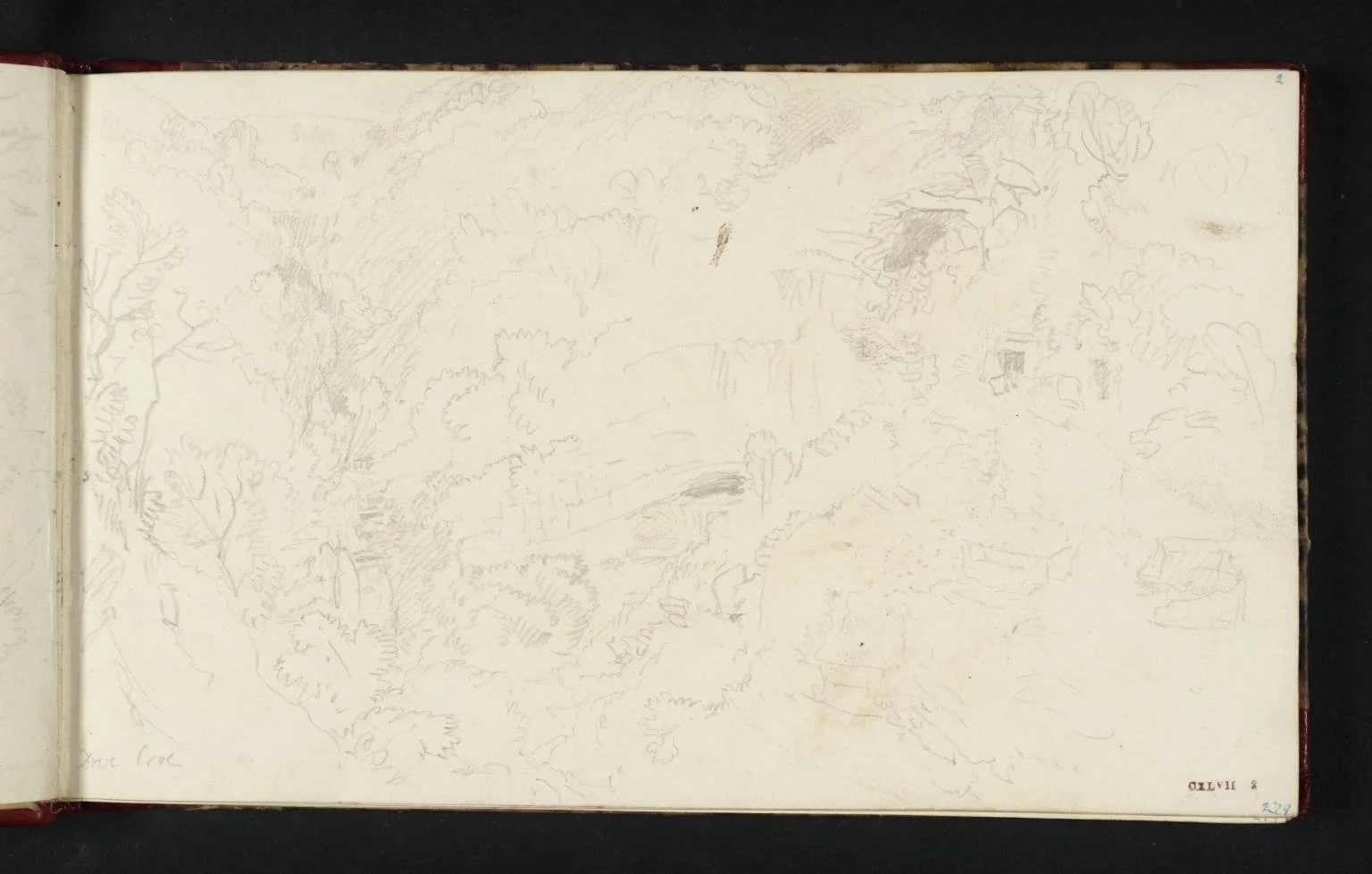
David Hill, ‘Dow Cave, near Kettlewell, Upper Wharfedale 1816 by Joseph Mallord William Turner’, catalogue entry, February 2009, in David Blayney Brown (ed.), J.M.W. Turner: Sketchbooks, Drawings and Watercolours, Tate Research Publication, December 2013, https://www.tate.org.uk/art/research-publications/jmw-turner/joseph-mallord-william-turner-dow-cave-near-kettlewell-upper-wharfedale-r1143578, accessed 10 December 2025.
In 1816, forty-one-year-old J.M.W. Turner, perhaps England's most famous painter, was scrambling around in the dirt of the English countryside, complaining to those he encountered about the terrible weather of the season: ‘Weather miserably wet. I shall be web-footed like a drake…but I must proceed northwards. Adieu’, he lamented in a letter to a friend, dated July 31, 1816. J.M.W. Turner was out in the elements that summer on a specific assignment, a slightly different conquest to his usual ramblings. He had been commissioned by Longman & Co, a longstanding publishing company, to produce one hundred and twenty watercolours for an illustrated history of Yorkshire. J.M.W. Turner was known for his deep appreciation and significant connection to the area, having spent long weeks and months touring the Yorkshire Dales at the turn of the nineteenth century. Despite planning on travelling alongside colleagues and friends whilst working on this commission, the torrential rains and persistent bad weather resulted in J.M.W. Turner taking the trip alone. A page of one of his sketchbooks remains coated in mud to this day, perhaps a sign of his relentless dedication to the trip despite the adverse conditions. Noticeably, as the weather impacted his journey, so did the volcanic eruption, affecting his use of colours in the following years. J.M.W. Turner’s rich landscapes and choice of red carmine pigment, capturing the apocalyptic colouring of the time, encoded within green and red pigment.
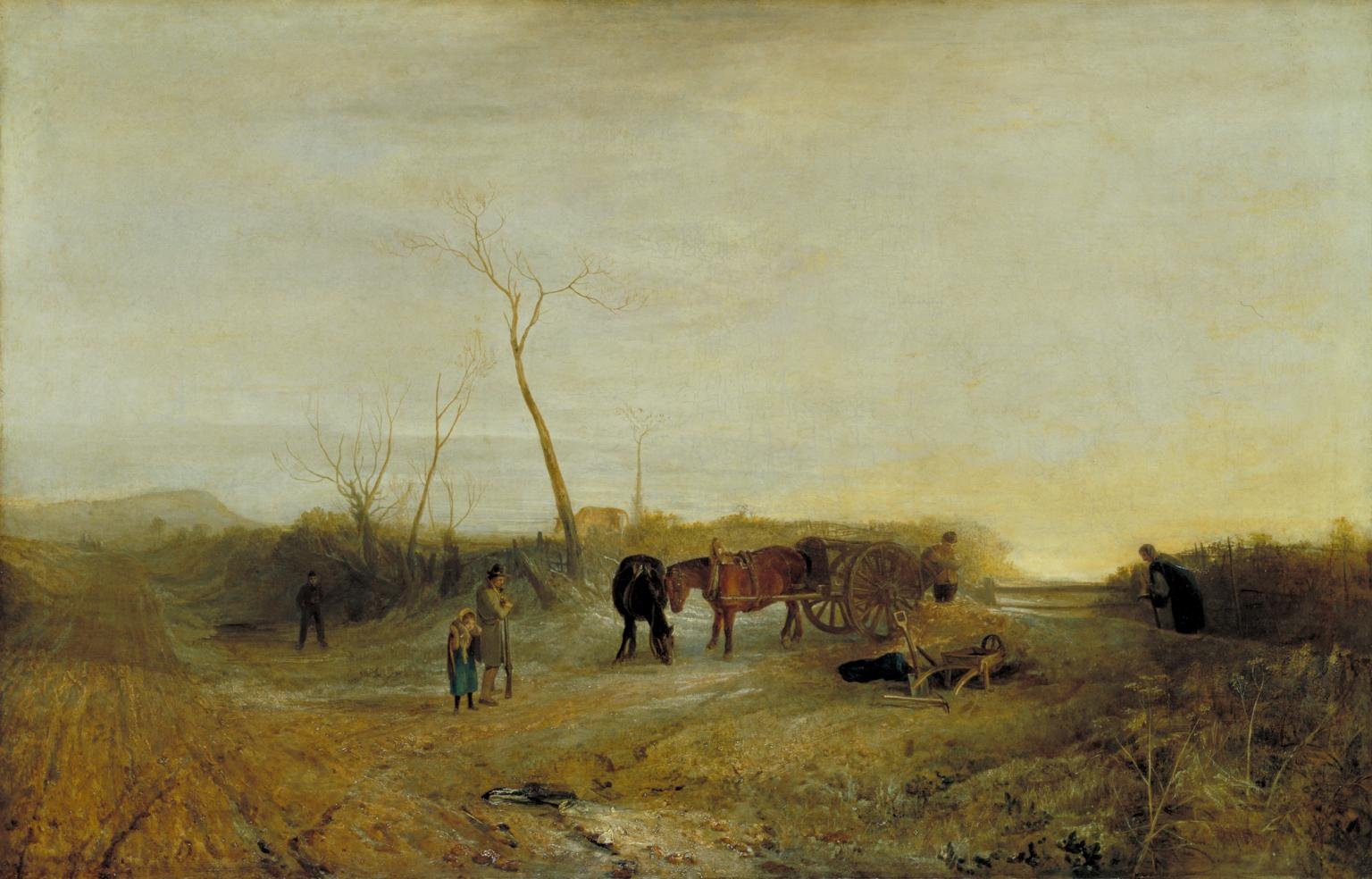
“Forsty Morning,” Joseph Mallord William Turner, 1813
Image Credit: Wikimedia Commons
Early in his career, J.M.W. Turner’s work was criticised for being too vague. At the time, within the Royal Academy, the fashion was for biblical accuracy: a clear definition between the mountains, the sky and therefore god. However, in 1813 at the Royal Academy Summer Show, J.M.W. Turner exhibited “Frosty Morning”, a work described as a ‘picture of pictures’, being J.M.W. Turner’s most successful piece that year. Here, J.M.W. Turner was painting ‘just as in nature’, with his landscapes and skies depicting what he saw with true clarity and ardent vulnerability; the “Spectator” on April 26th, 1835, writing: ‘The hard frosty ground, the naked trees, the cold, dead, white sky, and the pale, weak, yellow gleam of sunlight, that scarcely relieves the cheerless desolation, or lessens the cold of the air, are imitated with the most delicate truth. Here are no raw white masses of snow and black branches, but the true tone of nature is imitated to perfection, for the picture conveys the feeling of the season.’ A focus on the sublime had been rising within artistic theory and the connection between a natural disaster and the unknowable terror of nature is almost too obvious to state; J.M.W. Turner was a Romantic, part of a group of artists who were asking for nature to be revered. It is whispered in the halls of galleries and rumoured within the margins of history books that the last words uttered by Joseph Mallord William Turner are none other than, ‘Sun is God’, a true believer in the sublime.
With the changing of the climate of 1816, J.M.W. Turner’s detailed notation of colour reflected in modernday interpretations allows us a glimpse into the effect atmospheric and stratospheric circumstances had on the tonal shift of the world during that summer. Paintings from this era, specifically a number by J.M.W. Turner, have been used in recent scientific studies as an attempt to try and understand the climate of the time and the effect of the eruption on the atmosphere of the planet. When it comes to the climate of our past, often we have to rely on what is written about through art and culture, and Christos S. Zeferos, head of the research centre for Atmospheric Physicsand Climatology at the Academy of Athen, and his colleagues wanted to see if the colours of certain artists could tell us more about what it was like during that time. They aimed to try and understand and reconstruct the climate from a time in which there is barely any empirical data. To do this, they used a source of information that would not usually be considered for scientific measurement: they analysed the sunset colours depicted in hundreds of paintings between 1500 and 2000, an epoch in which there were over fifty volcanic eruptions. The hypothesis was that after major volcanic eruptions (which inject aerosols into the stratosphere), sunsets become redder and more vivid and perhaps, paintings from masters of the time reflect that. Taking from the colours of the skies depicted in the artwork, the team calculated the amount of aerosols like sulphates and ash in the air by measuring the red to green colour ratios as red and green tones intensify when airborne particles scatter more sunlight. Comparing their estimates to the actual amount of ash particles present in the atmosphere at the time of the painting, using ice core samples and other measurements, the team found that the ratio of red to green paint used in sunset representations corresponded to the actual level of volcanic aerosols in the atmosphere. Zeferos was also careful to point out that these occurrences were present regardless of which painter or school of painting was responsible for the artwork. The volcanic ash in the atmosphere caused red-orange sunsets, more notable than the period before 1500.

“The Lake, Petworth, Sunset,” Joseph Mallord William Turner, 1828
Image Credit: Wikimedia Commons
The eruption of Tambora was no outlier within this and the ash that affected the weather also had a great impact on Joseph Mallord William J.M.W. Turner’s works of the time. J.M.W. Turner’s “Red Sky and Crescent Moon” (1818) in his Skies Sketchbook is an excellent example of this: the vibrant, but subdued colours used for this study of the early evening sky may reflect the unusual atmospheric conditions. Compare this work to “The Lake, Petworth, Sunset,” painted by J.M.W. Turner in 1828 and the colours used are dramatically and irrevocably different.

“Decline of the Carthaginian Empire,” Joseph Mallord William Turner, 1817
Image Credit: Wikimedia Commons
In the newly opened show at Tate Britain, Turner & Constable: Rivals & Originals, extensive examples of both J.M.W. Turner and Constable's way with colour are freely given, and if you look closely, the effects of Tambora can still be felt. In the 1817 painting by J.M.W. Turner, The Decline of the Carthaginian Empire, the impact of the volcanic eruption can still be seen in the scene, even if the work isn’t exactly as representative of the English landscape as you might expect. The painting depicts a scene, the sun setting over the northern African settlement of Carthage, the centre of the world's most powerful empire until the birth and rise of Ancient Rome. The sun hangs low in the sky, a haze coating the scene with warm orange light, echoes of volcanic hues seeping into the tonal quality of the painting. Concerned with the sociopolitical landscape of the time and painted two years after France’s defeat at Waterloo by the British, the scene would have been immensely recognisable to the British public. As these works by J.M.W. Turner were committed to canvas many years before the invention of the camera, it is important to consider that these paintings become the camera; in a time before colour photographs were invented, these works of art are some of the most accurate depictions of the environmental changes that occurred after the Tambora eruption.
The full impact of large volcanic eruptions on climate and society, magnitude, timing and geographic reach, remains incompletely understood. By 1816, society was already facing severe hardship and food shortages from the war years. This makes it difficult to separate the specific weather effects of Tambora from the broader calamity of political unrest in Europe already underway. What is perhaps less complicated to establish, though, is that the skies and clouds of that summer had changed, as made clear through the works and sketchbooks of J.M.W. Turner and others. They present to us a localised and personal perspective of the weather and climate, colours taking centre stage and speaking first. Weather is inescapable in the works of the Romantics, both literary and painterly, and never before had they experienced the conditions that characterised the ‘year without summer’. A tonal shift in colour signifies a deep connection to the climate and is perhaps something we can not only study for scientific benefit, but also learn from; this deep, intertwined watching of the sky and recording what is present with intent and clarity.
Turner & Constable: Rivals & Originals, Now Open at Tate Britain, 27th December 2025 until 12th April 2026
Sources
Bibliology. “The Night Frankenstein Was Born.” 2021. https://www.biblio.com/blog/2021/10/thenight-frankenstein-was-born/.
Climate in Arts and History. “Volcanoes in Art.” https://www.science.smith.edu/climatelit/ volcanoes-in-art/.
Climate in Arts and History. “The Eruption of Mount Tambora (1815–1818).” 2023. https://www.science.smith.edu/climatelit/the-eruption-of-mount-tambora-1815-1818/.
Discover Magazine. Learn, John R. “How Mount Tambora and Other Volcanic Eruptions Inspired Artistic Masterpieces.” 2021. https://www.discovermagazine.com/how-mount-tambora-and-other-volcanic-eruptions-inspiredartistic-42291.
Klingaman, William K. “Tambora Erupts in 1815 and Changes World History.” Scientific American, 2013. https://www.scientificamerican.com/article/1816-the-year-without-summer-excerpt/.
Mercer, Alexandra. “On This Day in 1816: Introducing ‘The Year Without a Summer’ (Part I).” BARS Blog, 2016. https://www.bars.ac.uk/blog/?p=1024.
Tate. The Art of the Sublime. https://www.tate.org.uk/art/research-publications/the-sublime.
Veale, Lucy, and Georgina H. Endfield. “Situating 1816, the ‘Year Without Summer,’ in the UK.” The Geographical Journal 182, no. 4 (2016): 318–330. https://doi.org/10.1111/geoj.12191.
Wood, Gillen D’Arcy. “‘1816, The Year Without a Summer.’” BRANCH: Britain, Representation and Nineteenth-Century History. https://branchcollective.org/?ps_articles=gillen-darcy-wood-1816-the-year-without-a-summer.
Zerefos, Christos S., et al. “Environmental Information in Red-to-Green Ratios in Paintings by Great Masters.” Atmospheric Chemistry and Physics 14 (2014): 2987–3015. https://doi.org/ 10.5194/acp-14-2987-2014
Tambora Legacy Project. “Paintings in The Year Without a Summer.” 2018. https://tamboralegacy.wordpress.com/2018/04/30/paintings-in-the-year-without-a-summer/.
Images
https://www.tate.org.uk/art/research-publications/jmw-turner/joseph-mallord-william-turner-dow-cave-near-kettlewell-upper-wharfedale-r1143578
https://commons.wikimedia.org/wiki/File:Turner_-_Frosty_Morning,_exhibited_1813,_N00492.jpg
https://commons.wikimedia.org/wiki/File:Joseph_Mallord_William_Turner_(1775-1851)_-_The_Lake,_Petworth,_Sunset,_Sample_Study_-_N02701_-_National_Gallery.jpg#/media/File:Joseph_Mallord_William_Turner_(1775-1851)_-_The_Lake,_Petworth,_Sunset,_Sample_Study_-_N02701_-_National_Gallery.jpg
https://commons.wikimedia.org/wiki/File:Joseph_Mallord_William_Turner_-_The_Decline_of_the_Carthaginian_Empire_-_WGA23169.jpg
Cover Image
https://commons.wikimedia.org/wiki/File:Horror_und_Delight-Turner-Light_and_Colour_%28Goethe%27s_Theory_DSC2254.jpg