The Invention of Black
A History of Darkness, Depth and the Colour That Defined Art
“Black is the queen of all colours.”
Kazimir Malevich
Black is one of the oldest pigments in human history, yet also one of the most technologically elaborate. It has been used to illuminate cave walls, define sacred texts, elevate royal fashion, rupture artistic conventions and even spark legal and philosophical battles in the modern day. More than any other colour, black challenges the boundaries between presence and absence, material and immaterial, light and shadow.
To trace the invention of black is to follow human creativity from the charcoal of prehistoric fires to the nano-structures of modern laboratories. It is a story of chemistry and symbolism, of darkness and innovation, of artists who turned void into vision.
Origins: Black in Prehistoric Art
Long before human beings developed agriculture, written language or metal tools, they mastered one of the most elemental pigments: carbon black. Produced by charring organic materials -wood, bones, plant matter- carbon black offered prehistoric artists a versatile medium for line, shading, and depth.
In caves such as those of Chauvet, Lascaux and Altamira, black outlines and shadowing define animal bodies with astonishing sophistication. The earliest black pigments were used not only as artistic tools, but as narrative devices. They emphasised movement, perspective and emotion.
Black, therefore, was never simply an “absence of colour.” It was a presence; the first deliberate attempt by people to explain their world and leave their marks.

Detail of Hall of Bulls, Lascaux II (replica of the original cave, which is closed to the public), original cave: c. 16,000–14,000 B.C.E
Image Credit: Mary Beth Looney, "Hall of Bulls, Lascaux," in Smarthistory, November 19, 2015, accessed December 1, 2025, https://smarthistory.org/hall-of-bulls-lascaux/
These ancient blacks, often mixed with binders like saliva or animal fat, reveal the ingenuity of early humans. Black emerged as both material and metaphor, a medium that gave form to the otherwise invisible.
Black in the Ancient World: Symbolism, Science and Craft
Across ancient civilizations, black occupied a complex symbolic and functional role.
EGYPT: FERTILITY, REBIRTH AND THE SOIL OF THE NILE
In ancient Egypt, black was associated with the life-giving silt left after the Nile’s annual flood. The hieroglyph for “black” (kem) also forms the root of “Kemet,” the ancient name for Egypt itself. Far from representing death or negativity, black conveyed regeneration and divine protection.
Egyptian artisans used a variety of blacks: carbon black for ink and paint and mixed blacks formed by burning plant resins or layering mineral pigments.
GREECE AND ROME: BLACK AS TECHNIQUE
Greek vase painting, especially the iconic black-figure pottery, showcased the technical mastery of firing techniques that produced deep, glossy black slips. Through precise control of oxygen in the kiln, artisans turned liquid clay into reflective black designs capable of remarkable detail.
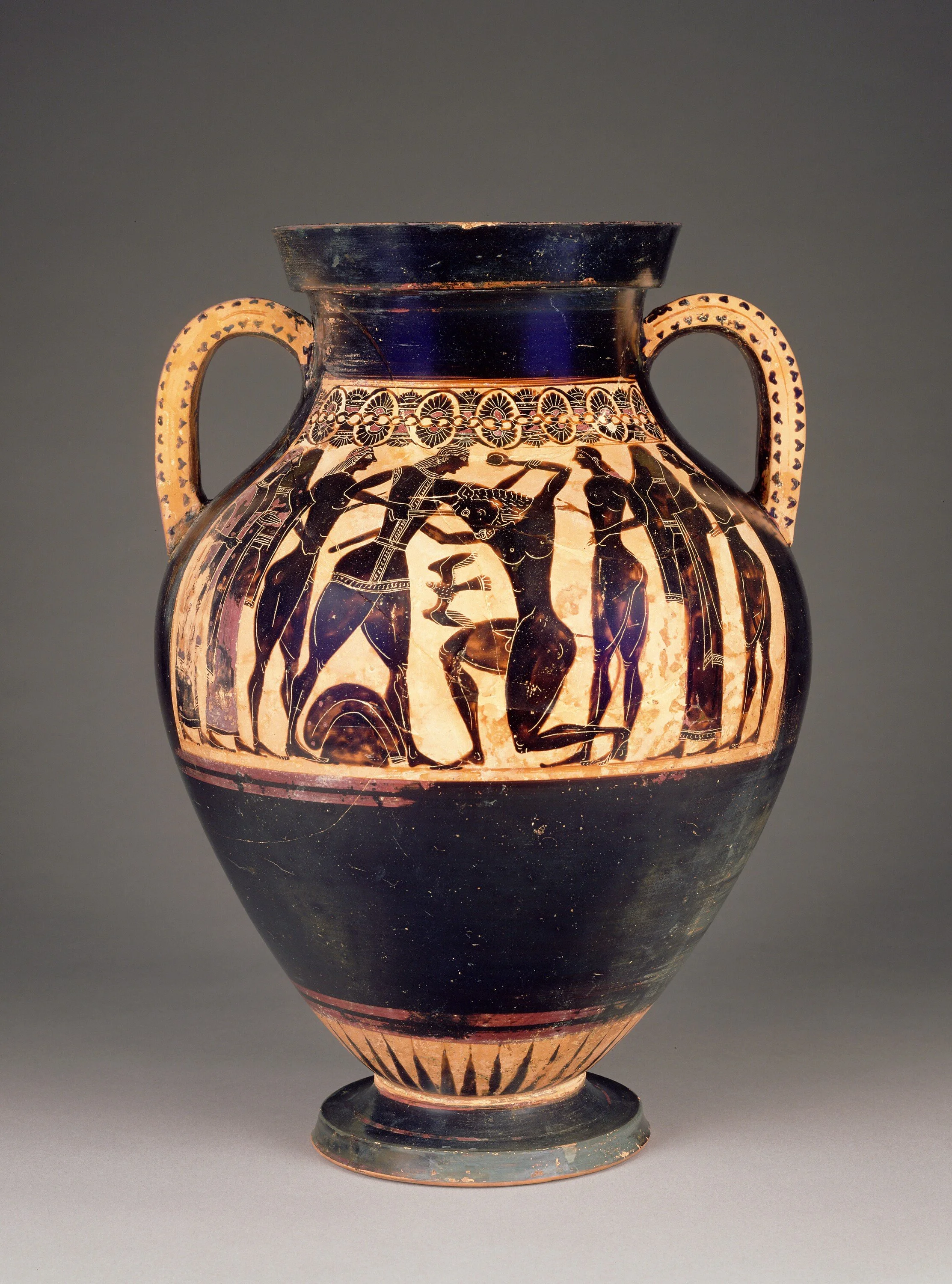
Attic Black-Figure Amphora
Image Credit: https://creativecommons.org/publicdomain/zero/1.0/
The brilliance of these early blacks demonstrates that the "invention" of black was also an invention of method; a dance between chemistry and artistry.
Ink, Faith and Authority: Medieval Blacks
In medieval Europe, black became the colour of permanence, intellect and sacred authority.
IRON GALL INK
The period’s most important black was iron gall ink; a mixture of crushed oak galls, iron sulphate and gum arabica. This ink literally etched itself into parchment, becoming darker as it oxidised.
It was used to write treaties, wills, bibles, philosophical treatises and poetry. Black ink became the visual language of European knowledge.
ARTISTIC USES
Artists, meanwhile, used a variety of blacks:
Lamp black: a soft, matte black from burning oil or resin
Bone black: a cooler black made by charring bones
Bistre: a warm, brownish-black derived from wood soot
These blacks formed the foundations of manuscript illumination, panel painting and early woodcut printing.
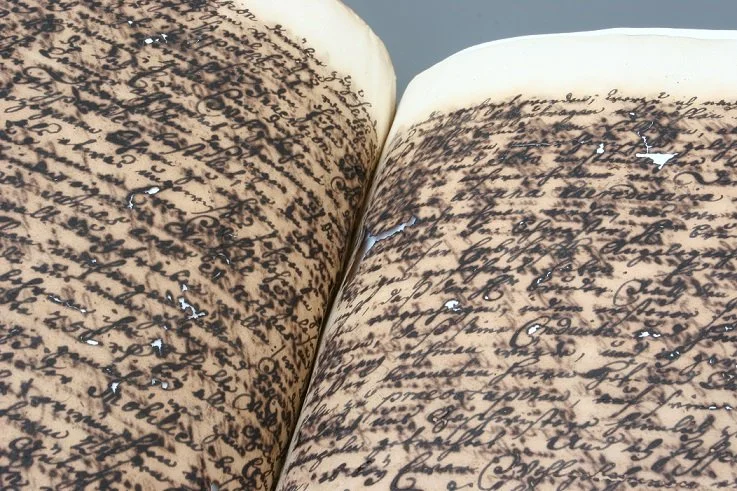
MS. Rawl. D. 869 – volume one of the papers of Philip Henry Zollmann, showing the damage caused by iron gall ink
Image Credit: https://blogs.bodleian.ox.ac.uk/archivesandmanuscripts/2023/05/15/the-gall-of-it/
Black was authority on a page; the colour of divine word, royal command and artistic structure.
Renaissance Blacks: Elegance, Shadows and the Rise of Fashion
During the Renaissance, black achieved new artistic and cultural heights.
CHIAROSCURO AND THE DRAMA OF DARKNESS
Artists such as Leonardo da Vinci, Titian and Caravaggio revolutionised the use of black to model depth and emotion. Caravaggio’s dramatic contrasts, using deep black backgrounds, created psychological intensity that reshaped European painting.
BLACK IN FASHION
At the same time, black clothing became a marker of wealth and refinement. High-quality black dyes were expensive and difficult to produce. Sumptuary laws in Spain and Italy restricted certain black garments to the elite.
Black, paradoxically, became luxurious.
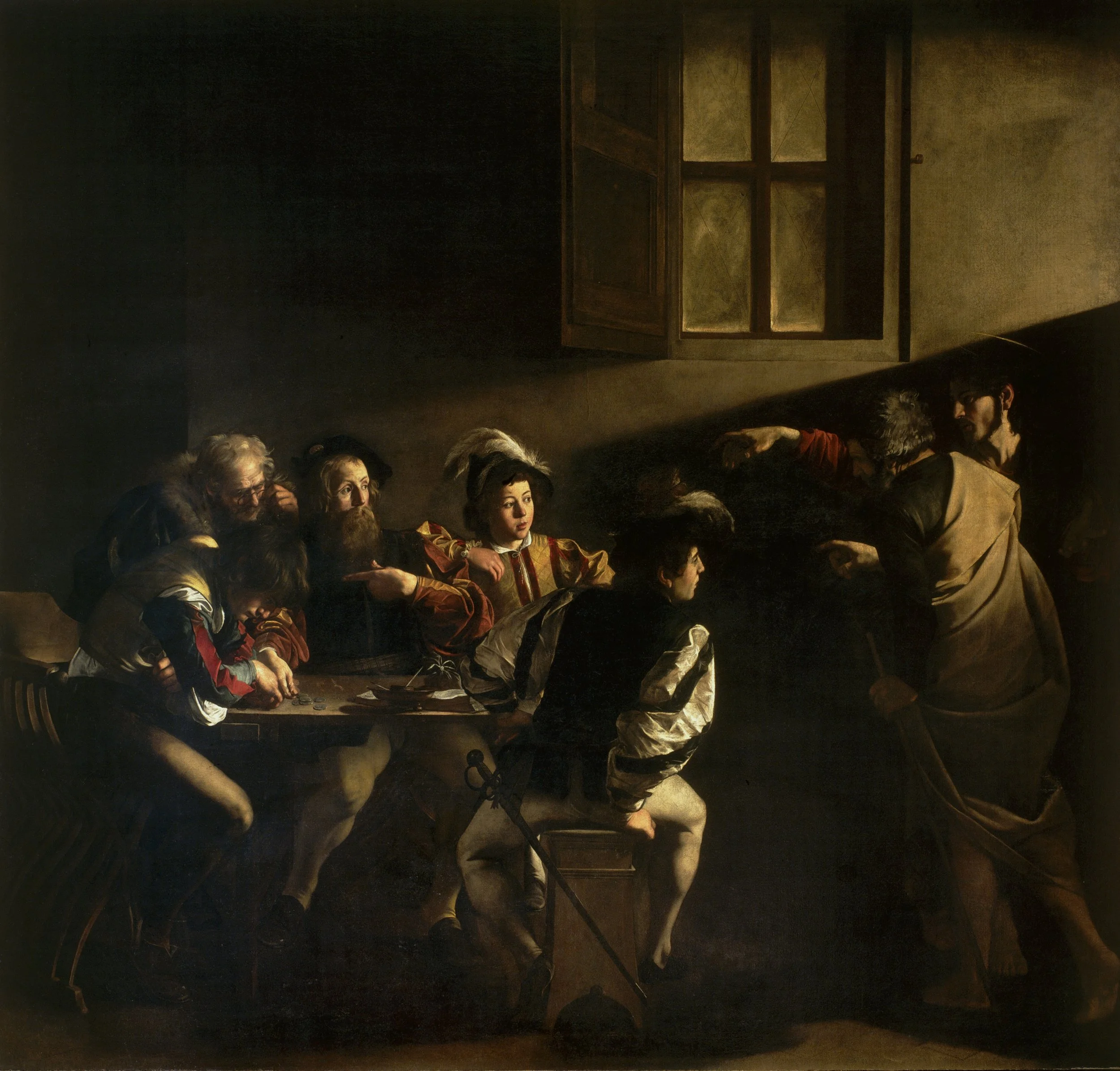
Caravaggio, The Calling of Saint Matthew
Image Credit: Wikimedia Commons
In both painting and dress, black signalled seriousness, dignity and sophistication.
Print, Industry and the Democratisation of Black
With the invention of the printing press in the 15th century, black ink became the heartbeat of modernity. Books, pamphlets and newspapers carried ideas across continents. Black ink on white paper democratised knowledge.
NEW PIGMENTS
The industrial era also brought new and refined blacks:
Refined bone black: deep, cool black perfect for printmaking
Aniline black: a synthetic dye with intense depth
Carbon black: used in printing, photography, and early industrial design

Rembrandt, Self-Portrait (1635)
Image Credit: Wikimedia Commons
Black had become essential not only for representation but for reproduction.
Modernism and the Black Canvas: From Rebellion to Reduction
The 19th and 20th centuries witnessed a radical transformation in the meaning of black.
MANET AND MODERNITY
Édouard Manet shocked critics by using black as a colour, not merely a tonal anchor. His bold black dresses and flat black backgrounds announced the arrival of modern painting.
SYMBOLIST AND EXPRESSIONIST BLACKS
For artists like Odilon Redon, Goya and Munch, black became emotional, psychological, symbolic; a colour of dreams, nightmares and the unconscious.
BLACK AS CONCEPT
In 1915, Kazimir Malevich unveiled his Black Square, a monochrome that represented pure feeling, pure form and pure concept. Black had become philosophical.
MINIMALISM AND MYSTICISM
Ad Reinhardt’s near-black canvases and Pierre Soulages’ “outrenoir” surfaces explored the perception of light on textured black surfaces.
Black was now a site of contemplation, meditation on perception itself.
Engineering Darkness: The World of Ultra-Black Materials
The 21st century introduced a new frontier: black as engineered absence.
VANTABLACK AND NANO-BLACKS
Developed through nanotechnology, Vantablack absorbs more than 99.9% of visible light. Its microscopic carbon nanotubes trap photons, preventing reflection. Objects coated in Vantablack appear flat, two-dimensional, like voids.
The material redefined black not as pigment but as a structure, darkness built from architectural light traps.
ARTISTIC CONTROVERSY
When an artist secured exclusive rights to use Vantablack, international debate erupted around material ethics, accessibility and artistic freedom. Rival inventors responded by creating publicly available ultra-blacks, turning colour-production into a cultural dispute.
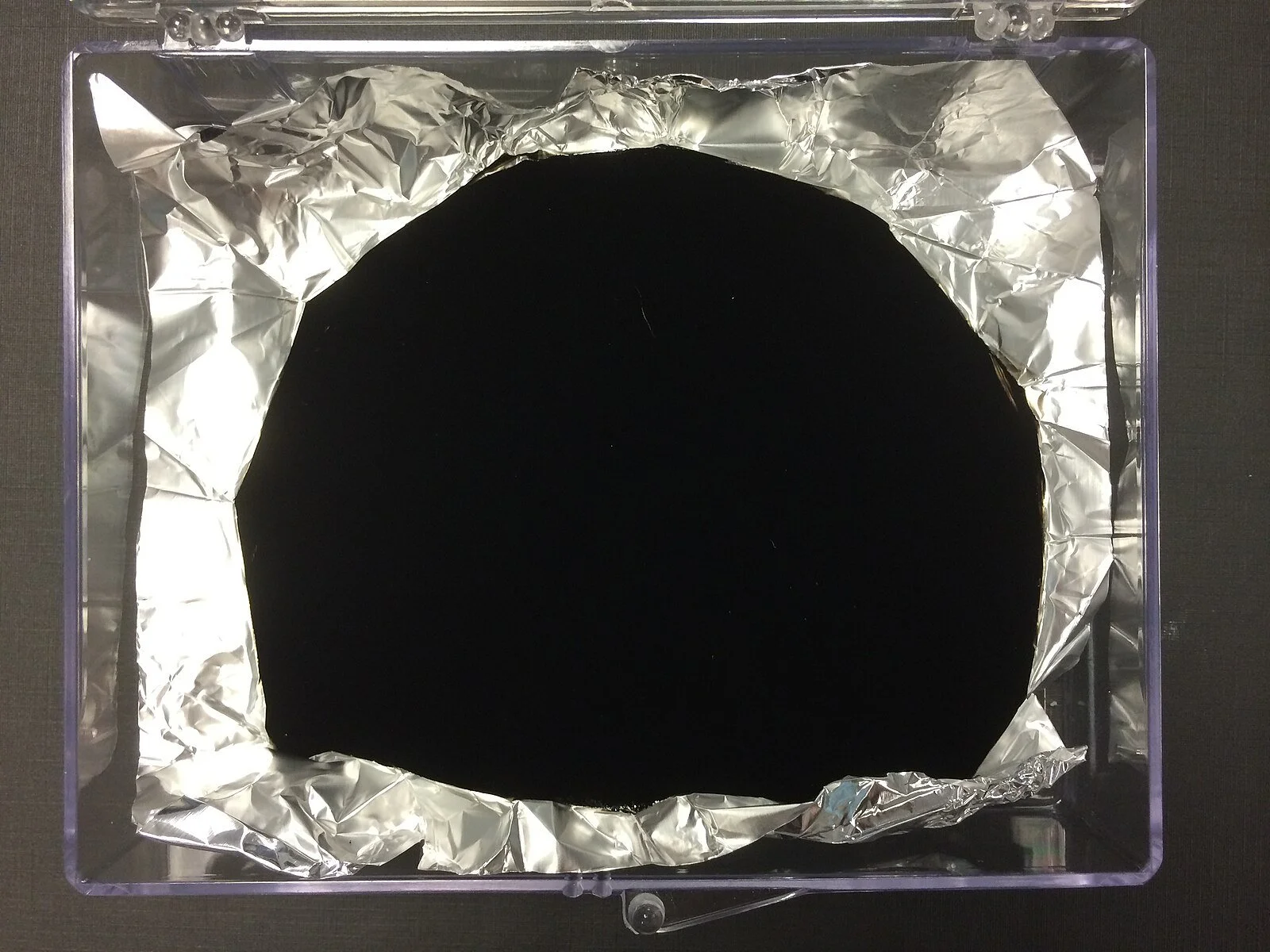
Vantablack Sample
Image Credit: Wikimedia Commons
Black had entered the realm of intellectual property and cultural politics.
Meaning in Darkness: The Cultural Symbolism of Black
Throughout history, black has carried shifting and sometimes contradictory meanings.
POWER AND AUTHORITY
Judges’ robes, clerical garments, academic gowns, these stem from long traditions linking black with seriousness and legitimacy.
ELEGANCE
From Elizabethan velvets to Chanel’s “little black dress,” black has symbolised refinement and timelessness.
REBELLION
Black leather jackets, punk fashion, goth identity and anarchist flags all use black as a symbol of resistance.
MOURNING
Across Europe and parts of Asia, black has long been associated with grief and remembrance.
MYSTERY AND ABSTRACTION
In contemporary art and design, black can evoke silence, introspection or technological sophistication. Black speaks different languages in different contexts, sometimes authoritative, sometimes subversive, always potent.
Black Today: Digital Screens, Architecture, Fashion and Art
The contemporary moment has expanded the meaning and use of black in new directions:
Digital black: true black pixels in OLED screens
Architecture: burned wood (shousugi ban), minimalist interiors
Fashion: designers like Yohji Yamamoto and Rei Kawakubo reinventing monochrome aesthetics
Painting and sculpture: artists using black to explore visibility, race, memory and materiality
Black remains one of the most compelling colours for creative exploration, not as emptiness but as possibility.
Conclusion
To understand black is to understand nuance. It is a colour that has been invented and reinvented; from soot and bone to ink and dye, from modernist canvases to nano-structured light traps.
Black has served as the backdrop of civilisation: the contour of a prehistoric horse, the letterform of a medieval manuscript, the silhouette of a modern dress, the void of a contemporary sculpture. It is one of the most expressive, flexible and symbolically charged colours in the human story.
Far from being an absence, black is a profound presence, one that continues to shape the way we see, feel, design and imagine.
Sources
Bomford, David. Art in the Making: Impressionism. London: National Gallery Publications, 1990. Gage, John. Color and Meaning: Art, Science, and Symbolism. Berkeley: University of California Press, 1999.
Kühn, Hermann. Conservation and Restoration of Works of Art and Antiquities. London: Butterworths, 1986.
Pastoureau, Michel. Black: The History of a Color. Princeton: Princeton University Press, 2009. Roqué, Xavier. “Material Histories of Darkness.” Journal of Material Culture (2018).
Varichon, Anne. Colors: The Story of Dyes and Pigments. New York: Abrams Books, 2006.
Images
https://smarthistory.org/hall-of-bulls-lascaux/
https://www.getty.edu/art/collection/object/103VZJ
https://blogs.bodleian.ox.ac.uk/archivesandmanuscripts/2023/05/15/the-gall-of-it/
https://commons.wikimedia.org/wiki/File:The_Calling_of_Saint_Matthew-Caravaggo_(1599-1600).jpg
https://commons.wikimedia.org/wiki/File:Self_portrait_wearing_a_white_feathered_bonnet,_by_Rembrandt_van_Rijn.jpg
https://commons.wikimedia.org/wiki/File:Vantablack_01.JPG