Lucy Mayes: Artist + Pigment Maker + Creator of London Pigment
Pigment maker and artist Lucy Mayes created ‘London Pigment’ where she makes and sells her handcrafted pigments, as well as educating on this practice through hosting workshops. Her practice focuses on an innovative technique where she uses urban waste as materials to make pigments. This method of recycling waste materials is a creative way to develop a more sustainable and circular approach to pigment making, which diverges from the typical innovations in pigment making that are often centered on plant-based pigments and avoiding the use of synthetic materials. This approach of using waste materials also serves as a documentation of human activities, as a lot of the materials that Lucy works with are from construction and vehicle waste. Using materials that have had a prior use adds complex layers to her work tied to urban memory and heritage. Through ‘London Pigment’ Lucy transforms materials that she finds intriguing and collects them from in and around where she lives, by doing this she is both preserving and transforming banal industrial waste into a new tangible and artistic medium.
In the below interview, Lucy Mayes opens up about her experience and practice, and provides insights of her newly published book ‘The Natural Pigment Handbook’:
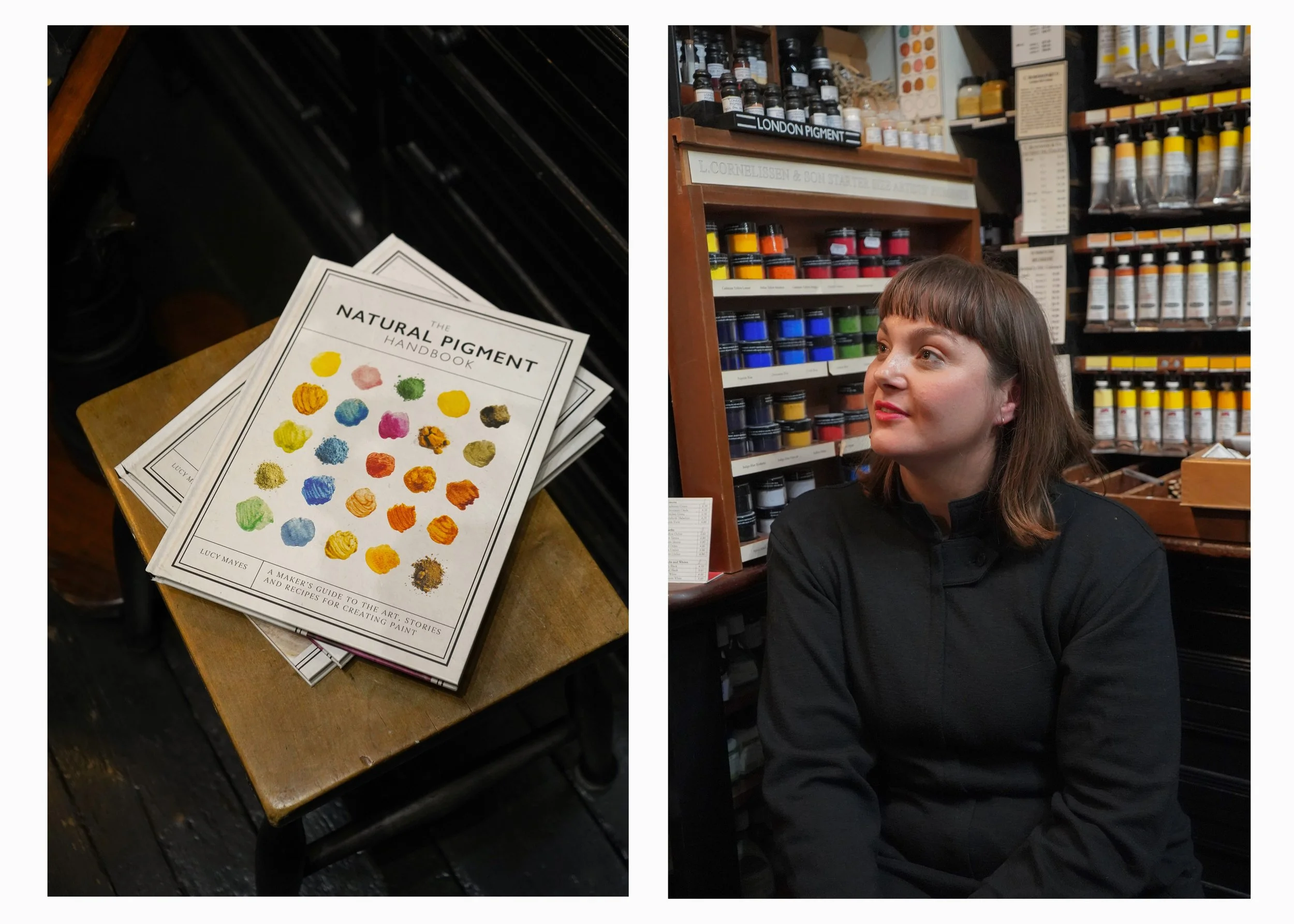
Lucy Mayes at the launch of her book, The Natural Pigment Handbook, at L. Cornelissen & Son
Photograph by Zeynep Sagir
You’re both an artist and a pigment maker. What gravitated you towards making art materials and for this to become central to your work?
I have a background in Fine Art, having studied at The Ruskin School of Art and the Royal College of Art. My interest in materials began during my foundation course at Camberwell College of Arts (UAL), where I started making my own oil paints. I’ve always been naturally curious about how things are made and fascinated by the material histories of objects. This curiosity deepened when I worked at L. Cornelissen & Son, a historic pigment retailer, where I worked closely with their pigment offering and historic pigment collection.
Given my formal training in Fine Art, it may not be surprising that I eventually found my way to making pigments. Looking back, I can see many signposts that pointed toward this vocation. As a painter, I was always intrigued by the pigments inside my paint tubes. Realising that many colours are misrepresented, I wanted to be certain of the raw materials I was using-so I began making the pigments and paints myself. The first pigments I produced came from processing clays: washing, crushing, sieving, and grading them, as well as converting dyes into pigments by binding them to a mineral called alum, in a process known as the laking process.
The work I do now-teaching, giving talks, and taking commissions for bespoke pigments and paints-has evolved from my deep interest in understanding supply chains and pigment manufacture. I consider the sharing of pigment-making knowledge to be central to my art practice, existing alongside the ways I describe and interpret these processes myself, and engaging with the poetic and philosophical nuances of craft. Now I take an almost forensic interest in the materials I use in my work, often going back to the source to trace the provenance of the colours I use - and, whenever possible, collecting them for myself.
A distinctive feature of your pigment making practice is your use of unconventional materials, often from urban waste, which you have described as ‘esoteric raw materials’. What does this term mean to you, and how does it influence your work?
Anything can be used for colour-making; it’s simply a matter of discovering how it fits into the recipe. I explore the colour potential of all materials- natural or synthetic, pristine or derived from waste. I do not consider there to be a hierarchy of materials, only different sets of associations to navigate. I’m drawn to the overlooked and the mundane, intrigued by the process of taking a material and exploring it-both materially and conceptually until it becomes useful.
I like to think of the materials I encounter as teachers-alive, responsive, and full of character. Take, for example, kaolin-widely known as china clay-a white clay used in the ceramics and paint industries. I collected a sample of ‘low-purity kaolin,’ a by product of lithium and tin prospecting in parts of Cornwall, and meticulously washed and refined it before using it as a central ingredient in the creation of synthetic ultramarine. From this humble material, I produced a vivid blue-a modern lapis lazuli (synthetic ultramarine) , a colour long associated with the celestial heavens and the Virgin Mary-elevating this raw, industrial by product into a substance of new symbolic resonance. Rethinking and reorienting ourselves to colour is something I hope to spark in my workshops. I like to think around the subject-reordering, realigning, and renovating old ways of seeing and making. Contrast is central to my approach; I’m often drawn to underdog materials that challenge or even usurp those of higher value. For instance, I might use a fragment of weathered red brick, salvaged from a demolition site, as a pigment to replace a traditional burnt sienna or burnt umber. Irresistible Renaissance rubbish.

Lucy Mayes at the launch of her book, The Natural Pigment Handbook, at L. Cornelissen & Son
Photograph by Zeynep Sagir
Many of the pigments you have developed are metal-based. Could you discuss the significance of metal pigments in the history of colour and how this history has inspired some of your innovations?
Many of the pigments I develop are metal-based, and I’ve long been fascinated by how deeply the histories of metallurgy and pigment making are intertwined. From the earliest human experiments with fire and minerals, both practices evolved side by side - each concerned with transforming matter through heat, oxidation, and reduction. Metallurgical discoveries provided pigment makers with the tools, materials, and knowledge needed to understand how colour could be created and controlled.
Some of the earliest pigments were naturally occurring metal compounds collected directly from the earth: iron oxides in shades from yellow to red, purple, and blue; copper carbonates in blue and green; lead white; mercury-based cinnabar; and arsenic minerals such as realgar and orpiment. Depending on the source, these materials might simply be ground and washed, or more extensively refined and processed.
As early metallurgists — such as copper refiners in ancient Egypt over 4,000 years ago — learned to manipulate ores and alloys, pigment makers began to mirror their methods, using furnaces, crucibles, and grinding stones to transform minerals into stable and luminous colours. This marked a turning point in both material culture and art history, when people began to synthesise pigments intentionally rather than relying solely on what the earth offered.
Even today, some of the most accessible colours can be made through reactions that echo metallurgical processes. Placing iron or copper near acidic vapours, for instance, initiates corrosion that produces compounds like rust or verdigris - vivid reminders of the living chemistry within materials. Many pigments that followed - cobalt blues, cadmium yellows and reds, and other metal-based hues - owe their existence to the evolving art and science of metallurgy.
The experimental knowledge established through early metallurgy ultimately laid the groundwork for the first truly synthetic pigments developed in the 18th and 19th centuries. Innovations such as Prussian blue, chrome yellow, and cadmium red emerged from an ever-deepening understanding of metal chemistry - transforming not only the artist’s palette but the very relationship between colour, industry, and technology.
In your practice, how has transforming tangible raw materials into pigments shaped your perception of colour and the connection between physical matter and sensory experience?
There is so much more to learn about the world through direct contact with it than can ever be found in books. The human body is a remarkably fine measuring instrument which, with constant attention and calibration, can be deeply relied upon. I draw on this tacit knowledge every day. I rarely measure ingredients for a recipe, preferring instead to respond instinctively to what I am doing. By simply rubbing a raw clay sample between my fingers, I can tell how much processing it will need and what additives might be required to distill the colours hidden within its depths. Using the body in this manner is an ongoing practice, to be further refined and used. Of course you have to start somewhere the recipes in the book are starting points for further experimentation and dynamic reinvention!

Lucy Mayes at the launch of her book, The Natural Pigment Handbook, at L. Cornelissen & Son
Photograph by Zeynep Sagir
Writing down dye and pigment recipes was an uncommon practice historically, as this knowledge was passed down orally alongside hands-on practices. As a result of this historical recipes can be crude, and serve more as technical guides than detailed instructions. Are there any particular historical recipes that have been especially influential or helpful in your work?
Yes — and indeed, many historical recipes include deliberate mistakes to prevent others from recreating the exact same colour as the master who devised them. I have followed and adapted many recipes from Natural Colorants for Dyeing and Lake Pigments: Practical Recipes and Their Historical Sources by Jo Kirby. Experimenting with the various ways in which insoluble pigments can be formed from soluble plant and animal dyes described in this book has significantly expanded my understanding and pushed my making skills further. I believe that a recipe needs to be repeated many times to truly understand how its materials interact and behave. Take, for instance, the process of fermenting madder root to make red lake pigments: the scent of the mixture shifts gradually from sweet to sour as it matures. It’s only through making these recipes again and again, at different times of the year, that you begin to sense when the conditions are just right. The ambient temperature and humidity of the room affect the rate of fermentation - and what works quickly in summer might move far too slowly in the colder months if you’re eager for results.
Your new book, The Natural Pigment Handbook, explores the history and alchemy of pigment making. What unique perspectives do you hope to share with the readers?
One of the main objectives of the book is to showcase the craft of pigment making and the depth of technical knowledge that can be uncovered about pigments - and then applied directly within painting or creative practice. It weaves together practical recipes with a rich account of the history of pigment manufacture, the evolution of historical palettes, and personal reflections drawn from my own experiences of making colour. Throughout the book, An Artist’s Aside offers moments of reflection on the act of making itself. I am particularly interested in the ongoing dialogue between the natural and the synthetic - and how these terms are not fixed opposites but part of a sliding scale that helps us to understand material transformation. This tension is explored through the recipes, where processes such as grinding a rock into fine powder and washing away its impurities echo the slow, natural erosion of stone by water over millennia.
What’s your favourite colour and why?